
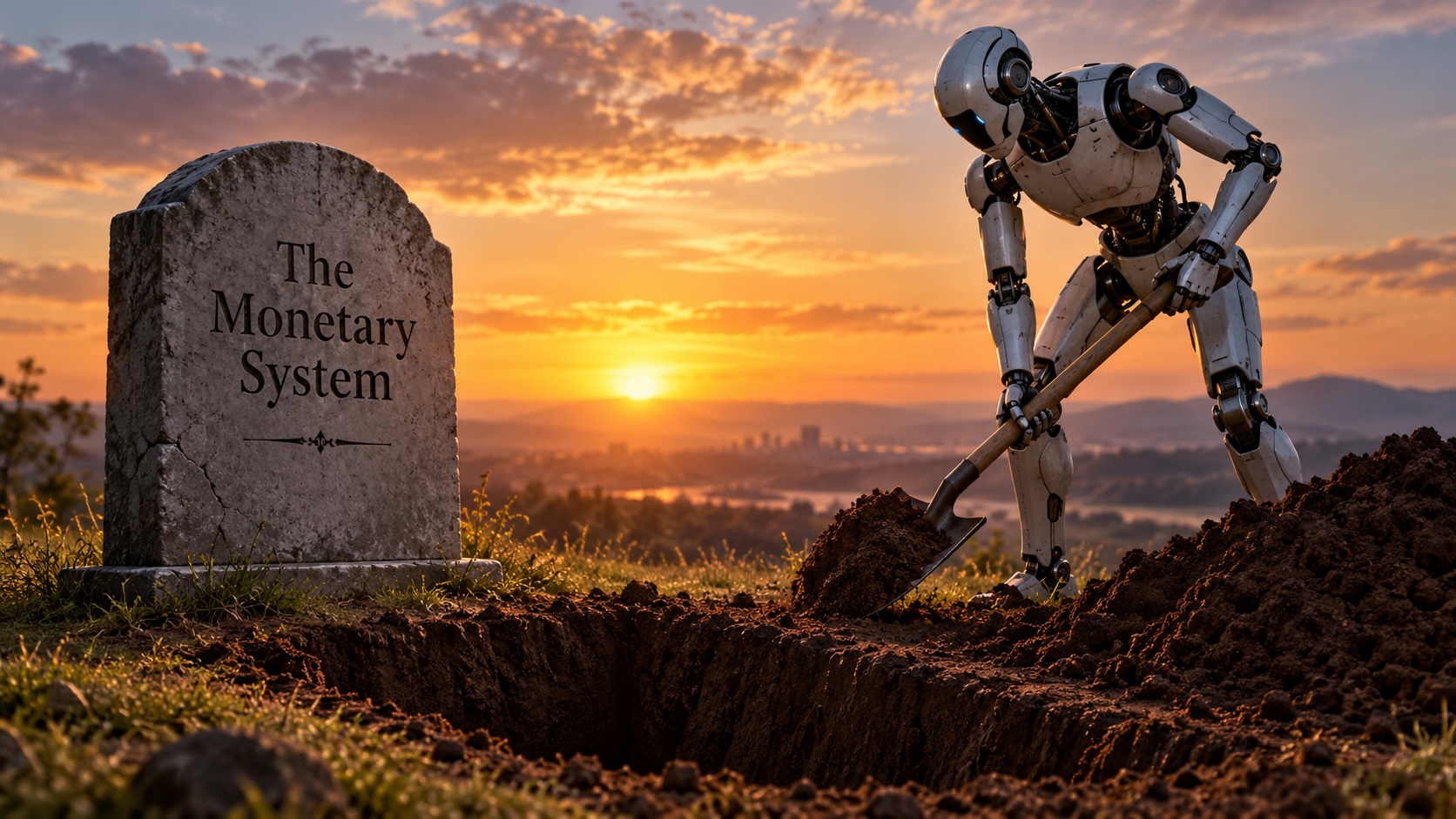
The monetary system may be digging its own grave.
Recently, Elon Musk responded to a post about wealth creation(eat the rich) with a simple warning:
“The problem is that after they ‘eat the rich’, they will starve.”
Someone responded by turning his argument around: the rich do not feed society. Workers do. If the rich vanished, work would continue. But without workers, what exactly would the rich have left to profit from?
There is an extraordinary irony here.
Elon Musk is building the technology that may actually make the workers vanish.
Not the people themselves.
But the need for their labor.
The Workers
For centuries, workers have been at the center of the monetary economy.
They work.
They receive wages.
They spend those wages.
Companies receive that money as revenue.
Governments tax wages, employment and consumption and use that revenue to finance society.
Then the cycle begins again.
Workers are therefore not merely a cost to businesses. They are also the customers who buy what businesses produce and an important part of the tax base supporting governments.
The OECD describes labor taxes—including income taxes, social-security contributions and payroll taxes—as a significant source of government revenue across its member countries. It also explicitly recognizes automation and AI as structural changes that may affect those tax bases. The system rewards efficiency.
Now introduce the robot.
The Robot
The robot doesn’t need a salary.
It doesn’t pay personal income tax.
It doesn’t need a pension.
It doesn’t go shopping after work.
It doesn’t take its family to a restaurant.
It doesn’t buy a Tesla.
Yet the company replacing the worker with that robot has a perfectly rational reason for doing so.
The robot can potentially work longer, produce more, make fewer mistakes and become cheaper over time.
From the perspective of an individual company, this can make perfect economic sense:
Reduce labor. Reduce costs. Increase productivity. Increase profit.
But what happens when everybody does it?
Suddenly we encounter something much bigger than unemployment.
We encounter a contradiction within the structure of the monetary system itself.
The Contradiction
The system itself rewards companies for eliminating human labor while simultaneously depending heavily on income generated through human labor to maintain purchasing power in order to keep the system running.
That is the constitutional contradiction.
Not constitutional in the political sense, but in the deeper meaning of the word: a contradiction in how the system itself is constituted.
Every individual company has an incentive to be more efficient: to automate.
But if automation eventually succeeds beyond our wildest dreams, who buys everything?
The machines can produce a million cars.
Wonderful.
Who buys them?
The machines can build houses.
Fantastic.
Who pays for them?
The machines can grow food, manufacture clothes, transport products, construct infrastructure and provide services.
Amazing.
But robots don’t receive wages.
And robots don’t go shopping.
The Taxes
Then there is another problem.
Governments are deeply connected to the same employment structure.
Workers pay income taxes and social-security contributions. Employers make employment-related contributions. Workers then spend their remaining income, generating VAT and other consumption taxes.
Remove enough paid human labor and governments may have to rethink where a substantial part of their revenue comes from.
Government Revenues
This isn’t merely speculation about an obscure tax problem. The OECD has specifically warned that automation could affect government revenues if labor-tax bases erode, particularly because many countries rely heavily on taxes connected to labor.
Of course governments can respond.
Tax corporations more.
Tax capital.
Tax automated production.
Create new forms of taxation.
Redistribute the proceeds.
Perhaps use some of that revenue to finance Universal Basic Income, which ironically is used to pay for products produced by the machines that made them unemployed in the first place.
Or, as Elon Musk prefers to call his envisioned future, Universal High Income. Musk has repeatedly argued that AI and robotics could eventually create enormous abundance while making conventional work optional.
But this raises another problem.
If human employment keeps disappearing, governments lose much of the very tax revenues upon which redistribution currently depends. Taxes would increasingly have to be shifted toward the companies, capital and automated productive systems where the remaining monetary income accumulates.
We would then be taxing the automated economy in order to give people money so that they could buy what the automated economy produced without them. Money itself becomes eroded and more and more pointless.
At some point we might reasonably ask:
Why are we keeping the money in the middle at all?
The Grave
This is what makes the present moment in human history so fascinating.
The monetary system is not necessarily being destroyed by revolutionaries standing outside the gates.
It may be undermining its own foundation by following its internal logic:
- Competition demands greater efficiency
- Greater efficiency demands automation
- Automation reduces the need for labor
- Reduced labor can reduce wage income
- Reduced wage income can reduce purchasing power
And reduced employment can weaken traditional tax bases.
The system is, in a sense, digging its own grave.
Not because somebody planned it.
Because everybody is doing exactly what the system tells them to do.
Increase efficiency.
The Fear
And yet, for many people, this doesn’t feel like liberation.
It feels terrifying.
If AI and robots takes our jobs, we may lose our income, our security and the system we have depended upon all our lives. Money has become so deeply connected to our existence that imagining a world without it can feel like imagining a world without security itself.
But does money actually secure our existence?
Money doesn’t feed us. Food does. Money doesn’t shelter us. Homes do. Money doesn’t produce the things we need. Resources, knowledge, technology and human ingenuity do.
Money is the system we currently use to gain access to them.
Perhaps the fear is understandable precisely because we have confused the two for so long. Resources and money. They are not the same.
And perhaps it is finally time to wean ourselves from that misconception.
Liberation
We’ve seen technological revolutions before.
Again and again, machines have replaced human labor.
And every time, we have celebrated increased productivity.
We call machines labor-saving devices.
But there has always been something strange about that expression.
Whose labor did they save?
If a machine eliminated your exhausting repetitive job but your survival depended upon the wage from that job, the machine didn’t necessarily make you feel liberated.
You lost your income.
You had to find another job.
Technology liberated humanity from one form of work while the economic system continued requiring us to work with something else.
Perhaps AI and robotics are finally bringing that contradiction to its conclusion.
Perhaps the ultimate purpose of labor-saving technology is not simply to save labor.
Perhaps it is to save all humans from compulsory labor.
True Freedom
Imagine that machines really can do most of the work we don’t want to do.
They grow the food.
Build the houses.
Manufacture the products.
Maintain infrastructure.
Transport resources.
Recycle materials.
AI helps coordinate production and distribution according to real human needs and real available resources.
What exactly have we lost?
Jobs?
Or have we gained something extraordinary?
Freedom.
Not the freedom to choose which employer we sell our time to.
Not the freedom to compete for enough money to survive.
Not the freedom to spend our lives earning access to the products our machines can already produce.
Something much more fundamental.
The freedom to live.
The freedom to create.
The freedom to learn.
The freedom to care for others.
The freedom to explore.
The freedom to contribute because we want to contribute.
The freedom to ask, perhaps for the first time:
What would I actually like to do with my life?
The Choice
And that brings us back to Elon Musk.
He warns that if we “eat the rich,” we may eventually starve.
But perhaps that is asking the wrong question.
What happens when nobody needs to eat anybody?
What happens when machines can produce enough food for everyone?
When robots can build enough homes?
When automated systems can manufacture what we need?
When AI can help us manage resources intelligently?
What happens when human labor is no longer the foundation upon which material abundance depends?
Humanity hasn’t suddenly become poor.
Quite the opposite.
We may have become richer than at any point in history.
Yet if access to that abundance still depends upon obtaining money through work that society no longer needs us to perform, we will have created one of the strangest situations imaginable.
We will have developed the technology to liberate humanity while maintaining an economic structure that prevents us from experiencing the liberation.
Maybe AI and robotics aren’t merely threatening the monetary system.
Maybe they are revealing that we are beginning to outgrow it.
Earth Constitution
But technology will not make the final decision for us.
However far AI and robotics advance, humanity will still have to decide what kind of civilization we want to create with them.
Perhaps nations could eventually come together and create a new Constitution of Earth, based upon global cooperation, stewardship of our common resources and freedom from economic coercion.
Not freedom to consume infinitely. We still live on a finite planet.
Not freedom to do anything regardless of its consequences for others.
But freedom from having to sell our labor simply to earn the right to live.
A world in which technology finally fulfills its greatest promise: not merely producing more for us, but setting us free.
Waking Up
How exactly do we get from here to there?
I don’t pretend to have a blueprint.
Waking Up: A Journey Towards a New Dawn for Humanity is not a manifesto detailing every step of the transition or every mechanism of a future civilization.
It is something much simpler.
A glimpse of what might be possible.
The story begins in 2015 with Benjamin Michaels, a billionaire facing terminal cancer. Desperate to escape death, he chooses cryonic preservation, hoping that future medicine will eventually cure him so he can wake up and continue expanding his empire.
He gets his wish.
Benjamin wakes up a century later.
His cancer is cured.
There is only one small problem.
His empire no longer exists.
Neither does his money.
Neither does anyone else’s.
The concepts upon which his entire life was built—money, trade and ownership—have disappeared.
Benjamin expected to wake up in the future and reclaim his wealth.
Instead, he wakes up in a civilization where wealth itself has been redefined.
Not a Blueprint
People no longer spend their lives earning the right to live. Technology handles much of the work once performed out of necessity. Resources are shared and managed intelligently. People are free to create, explore, learn, contribute and simply live.
Benjamin has awakened in the world this article has been imagining.
Not a perfect world.
Not a blueprint.
Not a prediction.
A possibility.
And perhaps that is where every transformation begins.
Before we can create a different world, we first have to be able to imagine one.
Leave a Reply