Category: Blog

  • The World of Billionaires

    The World of Billionaires

    The comfort of the rich depends upon an abundant supply of the poor.”— Voltaire

    It is fascinating how relevant this quote still is today.

    Especially now, in the age of AI and robotics.

    Some billionaires and technologists seem convinced that artificial intelligence will soon replace most human labor. Robots will build the products. AI will write the code. Autonomous systems will transport the goods. Machines will grow the food. The poor, they imagine, will simply become unnecessary.

    But there is one enormous problem with this vision:

    The monetary system of today cannot function without humans.

    Not just a few humans.
    Billions of humans.

    Especially poor and middle-class humans.

    Because the monetary system is not merely a production system.
    It is a human exploitation system.

    It requires workers.
    Renters.
    Borrowers.
    Taxpayers.

    Consumers.
    People competing for jobs.
    People needing and using money to survive.

    Without that pressure, the system breaks down.

    A robot does not need a salary and does not pay for goods or services.
    AI does not pay rent.
    A machine does not take a mortgage.
    A warehouse robot does not dream of buying a larger TV or a luxury SUV.

    Machines can produce.
    But they do not participate in monetary circulation.

    And that changes everything.

    The Great Contradiction

    Many billionaires now dream of a future where a tiny elite owns the AI systems while the rest of humanity becomes increasingly irrelevant.

    But irrelevant to what?

    If millions lose their jobs due to automation, who buys the products?
    Who pays the rents?
    Who services the debt?
    Who keeps consumption going?

    The current system still only recognizes human beings as “capital.”
    Not machines. Machines can do the work but not pay for the goods.

    And that means the system quietly depends upon vast numbers of ordinary people remaining economically dependent.

    The monetary system and advanced AI doing most or all productive labor simply cannot coexist long-term.

    Voltaire understood this centuries ago. The rich needs the poor.

    Extreme wealth only exists relative to inequality. There must be a big supply of poor and middle class consumers to uphold the rich.
    A billionaire is only a billionaire because millions of others possess comparatively little.

    The pyramid requires a base.

    Without a large population beneath the wealthy:

    • labor collapses
    • consumption collapses
    • debt expansion collapses
    • monetary circulation collapses

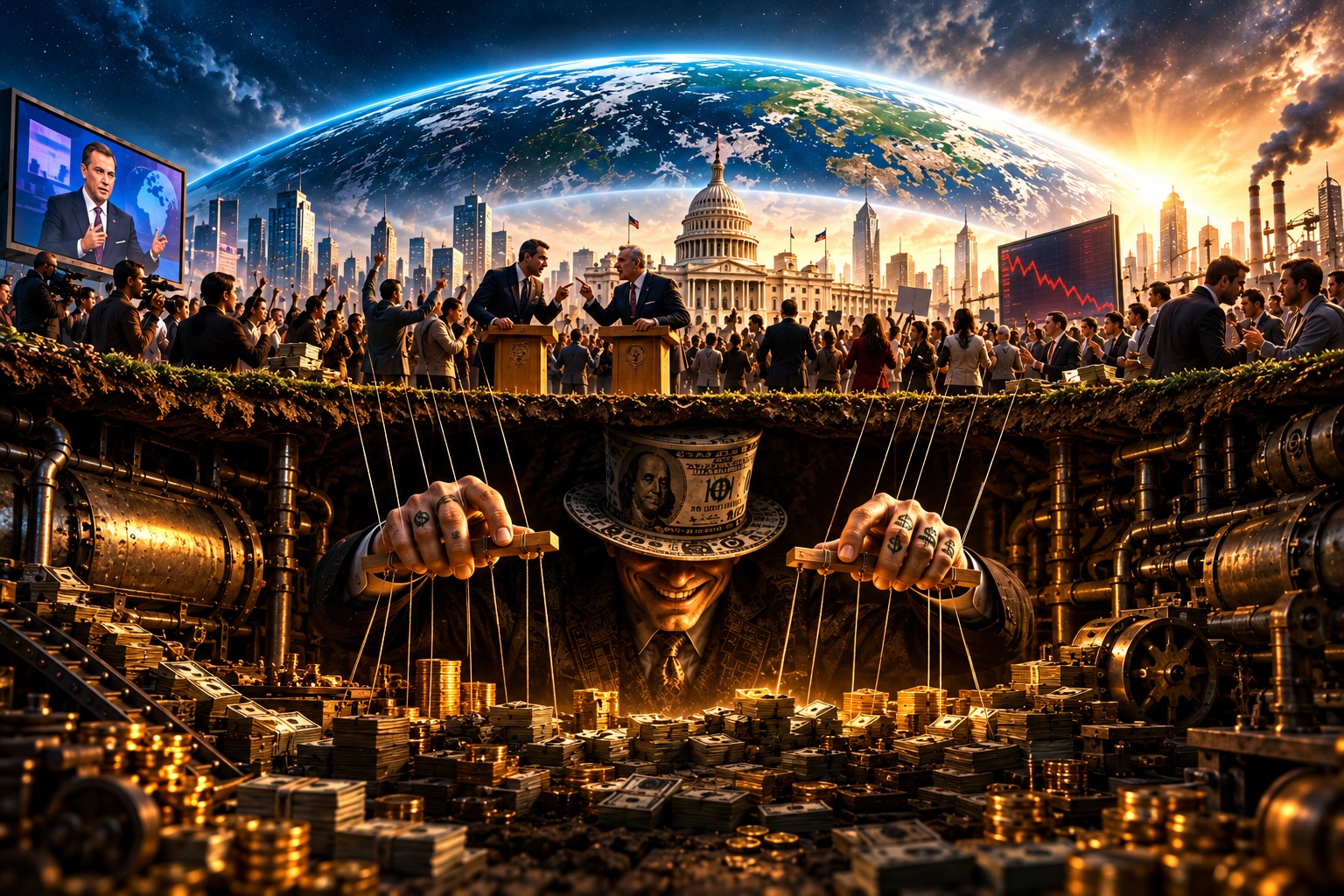
    The rich do not float above the system.
    They depend on it completely.

    The Overpopulation Misunderstanding

    This is why many discussions about “overpopulation” completely miss the deeper issue.

    Of course humanity must live sustainably.
    Of course population must stabilize voluntarily through education, security, and well-being.

    But many people speak as if humanity itself is the problem.

    As if fewer humans somehow automatically solve everything.

    Yet the current monetary system itself depends upon massive populations participating in it.

    A world of only a few hundred million people with advanced AI and robotics would not resemble modern capitalism at all. The logic of wages, labor competition, endless growth, and mass consumption would begin to dissolve.

    Because what happens when technology can increasingly produce abundance with minimal human labor?

    The entire logic of money starts breaking apart. The monetary system cannoy exist without humans.

    And that leads us to an uncomfortable but unavoidable conclusion:

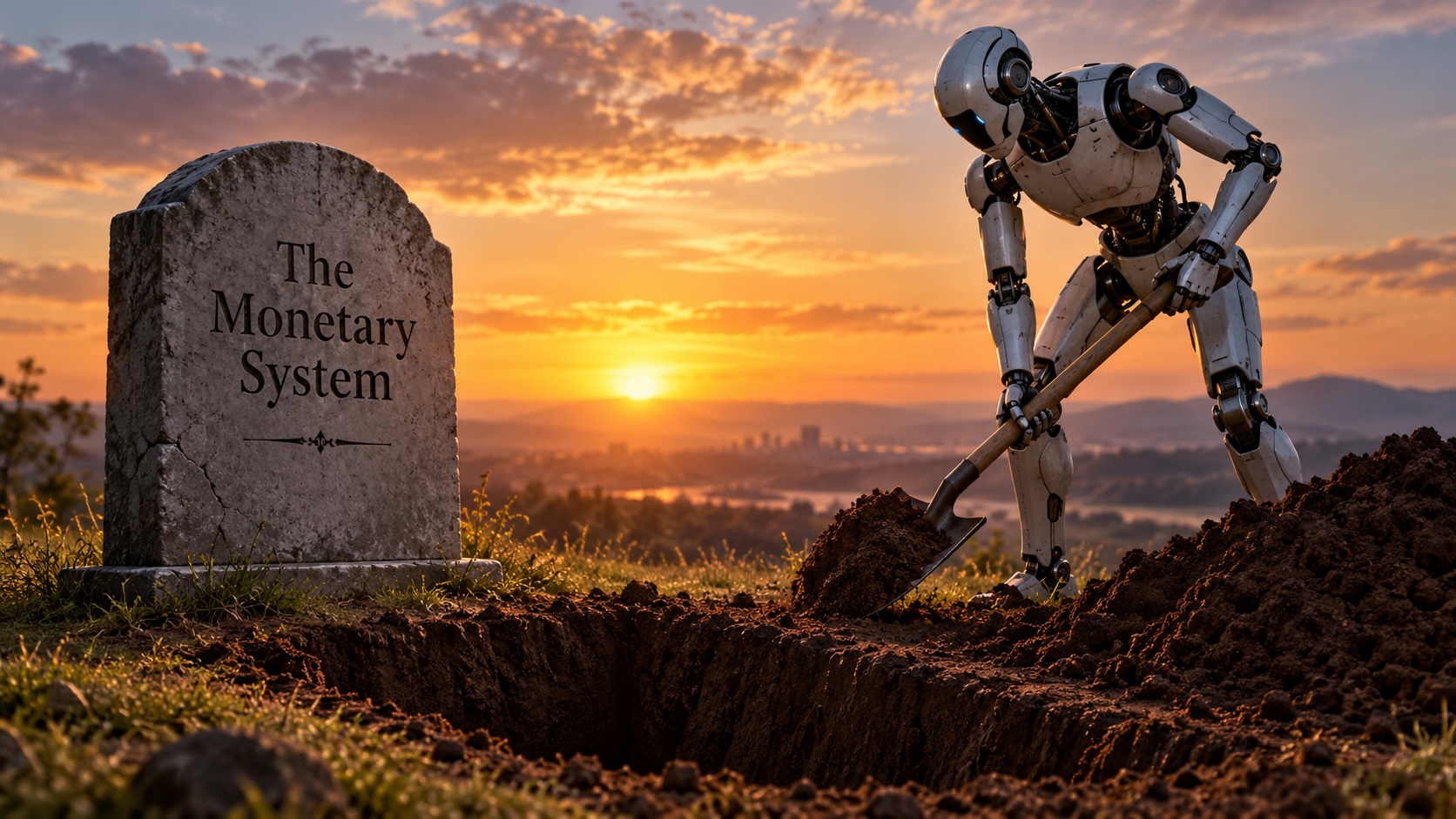
    Our only real choice is to replace the monetary system itself.

    What other choice is there?

    If fewer and fewer people are needed to work because AI and robotics can increasingly produce what humanity needs, then eventually there are not enough people participating in the monetary system to keep it functioning.

    Not enough people working = no monetary system.

    And no monetary system while humanity still depends entirely upon it for access to food, housing, healthcare, and survival = no stable Earth with billions of people.

    That is the real danger.

    Not technology.

    Not AI.

    But clinging to an outdated system that no longer matches technological reality.

    Which means humanity faces a profound transition.

    We can continue trying to preserve a system based upon scarcity, competition, ownership, debt, and wage dependency.

    Or we can begin designing what might be called a truly humanitarian system. The Humanitary system.

    A system where advanced technology serves humanity, nature and the planet directly.

    A system where access replaces artificial scarcity.

    A system where the wealth of society is measured not by how many billionaires exist at the top, but by how secure, free, healthy, and fulfilled ordinary human beings are.

    A World of “Billionaires”?

    Ironically, that could create the first true world of “billionaires.”

    Not billionaires in monetary terms.

    But billions of human beings living with abundance, security, dignity, and access to the necessities of life. Living lives with just as much, or maybe even more, time and access as the billionaires of today.

    Advanced technology will eventually force humanity toward a completely different realization.

    Not that everyone can become a billionaire in monetary terms.

    But that the very need for billionaires may disappear.

    Because if AI, robotics, automation, renewable energy, and intelligent resource management can provide abundance directly, then humanity no longer needs to organize society around artificial scarcity and survival-based competition.

    In such a world, we could all become “rich” in the ways that actually matter:

    Abundant access to:

    • secure housing
    • healthy food
    • healthcare
    • education
    • technology
    • creative freedom
    • free time
    • meaningful contribution
    • safety and stability

    Not because everyone owns billions of dollars.

    But because access itself becomes abundant.

    That is the direction technology is quietly pointing toward.

    The real question is whether humanity continues trying to force this new technological reality into an old monetary framework designed for scarcity, competition, and wage dependency.

    Or whether we finally begin designing a system that reflects the abundance now becoming technically possible.

    The Real Crisis

    Perhaps the real crisis is not overpopulation.

    Perhaps the real crisis is that we are trying to preserve a monetary system that increasingly contradicts technological reality itself.

    A system where human beings must constantly struggle for money in order to access resources that modern technology could increasingly provide with minimal labor.

    A system where endless consumption and economic growth are required simply to keep people employed.

    A system where pollution, waste, planned obsolescence, inequality, and artificial scarcity become structural necessities.

    And now, as AI and robotics rapidly advance, the contradiction becomes impossible to ignore.

    Because once machines can do most productive labor, the monetary system starts losing the very human dependency it was built upon.

    Which leaves humanity standing before a profound choice:

    Continue trying to preserve the old system through increasingly desperate financial mechanisms.

    Or begin creating a new one.

    A world where advanced technology serves humanity, nature, and the planet directly.

    A world where wealth is no longer measured by how many humans stand beneath you.

    But by how well we manage to make life work for everyone.


    Want to explore a future where humanity has moved beyond this outdated world of money, ownership, and artificial scarcity and made everyone a “billionaire”?

    Then follow the former billionaire Benjamin Michaels into the world of Waking Up – A Journey Towards a New Dawn for Humanity.

    👉 Discover the book here.

    And please share this article if it resonates. The more who reads this, the bigger chance we have of creating this new world…

  • Booms and Busts and Bubbles

    Booms and Busts and Bubbles

    A recent news report celebrated soaring GDP numbers and record-high stock markets in the United States.

    The economy is booming.

    At least that’s what we are told.

    GDP is rising. Stock markets hit record highs. Billionaires grow richer. Corporate profits soar. Politicians celebrate “growth.” Financial commentators smile in front of green arrows on television screens.

    And yet, millions of ordinary people feel increasingly stressed.

    Groceries cost more. Housing costs more. Insurance costs more. Electricity costs more. Debt grows heavier. Interest rates go up. Saving becomes harder. Many work more while feeling less secure.

    Two Different Economies

    How can both realities exist at the same time?

    Because they are, in many ways, two different economies.

    One economy exists in financial markets, stock valuations, speculation, and asset prices.

    The other exists in kitchens, grocery stores, rent payments, and exhausted families trying to make ends meet.

    You cannot eat GDP.

    The Normalization of Instability

    And perhaps the strangest thing of all is that we have normalized this instability.

    Booms.
    Busts.
    Bubbles.
    Crashes.
    Recessions.
    Recoveries.

    We speak about them almost like weather patterns.

    As if they are natural forces beyond human control.

    But the economy is not nature.

    We designed it.

    A System of Debt

    A system built around debt, interest, speculation, ownership accumulation, trading, profit and endless growth will naturally tend toward instability. It constantly pushes expansion. More lending. More consumption. More extraction. More profit. More more more.

    And when expectations grow larger than physical reality or people’s ability to pay, the bubbles begin to burst.

    Then comes the correction.

    That is the nature of bubbles. Too big and they burst.

    As long as they keep growing, they appear strong and unstoppable. But the larger they become, the more fragile they also become.

    And perhaps the biggest bubble humanity has ever created is the global debt bubble itself.

    A system demanding endless expansion on a finite planet. A system where nature, resources, ecosystems and human beings are constantly pressured to keep up with exponential growth.

    What happens when such a bubble finally bursts on a global scale, I honestly do not even dare to imagine.

    But if I should imagine it, perhaps I would imagine it not only as a catastrophe, but also as a possibility.

    Because perhaps humanity would finally realize that endless debt, endless growth and endless extraction are not signs of intelligence at all.

    Perhaps we would finally replace the devastating monetary system with one designed to work for all people, nature and the planet itself.

    The layoffs.
    The panic.
    The market collapse.
    The bankruptcies.
    The foreclosures.

    Then the cycle begins again.

    But why should human civilization function this way at all?

    Why should the global system humanity depends upon repeatedly destabilize itself?

    The Natural Way

    In nature, mature systems tend toward balance.

    A forest does not try to grow infinitely every quarter.

    An ecosystem that endlessly consumes without restoring and recycling  eventually collapses.

    Yet our economic system often behaves as if perpetual expansion is the definition of health.

    Technology Without Stability

    The irony is that humanity may now possess the technology to create far greater stability than ever before.

    We have knowledge and AI. We have advanced logistics. We have automation. We have global communication. We have immense productive capacity. We produce enough food to feed more than everyone.

    And yet insecurity continues to grow.

    Perhaps the real problem is no longer production itself.

    Perhaps the deeper problem is the way access to resources is organized.

    Today, financial growth can rise while human well-being declines.

    Stock markets can soar while homelessness increases.

    Corporate profits can explode while families struggle to buy groceries.

    The numbers may look healthy.
    But the society underneath may not be.

    The Hidden Danger of Bubbles

    And bubbles always contain another hidden danger.

    The larger they grow, the more dependent society becomes on keeping them inflated.

    Because when an entire economy is built upon the bubbles of  rising asset values, rising debt, and endless growth, slowing down itself becomes dangerous.

    The system begins needing instability in order to survive.

    More growth.
    More consumption.
    More extraction.
    More debt.

    Forever.

    But on a finite planet, infinite expansion eventually collides with reality.

    A Different Kind of Economy

    So perhaps the real question is not how to create bigger booms.

    Perhaps the real question is:

    Can humanity design an economy that remains stable, sustainable, and beneficial for everyone instead of repeatedly swinging between euphoria and crisis?

    An economy focused not on maximizing profit extraction, but on maximizing human and planetary well-being.

    An economy where technology is used to coordinate abundance intelligently instead of amplifying speculation.

    An economy where the goal is balance rather than endless expansion.

    In mature natural systems, balance is the result.

    Perhaps humanity is becoming mature enough now to create a balanced system as well…?

    Because if we can design stock markets, derivatives, global banking systems, AI algorithms, and trillion-dollar financial networks…

    Surely we can also redesign the way we organize human life itself.

    Maybe the real sign of an advanced civilization is not how large its financial bubbles become.

    But whether it still needs them at all.


    Benjamin Michaels was a man who had built his empire precisely on the booms and busts of the economy. He was at the peak of his life.

    Unfortunately, he also had terminal cancer with no treatment.

    In a final attempt to cheat death, he chose cryonic preservation of his body, hoping he would one day wake up again and continue expanding his empire.

    Big was his shock when he awoke 100 years later to a world where humanity had matured in the meantime and created precisely such a balanced system.

    Panicked and confused, Ben slowly realized that there was no more money on Earth.

    Humanity now lived in peace and cooperation within a new global moneyless system designed around access, sustainability and human well-being instead of profit and endless growth.

    How could such a world even function?

    And what happens to a billionaire whose entire identity was built upon the old system when that system no longer exists?

    Are curious to see what happens to Ben?

    If so, 

    👉 discover the story here.

    And please share this article if it resonates. That’s how we can move towards this new world together…

  • Sell Your Mother

    Sell Your Mother

    A joke, of course.

    But perhaps not as far from reality as we would like to think.

    We live in a world increasingly obsessed with monetization.

    Monetize your passion.
    Monetize your hobby.
    Monetize your spirituality.
    Monetize your attention.
    Monetize your relationships.
    Monetize your identity.
    Monetize your time.

    Monetize your family.
    Monetize yourself.

    And if you can’t monetize yourself directly, then at least build a brand around yourself somehow.

    Political philosopher Wendy Brown argues that neoliberalism is not merely an economic system, but a way of thinking that gradually transforms human beings into what she calls “human capital” — economic actors competing in an endless marketplace.

    In such a system, almost everything slowly drifts toward monetization.

    Not only labor.
    But life itself.

    And once you begin noticing it, you see it everywhere.

    Children becoming influencers.
    Meditation becoming subscription services.
    Spirituality becoming branding.
    Friendships becoming networking.
    People turning every hobby into a side hustle.

    Even simple peace of mind increasingly feels packaged and sold back to us.

    But are we really just human capital?

    A baby?
    Your mother?
    You?

    When did human worth become so entangled with economic value?

    Why do so many people feel pressure to monetize the very things they love the most?

    When you play piano because it moves your soul… should that immediately become a business model?

    When you walk in the forest… should that become content?

    When you meditate… should that become a subscription service?

    And perhaps most importantly:

    Why does modern life increasingly make us feel guilty for doing things that are not economically productive?

    Now, before we turn this into a simplistic attack on people trying to make a living, let’s be fair.

    Most people are not greedy.
    They are desperate.

    People are struggling.

    AI is beginning to replace jobs.
    Costs keep rising.
    Economic pressure keeps intensifying.
    And so naturally people start scrambling for security wherever they can find it.

    Monetize the hobby.
    Start the channel.
    Become a coach.
    Build the brand.
    Sell the course.
    Try to survive.

    The irony is that many people participating in this are deeply sincere human beings simply trying to navigate a system where access to life itself is tied to money.

    That is why I do not believe the problem is fundamentally human greed.

    I believe the deeper problem is systemic.

    We are not drowning in money.

    We are suffocating in the demand for it.

    Money is demanded before access to almost everything:
    Housing.
    Food.
    Healthcare.
    Education.
    Transportation.
    Security.
    Even time and peace of mind.

    And when every gate requires money, society naturally begins pressuring people to monetize more and more of themselves simply to breathe inside the system.

    The strange thing is that technologically, humanity should theoretically be moving toward greater freedom.

    We have automation.
    Artificial intelligence.
    Advanced production.
    Global communication.
    The ability to produce abundance with less human labor than ever before.

    Yet psychologically, many people feel more economically trapped than ever.

    Why?

    If technology increasingly reduces the need for labor, then why does human worth still seem so tightly tied to economic productivity?

    And yes, the irony is not lost on me.

    Here I am, offering a book for money while questioning a world obsessed with monetization.

    But that is precisely the point.

    We are all inside the system. Is there no escape?

    Even those imagining alternatives must still navigate a world where access to life is tied to money.

    Perhaps the real question is not whether individuals monetize things.

    Perhaps the real question is:

    What kind of system pressures human beings to monetize more and more of their existence simply to feel secure?

    And perhaps an even bigger question:

    Wouldn’t it be beautiful to live in a world where we could fully enjoy music, art, meditation, creativity, nature, learning, and human connection… without the constant pressure to turn every meaningful moment into economic value?

    What if human beings are something more than human capital?

    What if we are not here merely to compete, produce, consume, and survive… but to live?

    That is one of the core questions explored in my novel Waking Up – A Journey Towards a New Dawn for Humanity.

    What if another way of organizing human society is possible?

    If you want to get a glimpseinto a future where humanity has made the choice to live as human beings rather than human capital follow Benjamin Michaels into this  future.

    👉 You can discover the book here

    And if this article resonates, please share it. I thank you.

  • The Possible Impossible

    The Possible Impossible

    So you think my book and proposal are unrealistic?

    Good!

    Most things that ever became anything in this world were.

    “That’s unrealistic.”

    “Humans will never change.”

    If you’ve ever tried to describe a better future for humanity, you’ve likely heard some version of this.

    Not disagreement. But dismissal.

    The moment you step outside what is considered “realistic,” the conversation often ends before it begins.

    Part of the reason is simple:

    The world feels overwhelming.
    Too many problems.
    Too many variables.
    Too much to hold in one mind.

    War.
    Conflict.
    Crime.
    Pollution.
    Disease.
    Topsoil erosion.
    Environmental collapse.

    The list goes on.

    And then comes a proposal:

    One new system that can solve all of this?

    Hahaha… yeah, right.

    So what does the mind do?

    It narrows it down.
    Simplifies.

    “It’s just too many people.”

    Clean. Simple. Manageable.

    But also… an oversimplification.

    Yes, overconsumption and inequality play a huge role.
    But then what?

    What is the actual solution?

    Cull half of humanity?

    Or redesign the system that produces these outcomes in the first place?

    Because it is the system.

    The monetary system demands constant consumption and profit just to keep running.
    It has to keep extracting.
    It has to keep producing.
    It has to keep polluting.

    Because if it stops… the jobs stop.
    The income stops.
    And the system itself begins to collapse.

    Of course, population should be stabilized—voluntarily, through education and awareness.

    But we cannot realistically reduce humanity back to 1950 levels just to keep an outdated system running at full speed.

    We can make this work.

    But only if we are willing to rethink the system itself.

    And wake up—just a little bit.

    When things feel overwhelming, the mind looks for relief.

    It reaches for the simplest explanation.
    A single cause.
    A single answer.

    Something that makes the chaos feel manageable.

    And once it finds that… it holds onto it.

    Not just because it’s true.
    But because it brings a kind of rest.

    So when a new idea appears—something that expands the picture instead of simplifying it—it doesn’t feel like help.

    It feels like more to carry.

    And the fastest way to deal with that… is to reject it.

    Call it naïve.
    Call it unrealistic.
    Call it childish.

    End of discussion.

    Because it’s not really about the idea.
    It’s about what people believe is possible—and what they feel they can handle.

    But here’s the interesting part:

    We’ve seen this exact reaction many times before.


    The Pattern We Keep Forgetting

    Again and again throughout history, the same pattern appears:

    1. A new idea emerges — often simple, often human
    2. It is dismissed as naïve, unrealistic, or dangerous
    3. The majority rejects it
    4. A minority persists
    5. Conditions begin to shift
    6. The “impossible” becomes reality
    7. And eventually… it becomes normal

    Then we forget it was ever considered impossible in the first place.

    Here are some “impossible” examples from history:


    Ending Slavery

    In the late 1700s, a small group of abolitionists in Britain began campaigning against the slave trade. They were mocked and dismissed. How could an empire built on global trade suddenly abandon one of its most profitable systems?

    William Wilberforce stood in Parliament year after year, proposing abolition bills that were voted down repeatedly. Outside, activists gathered evidence, told stories, and exposed the brutality many preferred not to see.

    It took decades. But in 1807, the British slave trade was abolished. Later, slavery itself was outlawed.

    What was once considered economically impossible… was ended by persistence.


    Women’s Rights

    In 1893, New Zealand became the first country to grant women the right to vote.

    Before that, the idea was ridiculed. Women were said to be too emotional, too irrational, too unsuited for politics.

    Kate Sheppard and others organized petitions—one of them so long it had to be rolled out across Parliament. Thousands of women signed their names, demanding a voice.

    The law passed.

    What was once “unnatural”… became the beginning of a global shift.


    Humans Flying

    In 1903, two bicycle mechanics took a fragile wooden machine to a windy beach in North Carolina.

    The Wright brothers had no institutional backing, no advanced degrees—just a stubborn belief that controlled flight was possible.

    Their first flight lasted 12 seconds.

    Short. Fragile. Easy to dismiss.

    But it worked.

    Within decades, humans were crossing oceans through the air.


    Leaving Earth

    In 1969, a human being stepped onto the Moon.

    Neil Armstrong climbed down the ladder and placed his foot on a surface no human had ever touched before.

    Just a few decades earlier, this belonged entirely to science fiction.

    And yet there he was.

    Looking back at Earth.

    A species that once struggled to leave the ground… had left the planet.


    World Connected

    In 1969, a message was sent between two computers in California.

    The system crashed after two letters: “LO”.

    It was the beginning of ARPANET.

    At the time, no one imagined a world where billions of people would carry devices in their pockets, instantly connected to nearly all human knowledge.

    What started as a fragile experiment… became the internet.


    Peaceful Enemies

    In 1950, just five years after World War II, France and Germany were still defined by centuries of conflict.

    Then came a radical idea: instead of competing over coal and steel—the resources needed for war—countries would share control of them.

    The European Coal and Steel Community was formed.

    Former enemies became partners.

    Over time, cooperation replaced rivalry.

    One of the most war-torn regions in history moved toward lasting peace.


    So What About Today?

    Today we hear:

    “A world that works for all is unrealistic.”

    “Humans are too selfish.”

    It’s too many of us.

    “It will never happen.”

    But history whispers something else:

    We have said this before.

    Every time we stood at the edge of a new possibility.


    The Real Question

    Maybe the question is not:

    Is it possible?

    History has already answered that.

    Maybe the question is:

    What are we calling impossible today…

    that future generations will see as obvious?


    Hard Facts

    Let’s step out of opinion for a moment and look at the latest available data:

    • Global population (2024/2025 est.): 8.3 billion people
    • Food production capacity: enough to feed approximately 10 billion people
    • Food waste (FAO): 1.3 billion tonnes per year (≈33% of all food produced)
    • Undernourished people (FAO 2023): 735 million people
    • Homeless (UN est.): 150 million people
    • Empty homes (global est.): over 200 million vacant properties
    • Wildlife decline (WWF Living Planet Index): 69% average decline since 1970
    • Recoverable nature: Despite this decline, vast ecosystems still remain and have shown the ability to recover when protected and restored

    These are not small gaps.

    They are structural mismatches.

    If we already have:

    • enough food
    • enough space
    • enough knowledge

    …and still fail to meet basic human needs,

    then the question is no longer simply how many we are.

    The question becomes:

    How are we organizing what we already have?

    A Personal Note

    A world that works for all once felt impossible to me too.

    Unfamiliar. Hard to imagine.

    But the idea wouldn’t leave me.

    So I explored it.

    And eventually, I wrote it.

    So that you too could imagine the impossible…


    Step Into That Possibility

    If you want to experience a future where humanity has made that leap — where we’ve moved beyond the limitations we take for granted today — follow Benjamin Michaels into that world.

    👉 Discover the story here.


    Please share this article if it resonates. I thank you.

  • The Monetary Mindset

    The Monetary Mindset

    Where did the monetary system really come from?

    The Monetary System, the system that rules so to say everything we do today.

    Not the technical version. Not coins, banks, or stock markets.

    But the mindset behind it.

    Because systems don’t just appear. They are expressions of how we think.


    The Birth of Measurement

    Before measurement, there was no concept of “having more.” There was no counting of grain, no tally of cattle, and no dividing of land into owned pieces.

    People lived within nature, not above it. Food was gathered, shared, and consumed. Shelter was built and used. Time was experienced, not tracked.

    Life moved in cycles—seasons, daylight, weather, migration. There was no need to assign numbers to everything, because survival was not based on accumulation, but participation.

    Then, at some point in human history, something subtle shifted.

    We began to measure. Grain, cattle, land, and time were no longer just observed, but quantified.

    Not just to understand the world—but to secure it.

    Because fear had entered the picture. The fear of not having enough, and the fear that nature might not provide tomorrow what it provides today.

    And with that fear came a powerful ally: our rational mind. The same part of us that could observe, compare, and measure also became the part that tried to control and secure.

    This is where the ego took form—not as something evil, but as the part of us that feels fear and seeks certainty.

    So measurement was no longer just curiosity. It became protection.

    From that, ownership was born. Then trade. Then money. And eventually, an entire system built on quantifying life itself.


    The Fear Beneath It

    Why did we do this?

    Because part of us didn’t trust life. It didn’t trust nature, and it didn’t trust that tomorrow would provide.

    So it tried to control, to store, to accumulate, and to protect.

    But something else happened at the same time. As fear grew, so did the ego—the part of us that identifies, compares, and separates.

    It began to say: “I must secure more. I must not fall behind. I must protect what is mine.”

    Accumulation became not just practical, but psychological. The more you had, the safer you felt. The more you controlled, the more secure you seemed.

    Over time, this scaled. Individuals accumulated. Families accumulated. Groups accumulated.

    Until entire hierarchies emerged.

    Kings, rulers, and empires were not random accidents, but natural extensions of the same fear.

    Because if security comes from having more, then those who have the most appear the safest.

    And so they were not only obeyed—they were admired.

    Even when they were brutal.

    Most people did not rise against them. They accepted the structure and instead dreamed of rising within it. They aspired to become nobles, lords, barons, or dukes, while most others remained where they were—struggling, working, and surviving.

    And that pattern has never really disappeared.

    Today, the forms have changed, but the mindset remains. We no longer dream of becoming kings. We dream of becoming billionaires, celebrities, and icons of wealth.

    Not necessarily because we need more, but because we fear having less.

    Fear of loss. Fear of falling behind. Fear of tomorrow.

    The same fear that gave birth to the monetary system still drives it today.

    The Self-Reinforcing Loop

    The monetary system was created by the monetary mindset—and over time, it has grown into something far more powerful than its origin.

    It is no longer just a reflection of fear. It has become a machine that multiplies it.

    The same mindset that gave rise to measurement, ownership, and accumulation has now been embedded into the very structure of society. And that structure continuously feeds it back to us.

    It constantly tells us that we need more more more. More security. More money. More control. More property.

    It rewards accumulation and quietly punishes lack. It measures our worth through what we have, and in doing so, it keeps the fear alive.

    A self-reinforcing loop emerges: fear creates the system, and the system amplifies the fear and the ego.

    And the consequences of that loop have been immense.

    Much of human conflict and war has been driven by control over resources, land, and wealth. Nations, empires, and corporations have competed—not just for survival, but for dominance within the same framework.

    At the same time, the system has driven inequality, where some accumulate far beyond their needs while others struggle for basic security.

    It has driven relentless extraction from the planet, leading to pollution, environmental degradation, and the destabilization of natural systems.

    And on a personal level, it has created disease, stress, pressure, and a constant sense that what we have is never quite enough.

    So we accumulate more—not necessarily because we need to, but because the system teaches us that we must.

    More income. More assets. More things. More gadgets, TVs and phones. More protection against an uncertain future.

    And the more we participate in it, the more natural it feels.

    Until the mindset that created the system begins to feel like reality itself.


    The Other Part of Us

    But that fearful mindset is not all we are.

    There is another part—the part that trusts. The part that recognizes that nature already operates in balance, that ecosystems function without money, and that life, when not interfered with, organizes itself.

    This part does not ask, “How much can I secure?” It asks, “How can I participate?”

    And it has been with us all along—quiet, often ignored, but never gone.


    Something Is Shifting

    Today, something interesting is happening.

    We are beginning to trust again—not blindly, but consciously.

    We see cooperation working. We see technology making scarcity less real. We begin to understand that many of the world’s biggest problems are not physical, but systemic.

    They are created by the very mindset that once tried to protect us. The system is the mindset. The monetary system = the monetary mindset.


    Using the Ego… Differently

    The solution is not to destroy the ego.

    The ego gave us logic, structure, and precision. The problem is not the tool, but the fear driving it.

    So what if we keep the intelligence, but remove the fear?

    What if we used our ability to measure, organize, and optimize not to secure ourselves against each other, but to create a world that works for everyOne?


    Beyond the Monetary Mindset

    A different system becomes possible.

    One where resources are optimized, shared and managed, not owned, where access replaces trade, and where collaboration replaces competition.

    Not because we become saints, but because we finally align our systems with how life actually works.


    The Real Question

    The monetary system did not come from nowhere. It came from us—from a part of us that was trying to survive.

    But we are no longer in that same world.

    So the question is no longer, “How do we make the monetary system better?”

    But:

    Are we ready to move beyond the mindset that created it and create a new system instead?

    That is exactly what humanity have done in the novel Waking Up – A journey towards a new dawn for humanity


    👉 Follow Benjamin Michaels into that world where that shift has already happened and experience it for yourself:

    👉 Discover the story here

  • Can It Really Work?

    Can It Really Work?

    As people discover Waking Up, one question comes up again and again:

    Can it really work?

    Can we actually live in peace and harmony on planet Earth—without war, without constant conflict? Will there truly be enough for everyone to live in abundance? And perhaps the biggest question of all: how on Earth do we get from here… to there?

    A world that works for all? Really?

    For the first time in human history, we can actually begin to seriously consider it.

    The planet is not bigger than before. But our means are.

    For most of human history, we lived with limited technology, limited knowledge, and a mindset shaped by survival. Even on a vast and abundant planet, a fear of scarcity took hold. And from that fear, we created systems to protect ourselves—systems of ownership, trade, and money.

    In trying to secure (more than) enough, we created the very conflicts we feared.

    War. Competition. Hoarding.

    But today, something is different.

    We have unprecedented technological capability. We have global communication. We have the knowledge to produce and distribute what humanity actually needs.

    And yet, sometimes, it still feels like we are barbarians.

    But if we look a little deeper… there might be something else there.

    We might have been barbarians—and sometimes still are.

    But there is an awakening going on.

    More and more people want peace, and are beginning to realize it starts within.

    Peace and Harmony

    Is it possible?

    Yes. But not by accident.

    It requires agreement.

    Not a political agreement. Not a treaty between nations. A human agreement.

    A moment where humanity collectively reaches a threshold and says: enough is enough.

    Enough war.
    Enough conflict.
    Enough pollution, degradation, stress, disease, death, and destruction.

    And then something deeper happens.

    We realize it starts with us. The individual.

    Because what we focus on grows.

    If we continue to focus on fear, division, and scarcity, we will continue to create exactly that. But if we shift our focus—individually and collectively—toward peace, cooperation, and trust, something else begins to emerge.

    This is not wishful thinking. It is observable human behavior.

    Fear reproduces fear.
    Trust reproduces trust.

    A peaceful world is not imposed. It is grown.

    Abundance

    Will there be enough?

    Yes.

    Enough for everyone’s need—but not for endless greed.

    And that distinction matters.

    Today, we already produce more than enough food, housing, and goods for everyone on Earth. The issue is not production. The issue is distribution—and more importantly, the system that governs access.

    carrying capacity

    There’s also a deeper point often missed in this conversation: Earth’s “carrying capacity” is not a fixed number. It changes with how we organize ourselves, how we produce, and how we distribute. The planet already sustains more than 8 billion people today—but inefficiently and unevenly. When resources are managed intelligently, waste is reduced, and production is aligned with real needs rather than profit, the effective carrying capacity rises. In other words, the limit is not just physical—it is systemic.

    Money and pricing create artificial scarcity.

    They decide who gets access—not based on need, but on purchasing power.

    Remove that layer, and something remarkable happens:

    we can finally focus on producing what is actually needed.

    Not what sells.
    Not what manipulates attention.
    Not what advertising convinces us to desire.

    Without advertising driving artificial demand, much of what we consider “normal consumption” simply fades away.

    What remains is a quieter, more grounded form of abundance:

    • Enough food
    • Enough housing
    • Enough tools, technology, and comfort

    But far less waste.
    Far less stress.
    Far less conflict.

    A sustainable abundance.

    Not excess for the sake of excess—but sufficiency that allows life to flourish.

    The Transition

    And then we arrive at the hardest part.

    How do we get there?

    It feels impossible.

    And that feeling is completely understandable.

    Because we are trying to imagine a fundamentally different system… from inside the current one.

    That’s like trying to imagine color while living in a black-and-white world.

    This is precisely why I wrote Waking Up.

    Not as a blueprint.

    But as a bridge. An inspiration.

    A vision of the future

    A way to step into that imagined future and experience it—not as an abstract idea, but as a lived reality through the eyes of Benjamin Michaels.

    Because every transformation in human history begins the same way:

    Someone imagines it.

    Then a few more people begin to see it.

    And eventually, what once seemed impossible becomes inevitable.

    One Generation

    Many people assume that creating a world like this would take many generations.

    But it doesn’t have to.

    It can begin—and largely unfold—within a single generation.

    How?

    By focusing on the next one.

    If we teach our children about the possibility of a world that works for all—and actively help them create it—we change everything at the root.

    Children raised in a competitive, hostile environment tend to reproduce that environment.

    Children raised in a collaborative, creative and optimized environment tend to become collaborative and creative themselves.

    So what are we really dealing with?

    Not an overpopulation problem.

    But a mindset problem.

    A misunderstanding of how we relate to each other and to the resources of this planet.

    When children grow up learning how to collaborate, how to care, and how to intelligently organize and optimize resources for the well-being of all, they naturally begin to build a world that reflects those values.

    And suddenly, the narrative shifts.

    Having children is no longer seen as adding pressure to an “overpopulated” planet.

    It becomes part of the solution.

    Because each new generation—raised with a different understanding—moves us closer to a sustainable world that works for all. And each new generation doesn’t have to be much larger than the previous one as long as we voluntary stick to an average replacement rate of max two children per woman.

    So… Can It Really Work?

    Yes.

    But only when enough of us can imagine it clearly enough to begin moving toward it.

    That’s where it starts.

    👉 Step into that world through Benjamin Michaels and experience it for yourself:


    Discover the story here

    And if this perspective resonates with you, please share this article. That’s how new ideas begin to move.. I thank you.

  • The System We Can’t Escape — But Must

    The System We Can’t Escape — But Must

    This week, in Santa Marta, Colombia, more than 50 countries have gathered for a major climate meeting to discuss how to phase out oil, coal, and gas — not as a distant idea, but as an urgent necessity.

    Because the pressure is no longer abstract.

    It shows up as rising temperatures.
    Extreme weather.
    Supply shocks.
    Geopolitical tensions.

    It shows up in energy crises, in conflicts over transport routes, in sudden shifts that ripple through the global economy.

    And underneath it all lies a growing realization:

    The current energy model — and the system built around it — cannot continue indefinitely.

    Not The First Attempt

    Among those leading the conversation is Johan Rockström, one of the world’s most respected climate scientists, known for the concept of planetary boundaries — the idea that Earth has limits we must stay within to maintain a stable and livable planet.

    He and others are not questioning if we must act, but how to do it in time.

    And this is not the first attempt.

    At a previous meeting in Brazil, efforts to move forward were halted when a coalition of oil‑producing countries pushed back and blocked progress.

    Which raises an uncomfortable reality:

    They bring proposals:

    Rules.
    Regulations.
    Fees.
    Taxes.

    An action plan.

    And yet — it stalls.

    Because we’ve been here before.

    Meetings. Agreements. Targets. Promises.

    And still, the world struggles to move fast enough.

    So the question is no longer:

    Do we know what to do?

    We do.

    The real question is:

    Why aren’t we doing it?


    The Hidden Loop

    We tax what we want less of.

    But at the same time:

    Governments depend on tax revenue.
    Economies depend on activity being taxed.
    Jobs depend on that activity continuing.

    So we end up in a strange loop:

    We try to drastically reduce something…
    that the system still depends on.

    Which means:

    We cannot remove it completely.
    Only regulate it.

    The Consumption Engine

    And underneath it all lies another driver:

    Consumption.

    Because the system doesn’t just run on energy — it runs on us constantly consuming it.

    Fuel. Food. Housing. Clothing. Products. Everything.

    Every part of the economy depends on it.

    Which creates another uncomfortable reality:

    We know we consume too much.

    But reducing consumption at scale would halt the economy —

    and risk collapsing the very system people depend on.

    So again, we are caught in the dilemma:

    We try to reduce the pressure…

    while still needing the behavior that creates it.

    Which means:

    We cannot remove it completely. Only regulate it.


    The System Constraint

    This is not about a lack of intelligence.

    We have the data.
    We have the technology.
    We have the warnings.

    And now — we even have global meetings agreeing on direction.

    So what’s missing?

    A vision

    A vision of a completely new system.

    One that is not dependent on infinite growth — a model that inevitably drives resource depletion, inequality, pollution and environmental breakdown.

    But instead, a system focused on the wellbeing of all humans, nature, and the planet itself.

    Structure — yes.

    But more importantly, the willingness to imagine and adopt something fundamentally different.

    Because every solution proposed:

    Rules.
    Regulations.
    Taxes.

    All of them must operate within the current system.

    And that system has boundaries.

    It must:

    Keep economies stable.
    Protect jobs.
    Avoid collapse.
    Maintain growth.

    So any change must be:

    Careful.
    Gradual.
    Controlled.

    And thus not really changing anything.

    Even when the problem is hyper urgent.


    A Real-Time Example of the Trap

    Right as leaders meet to discuss phasing out fossil fuels, reality responds.

    When traffic through the Strait of Hormuz is disrupted, China increases efforts to produce gas from coal.

    Not because it wants to increase emissions.

    But because it needs energy security.

    And within the current system, energy security cannot be compromised.

    So the system adapts — not toward sustainability, but toward stability.

    Even if that means turning to something more polluting.

    This is the trap in real time:

    We try to move away from fossil fuels…

    But when pressure rises, the system falls back on whatever keeps it running.


    Why Progress Feels So Slow

    This is why meetings stall.

    Why agreements weaken.

    Why action plans get diluted.

    Not because people don’t care.

    But because the system defends itself.

    Oil-producing nations protect revenue.
    Industries protect investments.
    Governments protect stability.

    Everyone is acting rationally —

    inside an irrational system that makes real change extremely difficult.


    The Real Question

    The real question is:

    How can we truly thrive as humanity within nature and its limits on planet Earth?

    Not:

    What are we allowed to do within the system?

    But:

    What system can work and replace the one we have?

    And maybe even:

    When can we do it?


    A Shift in Perspective

    What if the problem isn’t just fossil fuels?

    What if the problem is the system and the fuels that co-created each other — and still sustain each other?

    When the growth‑fixated monetary system discovered fossil fuels, it took off completely — turning fossil fuels into the most important cornerstone of the monetary economy.

    Remove that cornerstone, and the whole structure is at risk of collapsing.

    Which is why it cannot be removed completely — at least not safely — unless a new system is ready to take its place.

    Because as long as:

    Growth is mandatory…
    Profit drives decisions…
    Competition sets the pace…

    Any solution must stay within the limits that protect those foundations.


    The Edge We’re Standing On

    This is where we are now.

    We know what needs to happen.

    We are trying to act.

    But we are trying to do it without changing the system that created the problem in the first place.

    And that might be why it feels so hard.


    One Step Further

    What happens if we don’t just adjust the system…

    but question it?

    Not through collapse.

    Not through chaos.

    But through redesign.

    Because maybe the real transition isn’t just about energy.

    Maybe it’s about how we organize everything.


    A Different Way to Imagine It

    What would a world look like where solving planetary problems doesn’t threaten the system itself?

    Where progress isn’t slowed down by the need to protect outdated structures?

    Where change can actually happen at the speed it needs to?

    Because the constraints of money and trading are no longer dictating what is possible.


    Step Into That World

    In the novel Waking Up – A Journey Towards a New Dawn for Humanity, the former billionaire Benjamin Michaels wakes up 100 years into the future —

    into a world where the system itself has been redesigned.

    A world where resources are optimized and managed, not owned. Where cooperation replaces competition. Where solving problems is no longer limited by profit or growth.

    What if that world isn’t just fiction…

    but a direction?

    👉 Discover the story here

    And please share this article if it resonates. I thank you.

  • The Inevitable Truth

    The Inevitable Truth

    Something is deeply wrong.

    We can feel it everywhere.

    The climate is changing faster than expected. Forests burn. Oceans warm. Species disappear. Weather becomes more extreme, more unpredictable. Entire regions are slowly becoming harder to live in.

    At the same time, millions of people struggle to meet basic needs. Food insecurity exists alongside food waste. Homelessness exists alongside empty homes. Stress, anxiety, and burnout are rising, even in the wealthiest societies.

    And then there is pollution.

    Not just CO₂ — but soot, chemicals, plastics, and particles filling the air, water, and soil. Soot from burning fossil fuels and industrial activity doesn’t just disappear. It lingers, darkens ice, accelerates melting, and harms human health.

    We know this.

    We talk about it constantly. Governments meet. Agreements are signed. Targets are set.

    And still… it continues.

    Which leads to a difficult question:

    Why?


    Time Is Running Out

    Climate change is not something waiting for us in the future.

    It is here. Now.

    We are already living in it.

    So the question becomes inevitable:

    Is it too late?
    Is there no hope left for humanity on planet Earth?
    Or do we still have time?

    The truth is this:

    It is not too late.

    But we are no longer early.

    We still have time — but not much.

    If we act quickly, we can still protect our future.

    But acting quickly doesn’t mean small adjustments.

    It means drastic changes to the way our world works.

    If you look at the trajectory, it can feel overwhelming.

    Even if emissions are reduced slightly, the system as a whole keeps pushing in the same direction. Growth. Production. Consumption. Expansion.

    We are told to recycle more, drive less, eat differently, buy smarter.

    But at the same time, the global system depends on increasing production and consumption every single year.

    It’s like trying to slow down a car… while pressing the accelerator.

    And deep down, many people feel it:

    Something doesn’t add up.


    What We Can Actually Control

    Some pollution is beyond our control.

    Volcanoes erupt. Forest fires burn. Nature releases soot and particles into the atmosphere.

    And once that soot is up there, it’s too late to stop.

    But that’s not where the real problem lies.

    Because what we can control — and what we are choosing not to control — is everything else.

    Every day, we burn enormous amounts of fossil fuels. Not because we have no alternatives, but because our entire system depends on it.

    Energy production, transport, manufacturing, agriculture — all tied to continuous extraction, consumption and combustion.

    And soot from these sources is not a natural accident.

    It is a direct consequence of how our system operates.


    The Uncomfortable Reality

    So why don’t we just stop?

    If we know that burning fossil fuels is driving pollution, climate change, and environmental destruction… why don’t we simply stop doing it?

    Because stopping it at the scale and speed required would do something else.

    It would stop the system. It would mean a total collapse of the monetary system itself.


    The System Behind the Symptoms

    The issue is not that we don’t understand the problems.

    We understand them very well.

    The issue is that the system we rely on to function as a global society is built on the very activities that are causing our demise.

    The monetary system depends on continuous growth and consumption.

    Growth depends on production.

    Production depends heavily on energy — and that energy still largely comes from fossil fuels.

    If you remove that foundation too quickly, you don’t just remove emissions — you trigger a chain reaction. The faster we cut, the more we pull the rug out from under the very system that keeps goods, jobs, and services flowing.

    You remove supply chains.

    You remove jobs.

    You remove the flow of goods that people depend on for daily life.

    In short:

    You risk collapse.


    The Trap

    This creates a trap that is incredibly difficult to escape.

    On one hand, we must reduce pollution, emissions, and environmental damage — and we must do it fast.

    On the other hand, doing it as fast as we really need to threatens the survival of the system that currently keeps billions of people alive.

    That is the core tension: the speed required to solve the problem is the same speed that risks collapsing the whole system.

    So we try to compromise.

    We tweak — more efficient engines, slightly better fuel standards, LED lights instead of old bulbs, electric cars that still rely on massive industrial supply chains and energy systems.

    We adjust — new climate targets, carbon taxes, subsidies for renewables, regulations that try to slow things down without stopping the overall growth machine.

    We patch — carbon offset programs, planting trees to compensate for emissions, cleaning plastic from oceans, installing filters and capture systems — all attempts to deal with the consequences after the damage has already been done by the monetary system.

    But the core direction remains unchanged.

    Because changing the core would mean questioning the system itself.


    The Inevitable Truth

    At some point, this contradiction cannot continue.

    We cannot simultaneously depend on a system that requires continuous consumption, extraction and burning…

    …and expect to stop the consequences of that very same extraction and burning.

    Something has to give.

    Either we continue as we are and face escalating environmental consequences.

    Or we replace the system — deliberately — before the consequences force that change upon us.


    What Comes Next?

    This is not about blame.

    It’s not about individuals making better choices.

    It’s about recognizing that the problems we see are not isolated.

    They are symptoms of a system.

    And the system producing those symptoms cannot solve them without fundamentally changing itself, or rather, being replaced.

    That realization can feel uncomfortable.

    But it can also be the beginning of something else.

    Because once we see the systemic problem clearly…

    We can start asking a different question.

    Not just:

    “How do we fix the symptoms?”

    But:

    “What kind of system would actually make those symptoms disappear?”


    Call To Action

    What would the world look like if we designed it from the ground up — not around profit and a polluting system, but around what actually works for people and the planet?

    In the novel Waking Up – A Journey Towards a New Dawn for Humanity, you don’t just read about that question… you step into it through Benjamin Michaels’ eyes.

    👉 Discover the story here

    And if this perspective resonates… please share this article. I thank you.

  • The New Perception of Humanity

    The New Perception of Humanity

    In 1917, something extraordinary happened in Russia.

    A centuries-old monarchy collapsed under pressure from war, poverty, and unrest. Workers and soldiers revolted, the Tsar abdicated, and a revolutionary movement seized power with a promise of “peace, land, and bread.”

    But to understand why, we have to look at what came before.


    Before the Revolution

    For centuries, Russia was ruled by the Tsars — absolute monarchs who held immense power over land, resources, and people.

    Society was deeply unequal and unfair.

    A small elite controlled vast amounts of land and wealth, while the overwhelming majority lived as peasants, many tied to the land in conditions not far removed from servitude.

    Life for most people was not about freedom or opportunity.

    It was about survival. While the elite lived in vast luxury.

    There was little political voice, little mobility, and very little hope of changing one’s circumstances.

    Pressure Builds

    By the early 20th century, pressure had been building for decades.

    Then came war, economic collapse, and growing unrest.

    And eventually, the system broke.

    Millions rose up against a world they experienced as deeply unfair.

    They wanted something different.

    A world without kings.
    A world without exploitation.
    A world that worked for everyone.

    And for a moment, it seemed possible.


    What Followed in Russia

    What followed can be seen as one of the most ambitious attempts in human history.

    The Attempt

    What followed can be seen as one of the most ambitious attempts in human history.

    An attempt to create a world without kings.

    Private ownership was removed. Land, housing, and production were brought under centralized control.

    The idea was simple and powerful:

    If no one owns everything, then no one can dominate.

    What Worked

    And in some ways, this system worked.

    • Basic needs were often, but far from always, secured. While the system aimed to guarantee essentials like housing, food, and employment, in reality this frequently depended on location, political conditions, and efficiency of local administration. Many people still experienced shortages, poor quality goods, overcrowded housing, and limited access to services, meaning that “security” was uneven and sometimes fragile rather than truly reliable.
    • Housing was guaranteed, but often with long waiting times, limited choice, and standardized living conditions
    • Extreme poverty was reduced

    Where It Breaks Down

    But the disadvantages were profound—and impossible to ignore.

    • Endless waiting times for housing and basic goods
    • Severe shortages despite available resources
    • Lack of choice in almost every aspect of life
    • Uniformity and lack of individuality
    • Bureaucratic inefficiency slowing everything down

    Instead of freedom from control, people experienced a different kind of control.

    Instead of choosing where to live, they were assigned housing.

    Instead of abundance, they often faced scarcity created by poor coordination.

    And most importantly:

    Power did not disappear.

    It concentrated.

    Not in private owners—but in the state.

    And when power concentrates, it becomes dangerous.

    This system enabled leaders to control entire populations.

    And in its worst form, this led to brutal outcomes.

    State Capitalism

    Under leaders like Stalin, this concentration of power turned into repression, fear, and mass suffering.

    • Mass purges and executions
    • A vast network of forced labor camps (the Gulag), where millions of people—often imprisoned for minor offenses or political suspicion—were sent to remote regions and forced to work under brutal conditions. Prisoners endured extreme cold, hunger, exhaustion, and unsafe labor, and many died from overwork, disease, or starvation
    • Widespread surveillance and lack of freedom
    • Policies like forced collectivization—where farmers were required to give up their land and join large, state-controlled farms—leading to severe disruption of food production and devastating famines

    What began as an attempt to eliminate domination ended up enabling domination at an even larger scale.

    Some have described this not as true communism, but as state capitalism—where the state became the ultimate owner.


    In the West

    In other parts of the world, a different path was taken.

    The Approach

    In other parts of the world, a different path was taken.

    Rather than attempting to remove ownership, it was expanded and protected.

    This became capitalism.

    A system based on private ownership, markets, and money.

    What Worked

    This system solved many of the visible problems of centralized control.

    • No waiting lists for basic goods in the same way
    • Greater choice and flexibility
    • Rapid innovation and technological progress

    Where It Breaks Down

    But its disadvantages are just as real—and in many ways just as severe.

    • Extreme inequality between rich and poor, often widening over time
    • Wealth and power concentrating in fewer and fewer hands
    • Housing treated as an asset, driving speculation and price bubbles
    • People priced out of basic needs like housing, healthcare, and education
    • Constant pressure to earn, compete, and remain “productive”
    • Debt becoming a long-term or permanent condition for many households
    • Periodic financial crises that wipe out jobs and savings (while some large institutions are rescued)
    • Profit incentives that encourage short-term gain over long-term well-being
    • Environmental destruction driven by extraction and growth imperatives
    • Precarious work and job insecurity in many sectors

    Instead of state control, the system created economic control.

    Instead of being assigned housing, people must buy it—often taking on large debts that can take decades to repay.

    And if they cannot afford it—they are excluded.

    Even when housing exists, it may be held empty as an investment, while others cannot access it.

    Access is not based on need, but on purchasing power.

    And over time, this creates a cycle:

    Those who own assets accumulate more.
    Those who do not fall behind.

    What began as a system of freedom can, for many, feel like a system of pressure and constraint.

    A New Feudalism

    In one sense, capitalism can be seen as a modern version of feudalism—where power is no longer held by Tsars or monarchs, but by banks, billionaires, and large corporations. The structure changes, but the concentration of control remains.

    And in this parallel, the old roles reappear in new forms:

    The vassals and serfs become wage earners and those trapped in cycles of endless debt—forced to labor in the system for access to basic needs.


    The Paradox of Abundance

    The dynamics described above in capitalism—ownership, money, and market-based access—lead to a striking outcome.

    Housing is perhaps the clearest example of this paradox—where abundance exists, but access is restricted.

    In capitalism, the housing shortage was “solved” through markets.

    Homes could be built, bought, and sold.

    And in many places, there is no shortage of housing.

    There are millions of homes.

    And yet:

    Millions of people struggle to afford them.

    Homes exist.
    People exist.

    But access is blocked.

    Not by lack of resources.

    But by money.

    This is the paradox:

    Abundance exists.

    But access is restricted.


    Two Systems, One Pattern

    So what we saw was the emergence of two major systems.

    Both trying to solve the challenges of humanity.

    Both attempting, in their own way, to create a world that works.

    And both, to some extent, succeeding.

    One brought security and basic access.
    The other brought innovation and expansion.

    But ultimately, both failed to create a world that truly works for everyone.

    One became too controlled.
    The other became too unequal.

    Different paths.
    Different strengths.

    But a similar result:

    Access remained controlled — either by the state or by money itself.


    Ownership and Money

    The deeper pattern becomes clearer when we look at the structure itself.

    Both systems rely on one core mechanism:

     A monetary system.

    Ownership determines who controls resources.

    Money determines who gets access.

    Change one without the other, and the system adapts.

    Remove private ownership → the state owns everything and controls access.

    Keep private ownership + money → markets control access.

    In both cases:

    Access is filtered.


    A Different Question

    So perhaps the real question is no longer:

    Which political system is right?

    But:

    Have we understood the limitation of both?

    And more importantly:

    Can we move beyond them?


    Beyond Ownership and Money

    What if the next step is not choosing between systems—but stepping outside their shared structure?

    For over a century, we have tried two different answers to the same problem—one through centralized control, the other through markets and money. We have debated which works better, which is fairer, which is more efficient—and those debates often hardened into opposing blocs, at times fueling conflict and even war.

    But in doing so, we rarely questioned the underlying structure they share:

    That resources are controlled through ownership.
    That access is filtered through money or authority.

    We changed who holds power—but not how power operates.

    So the question may not be which system to choose, but whether we are ready to rethink the structure itself.

    Not private ownership.
    Not state ownership.

    And not money as a gatekeeper.

    A system where resources are not owned—but used.

    Not controlled—but coordinated.

    From:

    “This is mine”

    To:

    “How do we make this work for all?”


    A New Perception

    Why has this not happened before?

    Because something essential was missing.

    Not resources.
    Not intelligence.

    But perception.

    The world was still seen through division:

    Us vs them.
    Competitors vs enemies.

    And from that perception, systems of control naturally emerged.


    A Peaceful Transition?

    Today, for the first time in history, we are in a different position.

    We have:

    • Global communication
    • Advanced logistics
    • Data and coordination systems
    • Artificial intelligence

    But more importantly:

    We have memory.

    We have seen both systems.

    We have lived their strengths.
    We have experienced their failures.

    So the question becomes:

    Are we ready to take the next step?

    Not through revolution.

    But through realization.


    A World That Works for All

    Can we create a system from scratch?

    One that takes the best:

    • Security and access
    • Innovation and flexibility

    And leaves behind:

    • Control
    • Inequality
    • Artificial scarcity

    Can we organize the world not around ownership and money—but around intelligent coordination of resources for all beings?

    Perhaps the answer does not lie in the past.

    But in how we now choose to see each other.


    A Different Lens

    What would it actually feel like to wake up in a world where nothing is owned, but stewarded, and everything is organized to work for everyone?

    In Waking Up – A Journey Towards a New Dawn for Humanity, you follow Benjamin Michaels — a former billionaire — as he experiences exactly that.

    Through his eyes, you don’t just read about a different world.

    You live it.

    👉 Discover the story here: 

    Discover Waking Up

    If this perspective resonates, please share this article: 

  • The Popularity Contest

    The Popularity Contest

    Why popularity is deciding our future — and what that reveals

    More than 2,400 years ago, Socrates warned that democracy could destroy itself — not through force, but through persuasion.

    To understand why this worried him, we have to remember how democracy first worked.

    In ancient Athens, democracy was direct. Citizens gathered, listened, spoke, and voted on laws, war, and public affairs. It was radical, participatory, and deeply human.

    But it had a weakness.

    In an open assembly, decisions were not made by those who understood an issue best, but by those who argued most convincingly. Rhetoric mattered. Charisma mattered. Emotion could outweigh reason.

    Socrates saw something most people preferred not to see:

    A system based purely on persuasion will tend to reward confidence over competence — and certainty over understanding.

    His concern was not that people would choose badly once.

    It was that the system itself would slowly select for the wrong qualities.

    History proved the concern was not abstract.

    Socrates was executed by a democratic vote.

    Plato’s warning: when democracy hollows out

    After witnessing this, Plato sharpened the critique.

    He described how democracy can decay when freedom loses its grounding in knowledge. When every opinion is treated as equal regardless of consequence, when expertise is rejected, when emotion replaces understanding — democracy begins to eat itself.

    Disorder follows. Fear grows.

    And eventually, a strong voice promises order.

    This was not an argument for kings.

    It was a warning about freedom detached from reality.

    The same weakness — now amplified

    Fast-forward to today.

    Democracy has expanded enormously in scale, but its basic vulnerability has not changed.

    What has changed is the power of persuasion.

    Modern democracies operate through mass media, social platforms, and attention-driven systems that reward speed, outrage, and simplicity.

    Persuasion is no longer local and human-scale.

    It is:

    • amplified

    • repeated

    • optimized

    • monetized

    What Socrates observed in a public square now operates globally, continuously, and at scale.

    The result is a familiar pattern:

    Democracy survives as a procedure.

    But its substance thins.

    Voting remains.

    Deliberation weakens.

    Complexity loses to slogans.

    The symptom that proves the problem

    This is where the weakness becomes visible.

    Donald Trump is not the disease.

    He is the symptom that proves the problem.

    He did not overthrow democracy.

    He succeeded within it.

    By using:

    • emotional mobilisation

    • spectacle

    • identity

    • rhetorical dominance over careful reasoning

    The point is not Trump himself.

    The point is what his rise reveals:

    If a system consistently rewards persuasion over judgment, then the issue is not the individuals it produces.

    The issue is the system itself.

    Democracy by popularity

    Today, we still use the word democracy.

    But in practice, much of it has become something else:

    👉 A popularity contest.

    Voting is called democracy.

    Elections are called democracy.

    Even when:

    • choices are pre-filtered

    • narratives are engineered

    • fear is deliberately triggered

    • attention is algorithmically steered

    …the ritual alone is enough to claim legitimacy.

    This is not simply mob rule.

    It is managed perception.

    The original flaw has not disappeared.

    It has been industrialized.

    The real problem

    This critique is often misunderstood as elitist.

    It is not.

    The problem is not people.

    The problem is asking opinion to carry responsibility that requires understanding.

    Modern societies are extraordinarily complex.

    Climate systems, ecosystems, infrastructure, health, and planetary limits do not respond to opinion. They operate according to reality.

    When decisions are based on popularity instead of knowledge:

    • short-term sentiment overrides long-term consequences

    • narratives replace evidence

    • truth becomes political

    Even failure can still be called democratic — because the procedure was followed.

    Democracy is not finished

    This does not mean democracy has failed.

    It means democracy is unfinished.

    As complexity increases, decision-making cannot rely on persuasion alone.

    At the same time, removing people entirely leads to technocracy and alienation.

    So the question becomes:

    👉 How do we keep human participation

    without letting popularity override reality?

    A simple inversion

    The future described in Waking Up – A Journey Towards a New Dawn for Humanity is built on a simple but radical shift:

    Knowledge sets the boundaries.

    Humans operate freely within them.

    Knowledge answers:

    • What is physically possible?

    • What is ecologically safe?

    • What causes harm — now or later?

    • What affects others without consent?

    These are not matters of opinion.

    They are matters of reality.

    Within those boundaries, human freedom flourishes.

    People still choose, create, express, and explore.

    What disappears is not freedom.

    What disappears is the illusion that popularity equals wisdom.

    Beyond slogans

    The real question is no longer how to defend democracy as a word.

    The real question is this:

    Why should popularity decide our future when knowledge is available?

    We trusted popularity when we lacked tools.

    We now have tools — and still cling to it.

    That is not wisdom.

    That is inertia.

    If you want to explore what a world beyond popularity-based decision-making could look like in lived, human terms, that world is explored in the novel:

    Waking Up – A Journey Towards a New Dawn for Humanity

    If this article resonates, please share it. I thank you.