Tag: ROBOTS

  • The Constitutional Contradiction

    The Constitutional Contradiction

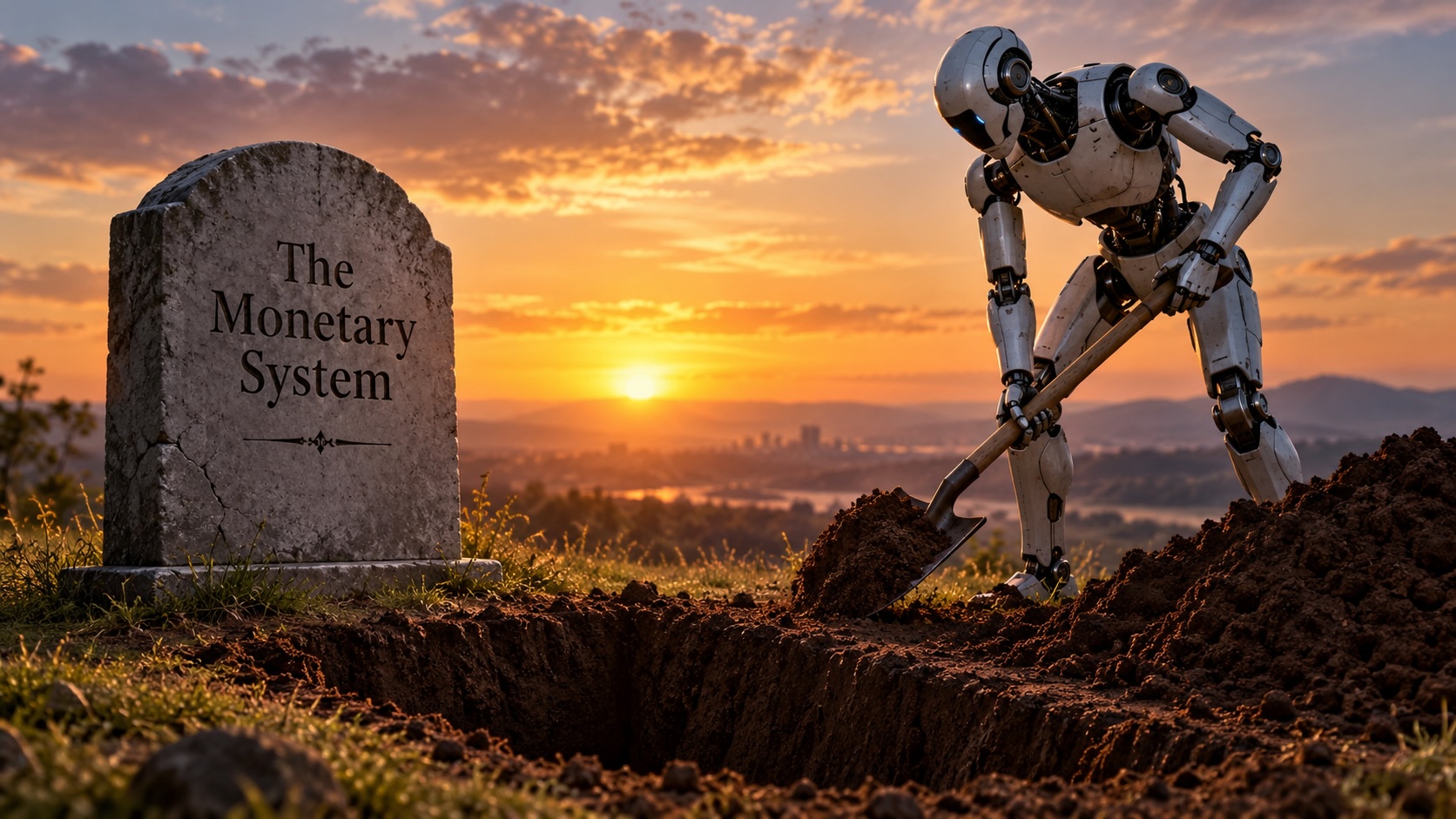
    The monetary system may be digging its own grave.

    Recently, Elon Musk responded to a post about wealth creation(eat the rich) with a simple warning:

    “The problem is that after they ‘eat the rich’, they will starve.”

    Someone responded by turning his argument around: the rich do not feed society. Workers do. If the rich vanished, work would continue. But without workers, what exactly would the rich have left to profit from?

    There is an extraordinary irony here.

    Elon Musk is building the technology that may actually make the workers vanish.

    Not the people themselves.

    But the need for their labor.

    The Workers

    For centuries, workers have been at the center of the monetary economy.

    They work.

    They receive wages.

    They spend those wages.

    Companies receive that money as revenue.

    Governments tax wages, employment and consumption and use that revenue to finance society.

    Then the cycle begins again.

    Workers are therefore not merely a cost to businesses. They are also the customers who buy what businesses produce and an important part of the tax base supporting governments.

    The OECD describes labor taxes—including income taxes, social-security contributions and payroll taxes—as a significant source of government revenue across its member countries. It also explicitly recognizes automation and AI as structural changes that may affect those tax bases. The system rewards efficiency. 

    Now introduce the robot.

    The Robot

    The robot doesn’t need a salary.

    It doesn’t pay personal income tax.

    It doesn’t need a pension.

    It doesn’t go shopping after work.

    It doesn’t take its family to a restaurant.

    It doesn’t buy a Tesla.

    Yet the company replacing the worker with that robot has a perfectly rational reason for doing so.

    The robot can potentially work longer, produce more, make fewer mistakes and become cheaper over time.

    From the perspective of an individual company, this can make perfect economic sense:

    Reduce labor. Reduce costs. Increase productivity. Increase profit.

    But what happens when everybody does it?

    Suddenly we encounter something much bigger than unemployment.

    We encounter a contradiction within the structure of the monetary system itself.

    The Contradiction

    The system itself rewards companies for eliminating human labor while simultaneously depending heavily on income generated through human labor to maintain purchasing power in order to keep the system running.

    That is the constitutional contradiction.

    Not constitutional in the political sense, but in the deeper meaning of the word: a contradiction in how the system itself is constituted.

    Every individual company has an incentive to be more efficient: to automate.

    But if automation eventually succeeds beyond our wildest dreams, who buys everything?

    The machines can produce a million cars.

    Wonderful.

    Who buys them?

    The machines can build houses.

    Fantastic.

    Who pays for them?

    The machines can grow food, manufacture clothes, transport products, construct infrastructure and provide services.

    Amazing.

    But robots don’t receive wages.

    And robots don’t go shopping.

    The Taxes

    Then there is another problem.

    Governments are deeply connected to the same employment structure.

    Workers pay income taxes and social-security contributions. Employers make employment-related contributions. Workers then spend their remaining income, generating VAT and other consumption taxes.

    Remove enough paid human labor and governments may have to rethink where a substantial part of their revenue comes from.

    Government Revenues

    This isn’t merely speculation about an obscure tax problem. The OECD has specifically warned that automation could affect government revenues if labor-tax bases erode, particularly because many countries rely heavily on taxes connected to labor.

    Of course governments can respond.

    Tax corporations more.

    Tax capital.

    Tax automated production.

    Create new forms of taxation.

    Redistribute the proceeds.

    Perhaps use some of that revenue to finance Universal Basic Income, which ironically is used to pay for products produced by the machines that made them unemployed in the first place.

    Or, as Elon Musk prefers to call his envisioned future, Universal High Income. Musk has repeatedly argued that AI and robotics could eventually create enormous abundance while making conventional work optional.

    But this raises another problem.

    If human employment keeps disappearing, governments lose much of the very tax revenues upon which redistribution currently depends. Taxes would increasingly have to be shifted toward the companies, capital and automated productive systems where the remaining monetary income accumulates.

    We would then be taxing the automated economy in order to give people money so that they could buy what the automated economy produced without them. Money itself becomes eroded and more and more pointless.

    At some point we might reasonably ask:

    Why are we keeping the money in the middle at all?

    The Grave

    This is what makes the present moment in human history so fascinating.

    The monetary system is not necessarily being destroyed by revolutionaries standing outside the gates.

    It may be undermining  its own foundation by following its internal logic:

    • Competition demands greater efficiency
    • Greater efficiency demands automation
    • Automation reduces the need for labor
    • Reduced labor can reduce wage income
    • Reduced wage income can reduce purchasing power

    And reduced employment can weaken traditional tax bases.

    The system is, in a sense, digging its own grave.

    Not because somebody planned it.

    Because everybody is doing exactly what the system tells them to do. 

    Increase efficiency.

    The Fear

    And yet, for many people, this doesn’t feel like liberation. 

    It feels terrifying.

    If AI and robots takes our jobs, we may lose our income, our security and the system we have depended upon all our lives. Money has become so deeply connected to our existence that imagining a world without it can feel like imagining a world without security itself.

    But does money actually secure our existence?

    Money doesn’t feed us. Food does. Money doesn’t shelter us. Homes do. Money doesn’t produce the things we need. Resources, knowledge, technology and human ingenuity do.

    Money is the system we currently use to gain access to them.

    Perhaps the fear is understandable precisely because we have confused the two for so long. Resources and money. They are not the same.

    And perhaps it is finally time to wean ourselves from that misconception.

    Liberation

    We’ve seen technological revolutions before.

    Again and again, machines have replaced human labor.

    And every time, we have celebrated increased productivity.

    We call machines labor-saving devices.

    But there has always been something strange about that expression.

    Whose labor did they save?

    If a machine eliminated your exhausting repetitive job but your survival depended upon the wage from that job, the machine didn’t necessarily make you feel liberated.

    You lost your income.

    You had to find another job.

    Technology liberated humanity from one form of work while the economic system continued requiring us to work with something else.

    Perhaps AI and robotics are finally bringing that contradiction to its conclusion.

    Perhaps the ultimate purpose of labor-saving technology is not simply to save labor.

    Perhaps it is to save all humans from compulsory labor.

    True Freedom

    Imagine that machines really can do most of the work we don’t want to do.

    They grow the food.

    Build the houses.

    Manufacture the products.

    Maintain infrastructure.

    Transport resources.

    Recycle materials.

    AI helps coordinate production and distribution according to real human needs and real available resources.

    What exactly have we lost?

    Jobs?

    Or have we gained something extraordinary?

    Freedom.

    Not the freedom to choose which employer we sell our time to.

    Not the freedom to compete for enough money to survive.

    Not the freedom to spend our lives earning access to the products our machines can already produce.

    Something much more fundamental.

    The freedom to live.

    The freedom to create.

    The freedom to learn.

    The freedom to care for others.

    The freedom to explore.

    The freedom to contribute because we want to contribute.

    The freedom to ask, perhaps for the first time:

    What would I actually like to do with my life?

    The Choice

    And that brings us back to Elon Musk.

    He warns that if we “eat the rich,” we may eventually starve.

    But perhaps that is asking the wrong question.

    What happens when nobody needs to eat anybody?

    What happens when machines can produce enough food for everyone?

    When robots can build enough homes?

    When automated systems can manufacture what we need?

    When AI can help us manage resources intelligently?

    What happens when human labor is no longer the foundation upon which material abundance depends?

    Humanity hasn’t suddenly become poor.

    Quite the opposite.

    We may have become richer than at any point in history.

    Yet if access to that abundance still depends upon obtaining money through work that society no longer needs us to perform, we will have created one of the strangest situations imaginable.

    We will have developed the technology to liberate humanity while maintaining an economic structure that prevents us from experiencing the liberation.

    Maybe AI and robotics aren’t merely threatening the monetary system.

    Maybe they are revealing that we are beginning to outgrow it.

    Earth Constitution

    But technology will not make the final decision for us.

    However far AI and robotics advance, humanity will still have to decide what kind of civilization we want to create with them.

    Perhaps nations could eventually come together and create a new Constitution of Earth, based upon global cooperation, stewardship of our common resources and freedom from economic coercion.

    Not freedom to consume infinitely. We still live on a finite planet.

    Not freedom to do anything regardless of its consequences for others.

    But freedom from having to sell our labor simply to earn the right to live.

    A world in which technology finally fulfills its greatest promise: not merely producing more for us, but setting us free.

    Waking Up

    How exactly do we get from here to there?

    I don’t pretend to have a blueprint.

    Waking Up: A Journey Towards a New Dawn for Humanity is not a manifesto detailing every step of the transition or every mechanism of a future civilization.

    It is something much simpler.

    A glimpse of what might be possible.

    The story begins in 2015 with Benjamin Michaels, a billionaire facing terminal cancer. Desperate to escape death, he chooses cryonic preservation, hoping that future medicine will eventually cure him so he can wake up and continue expanding his empire.

    He gets his wish.

    Benjamin wakes up a century later.

    His cancer is cured.

    There is only one small problem.

    His empire no longer exists.

    Neither does his money.

    Neither does anyone else’s.

    The concepts upon which his entire life was built—money, trade and ownership—have disappeared.

    Benjamin expected to wake up in the future and reclaim his wealth.

    Instead, he wakes up in a civilization where wealth itself has been redefined.

    Not a Blueprint

    People no longer spend their lives earning the right to live. Technology handles much of the work once performed out of necessity. Resources are shared and managed intelligently. People are free to create, explore, learn, contribute and simply live.

    Benjamin has awakened in the world this article has been imagining.

    Not a perfect world.

    Not a blueprint.

    Not a prediction.

    A possibility.

    And perhaps that is where every transformation begins.

    Before we can create a different world, we first have to be able to imagine one.

    Discover the story

  • The Unavoidable Predicament

    The Unavoidable Predicament

    What happens when humanity creates machines that can do most work better, faster, cheaper, and eventually more intelligently than humans themselves?

    At first, it sounds like paradise.

    No more dangerous or tedious labor. No more exhausting repetitive tasks. No more people breaking their backs merely to survive. Factories running automatically. Food systems optimized by AI. Self-driving transport. Robotic construction. Automated logistics. Automated farming. Automated manufacturing. Automated administration.

    The dream humanity has chased for centuries.

    Until one realizes something disturbing:

    The entire monetary system depends on humans needing jobs.

    But the solution is not to stop technological development, but rather to rethink the system itself.

    Not because work itself is noble.
    Not because humans love commuting, stress, burnout, debt, and survival anxiety.
    But because money only circulates if enough people:

    • earn wages
    • spend wages
    • borrow money
    • repay debt
    • consume products and keep the economic wheel spinning.

    But robots do not receive salaries. AI does not go shopping. Machines do not take mortgages. Algorithms do not buy dinner. Computers do not pay rent.

    And suddenly humanity arrives at what may become the greatest economic predicament in history.

    The success that breaks the system

    For generations, technological progress created new industries while destroying old ones.

    The tractor reduced farm labor, but factories emerged.
    Factories automated, but office work exploded.
    The internet disrupted industries, but created entirely new digital economies.

    The system survived because humans were still economically necessary.

    But AI and robotics are different.

    This time it is not merely muscle being replaced.
    It is increasingly:

    • perception
    • analysis
    • driving
    • coding
    • writing
    • logistics
    • diagnosis
    • administration
    • customer service
    • manufacturing and even parts of creativity and decision-making.

    The more successful automation becomes, the less human labor the economy structurally requires.

    And this creates a paradox:

    The very technology humanity develops to free itself from labor may simultaneously destroy the labor-based monetary system itself. This leaves us with limited choices.

    The three roads ahead

    Humanity now appears to face three broad possibilities:

    1. Patching the system

    Universal Basic Income.
    Robot taxes.
    Debt expansion.
    State subsidies.
    Artificial job creation.
    Shorter work weeks.

    These measures may temporarily reduce suffering and buy time.

    But they do not solve the deeper contradiction.

    Because eventually society risks entering a strange loop where:

    • machines produce most value,
    • a minority owns the productive systems,
    • governments redistribute money merely to maintain consumption,
    • and money circulates primarily to preserve the existence of the monetary system itself. The ultimate paradox.

    Meanwhile millions of people may increasingly feel economically unnecessary in a civilization where survival and dignity are still tied to income.

    2. Extreme concentration

    The second path is darker.

    As automation advances, ownership of AI, robotics, infrastructure, energy, data, and resources could become concentrated in fewer and fewer hands.

    Not necessarily because individuals are uniquely evil.
    But because automation naturally centralizes power.

    One AI system can replace thousands of workers.
    One automated factory can replace entire industries.
    One global platform can dominate worldwide distribution.

    And eventually a civilization can emerge where:

    • fewer humans are economically needed,
    • purchasing power collapses for large parts of society,
    • inequality explodes,
    • and social instability intensifies.

    In some ways, it begins resembling ancient slave civilizations.

    There was an upper class using money, land, trade, and luxury among themselves.
    While the laboring class largely existed outside real economic participation.

    Ironically, the robots themselves would not suffer.
    They would simply be machines.
    In one sense, they would become humanity’s mechanical servants.

    But unless the majority of humans are to become economically irrelevant as well — dependent, excluded, and disconnected from meaningful participation in civilization — humanity would have to fundamentally rethink the structure underneath the system. The humans who don’t own robots will only exist to justify the monetary system itself, keeping it going through consumption, loan payments and monetary circulation.

    Even the ultra wealthy would not truly be safe in such a world. Because a civilization built on permanent exclusion eventually destabilize itself.

    And that is precisely what leads toward the third possibility:

    3. Redesigning the system itself

    The third path asks a more fundamental question:

    What if the purpose of technology is not to preserve profit and employment… but to reduce unnecessary labor?

    And if that is true, why should survival continue depending entirely on selling labor? Ultimately, we could have one huge global “upper class” being served by the machines. And no other classes. Basically all humans being in the same “class” which is one of dignity and respect for each other, nature and the planet itself. 

    This path does not mean a world without contribution, responsibility or purpose.

    It means reorganizing civilization around:

    • free access instead of artificial scarcity/money,
    • stewardship instead of ownership,

    because in a world with a global “upper class,” who would actually own the machines?

    The most logical solution may ultimately be: no one.

    Instead, humanity becomes the steward of the systems supporting civilization.

    • optimization instead of waste,
    • and human and planetary well-being instead of endless monetary growth.

    In such a system, technology becomes a tool for civilization rather than merely a machine for profit extraction.

    AI and automation would help optimize:

    • food systems,
    • transport,
    • housing,
    • recycling,
    • renewable energy,
    • water management,
    • healthcare,
    • education,
    • ecosystem restoration,
    • and resource coordination.

    The irony is profound.

    The same technologies currently threatening the monetary system may also make possible the most abundant civilization humanity has ever seen.

    Technology may decide for us

    People can debate endlessly whether humanity should move beyond the monetary system or not.

    Some will defend capitalism.
    Some will argue for reforms.
    Some will insist the current system can continue indefinitely.
    Others will call any alternative unrealistic.

    But beneath all ideological debate, something deeper is happening.

    Technology itself may be making the decision for us.

    Because the monetary system fundamentally depends on human labor, wages, purchasing power, and continuous circulation of money through billions of human economic participants.

    But automation steadily removes humans from that loop.

    You can say whatever you want about reasons for or against abandoning the monetary system.

    It increasingly appears that technology is abandoning it for us.

    Unavoidably.

    And the more successful AI and robotics become, the harder it becomes to avoid the contradiction.

    If machines can increasingly produce abundance with minimal human labor, then eventually humanity must answer a difficult question:

    How can survival remain dependent on selling labor in a world where labor itself is no longer structurally necessary?

    And not only will there be fewer jobs.
    There will also be less money in circulation.

    Because money is tied to people.
    Working people.
    People participating in the economic machine.

    People not working means no monetary circulation which ultimately means no monetary system. 

    Not because someone politically abolished it.

    But because technology gradually make it structurally obsolete. 

    The real question

    Perhaps this is the unavoidable predicament humanity now faces:

    Technology is making human labor increasingly unnecessary.

    But the monetary system still ties survival to labor.

    Those two realities cannot expand forever side by side.

    Eventually humanity must answer a civilizational question:

    Do we continue forcing humans to compete for survival inside a system increasingly run by machines?

    Or do we finally use our technology, intelligence, and resources to create a civilization where life itself is no longer dependent on economic struggle?

    That may ultimately become the defining question of the 21st century.

    And perhaps the most important realization of all is this:

    The predicament itself is not the tragedy.

    The tragedy would be refusing to rethink the system even after technology has already made the old one obsolete.


    A glimpse into the civilization beyond work

    If technology is making the old system obsolete, what kind of civilization comes next?

    That is exactly the question explored in the book Waking Up – A Journey Towards a New Dawn for Humanity — a story about a former billionaire who wakes up 100 years into the future only to discover that humanity has moved beyond money, ownership, and artificial scarcity. If you want to see what happens to him you can:

    👉 Discover the book here.

    And if this resonates with you, please share this article.

    Maybe our children can enjoy this new world…

  • Are we making ourselves Obsolete?

    Are we making ourselves Obsolete?

    In a world increasingly dominated by artificial intelligence, automation, and robotics, a pressing question looms: Will humans still have a place, or are we making ourselves obsolete?

    The machines are rising, and they’re not coming for our lives—they’re coming for our jobs. From warehouse logistics and transportation to law, medicine, and education, automation is no longer just a futuristic concept. It’s here, now, and accelerating.

    Machines don’t sleep. They don’t demand wages, pensions, or healthcare. They don’t complain. And they can work with staggering efficiency 24/7. It’s no surprise that industries are eagerly replacing human labor with algorithms and robots that deliver more for less.

    But this massive shift brings with it a paradox: as machines become more productive, humans become less essential—at least in the traditional economic sense.


    No more work no more people

    We’ve long defined our place in the world through our work. Jobs have given us structure, purpose, and identity. But what happens when the need for human labor disappears?

    If AI can diagnose diseases better than doctors, write reports faster than journalists, create art more prolifically than painters, and now even power robots that build houses, clean streets, and perform physical labor once thought to be exclusively human—what is left for us to do? Are we headed toward a future where humans are reduced to passive spectators of their own civilization?

    It’s a question that’s as psychological and spiritual as it is economic. Because beneath the fear of unemployment lies a deeper fear: that we no longer matter.


    The Economic Trap

    Our economic systems are built on a very old assumption: people work, earn money, and spend that money to keep the system going. But in a world where robots do the work, what happens to those who are no longer needed?

    If people aren’t earning, they aren’t spending. And if they aren’t spending, businesses collapse—regardless of how efficiently robots can produce. This is the fundamental paradox of automation: abundance created without anyone affording to consume it.

    So even as technology races ahead, we find ourselves stuck. We’ve created tools to free ourselves from labor, yet we remain bound to an economic system that punishes idleness—even when it’s the machines doing all the work.


    The Illusion of Easy Solutions

    Universal Basic Income (UBI) is often proposed as the solution. Everyone gets a set amount of money regardless of employment status. It sounds fair—and maybe even inevitable. But will it work?

    UBI might offer short-term relief, but it doesn’t address the root issues:

    • It keeps us locked in a consumption-based economy.
    • It risks turning people into permanent spectators, surviving but not thriving.
    • It assumes that purpose can be replaced with payments.

    In other words, UBI might temporarily stop the bleeding, but it doesn’t heal the wound.


    What Will Humans Do?

    If machines handle the boring, repetitive, dangerous, and essential—what’s left for us?

    The answer could be everything else.

    • Creating art, music, and stories.
    • Exploring the universe.
    • Healing the planet.
    • Deepening relationships, community, and consciousness.

    But none of this will emerge naturally from the current system. It demands a new model of value, one that sees human life not as a tool of production, but as an expression of potential.


    A New Operating System for Humanity

    What we need isn’t just a better patch on capitalism—it’s a different operating system. One that doesn’t collapse when machines do the work. One that measures wealth not in dollars, but in well-being, creativity, ecological balance, and collective thriving.

    This is where visions like the Natural Exchange System and resource-based economies come in—not as utopias, but as real alternatives in reframing what matters.

    This is also the world imagined in Waking Up: A Journey Towards a New Dawn for Humanity. In it, a former billionaire confronts a civilization where money is obsolete, and value flows from connection, contribution, and care. It’s a world where humans are not obsolete—but reborn.


    Conclusion: Obsolete or Awakened?

    We stand at a threshold. One path leads to obsolescence—not because machines destroy us, but because we failed to adapt. The other leads to awakening—where we redefine our purpose not by what we produce, but by how we live.

    The machines and technology will keep evolving. The real question is: will we?

    If this vision resonates with you, take the next step into that future—read Waking Up: A Journey Towards a New Dawn for Humanity. Follow Benjamin Michaels on his transformative journey from a world of profit and productivity to one of purpose, peace, and planetary stewardship.

    👉 Order the book now: