
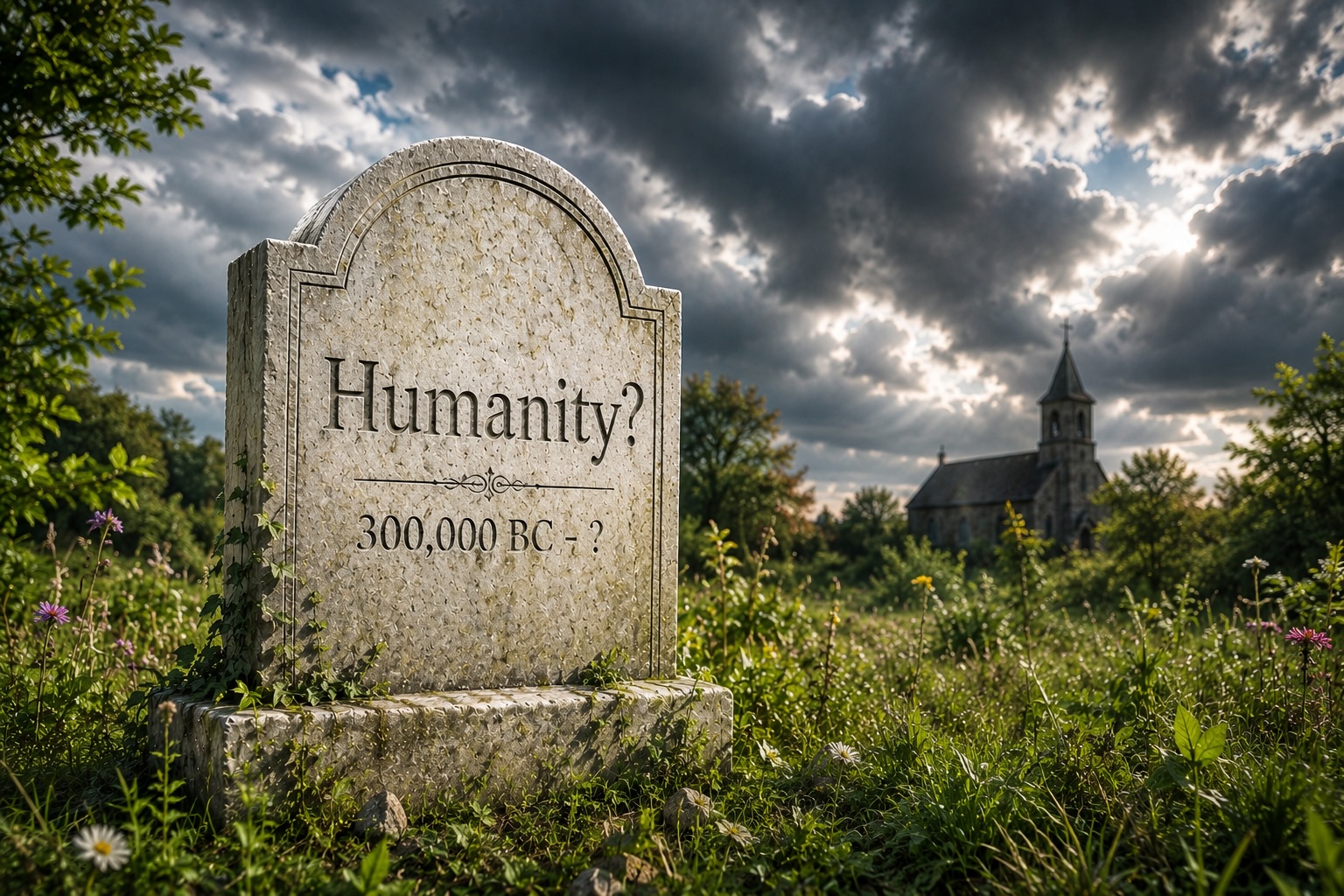
Yesterday I came across another news report.
Europe’s waterways are at record-low levels.
The Rhine and the Danube—two of Europe’s most important rivers—have become so shallow that cargo ships can no longer sail fully loaded. Even nuclear power plants are being affected because low water levels interfere with their cooling systems.
Tomorrow it will probably be another headline.
A glacier disappearing.
The north pole ice is already gone.
Another record-breaking heatwave.
Another drought.
Another forestfire.
Another flood.
Whether climate change is entirely human-made or not is, in one sense, beside the point.
What matters is that something fundamental seems to be changing.
For centuries, humanity has lived on an extraordinarily friendly planet. Rivers carried our goods. Fertile soils produced abundant food. Glaciers stored fresh water. Stable seasons allowed civilizations to flourish.
Nature quietly made our civilization possible.
Now the conditions that supported us for so long are becoming less predictable.
Earth Emergency
Does this mean life is over for humanity?
Not necessarily.
But it does mean we have entered a new reality.
For most of human history, our greatest challenges were each other.
From survival with each other on the planet to:
Empires.
Wars.
Borders.
Politics.
Economics.
But today, a new challenge stands above them all:
The condition of the very planet that makes civilization possible.
If the rivers continue drying up…
If agriculture becomes increasingly unstable…
If ecosystems continue breaking down…
…then every other problem becomes harder to solve.
This is no longer just another political issue.
It is becoming the foundation beneath every political issue.
And that makes it something entirely different.
A planetary emergency.
Fighting Each Other
Yet look at how we respond.
We continue acting as though the greatest threat is one another.
We argue over political parties.
We blame other countries.
We compete economically.
We prepare for wars and go through with them.
We still seem to believe that if only our side wins, everything will somehow be fine.
But rivers do not recognize borders.
The atmosphere does not vote.
The oceans do not distinguish between left and right.
Nature has never accepted our illusion of separation.
What We Normally Do In Emergencies
Imagine a forest fire racing toward a town.
Do the firefighters stop to debate politics?
Do they argue over religion?
Do they refuse help because it comes from another country?
Of course not.
They gather every available person, every vehicle and every resource.
They work together because the emergency is greater than their disagreements.
That is what intelligent beings do.
So why should a planetary emergency be any different?
History Says It Isn’t Impossible
Some people will say humanity could never unite.
History disagrees.
Few believed the Soviet Union would open itself through Glasnost.
Few imagined apartheid could end with forgiveness instead of endless revenge.
Few expected Britain to leave India after centuries of colonial rule.
History is full of moments that looked impossible…
…until they happened.
Not because humanity became perfect.
But because enough people finally realized that continuing the old way was no longer an option.
The Hard Question
So perhaps the question is not whether humanity can survive.
Perhaps the question is whether our system is designed to deal with a planetary emergency.
For thousands of years we have built civilization on the system of ownership.
On money.
On trade.
On competition.
On the pursuit of endless economic growth.
Those foundations have brought us extraordinary technological progress.
But have they also encouraged us to treat the planet as something to care for rather than something to exploit?
If our civilization rewards extracting more, consuming more and competing more, should we really be surprised that the living systems supporting all of us are beginning to struggle?
Perhaps this is why solving one environmental problem after another never seems enough.
We are trying to repair the roof while the foundations remain unchanged.
What About Overpopulation?
Whenever humanity’s environmental problems are discussed, someone always arrives at the same conclusion.
“There are simply too many of us.”
It is true that population matters. No planet can support unlimited growth forever, and we should aim for a stable global population over time.
But when people talk about rapidly reducing the population, the images that come to mind are not ones I want to think about.
History has already shown us where that kind of thinking can lead.
No.
If we are going to do something drastic, let it be this:
Let’s drastically redesign the way civilization operates.
Instead of reducing people, let’s reduce waste.
Instead of reducing people, let’s reduce pollution.
Instead of reducing people, let’s reduce the unnecessary consumption of resources.
Instead of asking how to make humanity smaller, perhaps we should ask how to make humanity wiser.
Our economic system was established in an age when the planet seemed vast and its resources almost limitless. Today we know better.
So perhaps the emergency is not that there are eight or nine or ten billion people alive.
Perhaps the emergency is that billions of people are participating in a civilization that rewards ever-increasing extraction, consumption and economic growth on a planet with clear physical limits.
That is a systemic design problem.
And unlike population, a system can be changed. And population will change with it.
If we have the courage to face reality, the most humane response to our crisis is not to cull humanity.
It is to redesign civilization so that humanity—and the living world we depend on—can thrive together for generations to come.
A Civilizational Transition
This is why I don’t believe another election will solve our problems.
Nor another war.
Nor another economic package.
This is not primarily a political or economic crisis.
It is a civilizational one.
The solution is not for one nation to defeat another.
Nor for one ideology to defeat another.
The solution is for humanity to begin acting as humanity.
To recognize that we share one planet, one biosphere and one future.
To gather our knowledge, technology, resources and compassion—not to compete against one another, but to preserve the extraordinary world that has given us life for so long.
Because if history has taught us anything, it is that impossible changes sometimes become inevitable.
Imagine That Future
This is exactly what has happened in the novel, Waking Up – A Journey Towards a New Dawn for Humanity.
Humanity has redesigned the whole system from one on endless monetary growth to to a system that supports nature and humanity forever.
Not by becoming perfect.
But by growing up.
By leaving behind the illusion of separation and building a civilization designed to work for everyone—and for the planet that makes every human life possible.
Perhaps that future begins the same way every great change in history has begun.
With enough people daring to imagine it.
The bewildered billionaire Benjamin Michaels wakes up one hundred years into the future expecting to expand his empire.
Instead, he discovers that humanity finally recognized the emergency and done something about it.
Are you curious of how the world he wakes up in looks?
If so, you can discover his story here.
If you believe there is still hope for humanity and think our future depends on as many as possible waking up to the possibility of a world that works for all I invite you to share this article. I thank you.
Leave a Reply