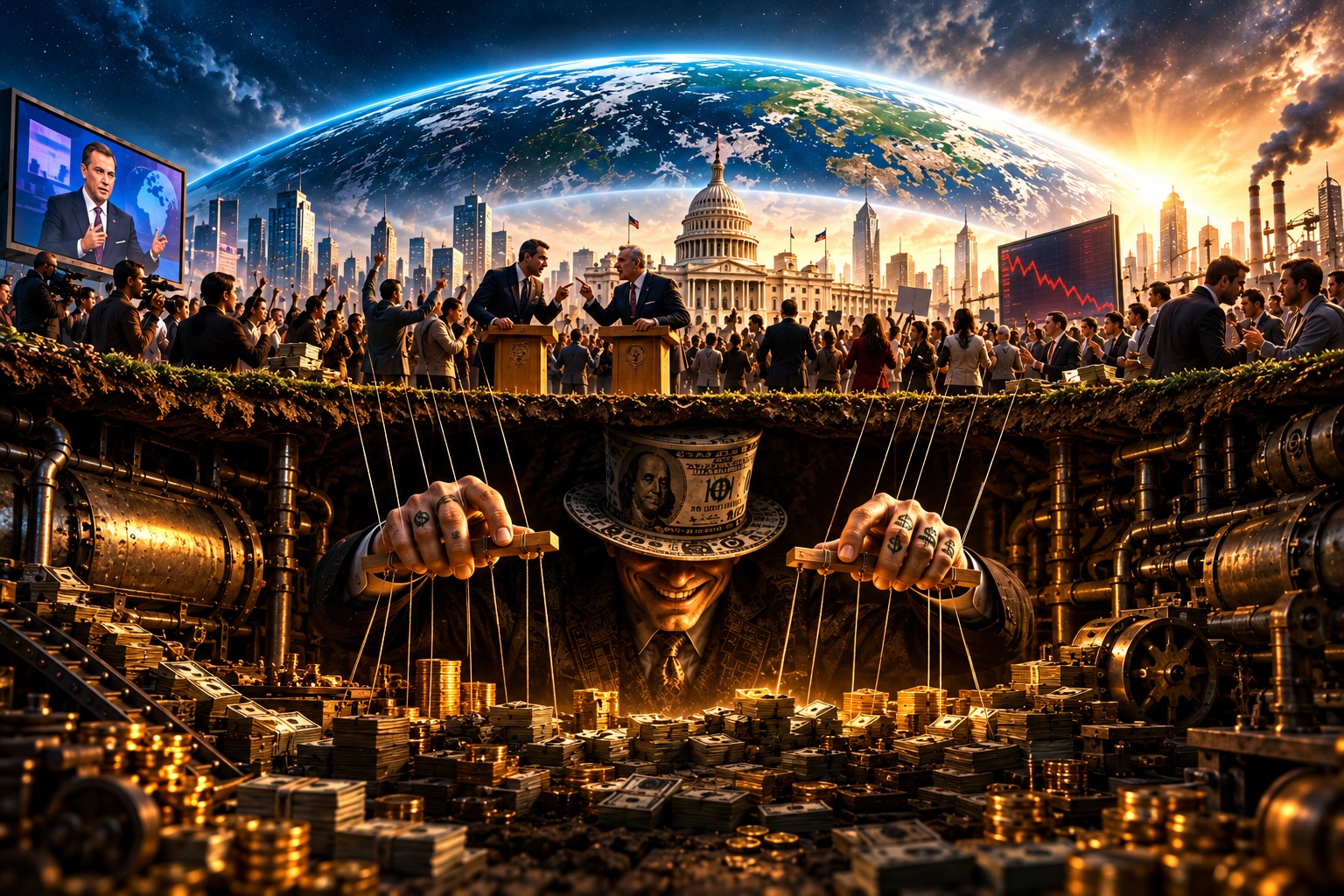
You cannot create abundance by creating and distributing more money. You can only create abundance by producing more of what people actually need. And distribute that.
Elon Musk has repeatedly predicted a future in which artificial intelligence, robotics, and automation will make human labor largely unnecessary. He has even suggested that money itself may eventually become irrelevant.
At the same time, he has introduced the idea of Universal High Income (UHI), which is a high basic income where everyone receives enough money to enjoy a high standard of living, regardless of whether they work on not.
It sounds wonderful, doesn’t it?
Machines do all the work, everyone receives a generous income, and humanity is finally liberated from the necessity of working for a living.
But there is a fundamental problem with this vision.
Universal High Income attempts to create universal abundance through a monetary system that cannot guarantee it.
And the reasons are surprisingly simple.
1. Resources – Money Does Not Create Resources
Imagine that tomorrow morning, everyone on Earth wakes up to discover that one million euros has been deposited into their bank account.
Wonderful! Everyone is suddenly a millionaire!
But what has actually changed?
Has a single additional house been built? Has one extra tomato been grown? Has another hospital opened? Has more electricity been generated? Are there suddenly more resources available to humanity?
No.
The world contains exactly the same physical resources and productive capacity as it did yesterday.
The only difference is that everyone now has much more money with which to compete for those resources.
Money is not food. Money is not housing. Money is not energy. Money is simply a means of gaining access to these things within the monetary system.
Of course, additional purchasing power can stimulate production where unused capacity exists. But production still requires actual resources, energy, infrastructure, and technology.
And if those resources are already being used to their limits, distributing more money will not magically create more of them.
You cannot print abundance. You have to produce it.
This is the first and most fundamental problem with Universal High Income.
2. Prices – Supply and Demand Will Absorb the Money
The second problem is built into the monetary system itself.
Supply and demand.
When more people have more money to spend, demand increases. And when demand increases faster than supply, prices tend to rise.
Imagine a city with 10,000 available apartments and 100,000 people who would like to live in them.
Now imagine everyone suddenly receives €10,000 per month through Universal High Income.
Does that create another 90,000 apartments?
Of course not.
Instead, many more people can now afford to compete for the same limited number of apartments.
Landlords and property owners discover that tenants can pay considerably more. Rents rise. Property prices rise.
An apartment that previously rented for €1,000 per month might eventually cost €5,000 or more.
And suddenly, that wonderful €10,000 monthly income doesn’t seem quite so wonderful anymore. Because prices have not only gone up on rent, but everything. When everyone suddenly have more money prices will automatically go up. That’s how our monetary system works.
The same principle applies to food, energy, water, land, and other necessities whenever supply cannot keep up with demand.
Even if automation makes televisions, computers, clothing, and countless manufactured products cheaper, it does not automatically make desirable land, housing, or every essential resource equally abundant.
And what happens when governments increase UHI to compensate for rising prices?
More purchasing power enters the market, potentially driving prices even higher.
Higher incomes. Higher demand. Higher prices. Another increase in income.
Standard of Living
The cycle can continue without necessarily improving people’s actual standard of living.
And there is another important consideration. What constitutes a high standard of living is highly subjective.
Some people may feel they need a luxurious mansion, several expensive cars, and countless possessions to be satisfied with their lives, while others may be perfectly happy living in a modest three-bedroom apartment with everything they need.
There is no universal definition of how much is enough.
And perhaps this points to something even more fundamental. Maybe humanity needs to reconsider not only its economic system, but also what it values, what it considers prosperity, and what actually makes people happy.
Because creating a world of abundance should not mean encouraging everyone to consume as much as possible. It should mean creating a world where everyone has the opportunity to live a fulfilling life according to their own needs, interests, and preferences, while respecting the needs of others and the limits of our planet.
Of course, prices will not rise equally everywhere. Where production can expand rapidly enough, additional supply can satisfy increased demand without major price increases.
But this only reinforces the central point.
It is the availability of actual goods and resources, not the amount of money people receive, that ultimately determines their material standard of living.
Universal High Income does not guarantee universal high purchasing power.
And a world full of millionaires is not necessarily a world full of abundance.
3. Eroded taxes – Who Will Pay for the Universal High Income?
There is another problem that becomes particularly interesting when considering the future Musk describes.
Where will the money come from?
Today, governments collect taxes from employment income, business profits, consumption, property, and other economic activities.
But what happens when AI and robotics replace an enormous proportion of human employment?
If millions or billions of people no longer receive wages, governments will lose a substantial part of their traditional income-tax and payroll-tax revenues.
At the very moment when they would need enormous amounts of money to finance Universal High Income, one of their major sources of revenue could be disappearing.
Of course, governments could tax the corporations that own the robots and automated factories instead.
But consider what that means.
The corporations produce the goods and services. People receive money from the government to purchase those same goods and services. The corporations receive that money, and the government then taxes the corporations to finance the next round of payments.
Money circulates from governments to consumers, from consumers to corporations, and from corporations back to governments.
Such a system is not mathematically impossible. Governments already redistribute money through taxation and public spending.
But why preserve this elaborate financial arrangement if the machines are already capable of producing what everyone needs?
Why not concentrate on making the actual goods and services available instead?
And there is another important question.
Who owns those machines?
4. The Owners Will Still Own Everything
Universal High Income does not fundamentally change the ownership structure of the monetary system.
Far from it. If anything, it reenforces it.
Land still belongs to landowners. Factories still belong to corporations. Automated production systems still belong to whoever owns them.
And everyone else still needs money to access what those owners control.
As long as there are still owners there will be rich and poor.
Imagine a future in which millions of humanoid robots produce food, construct buildings, manufacture products, and provide services.
Human labor has become largely unnecessary.
But if the robots, factories, land, and resources remain concentrated in relatively few hands, everyone else remains dependent on purchasing access to their output.
Universal High Income could then become a mechanism for distributing purchasing power to the population while preserving the existing concentration of productive ownership.
The owners receive money from consumers, while consumers depend on governments to provide that money.
Even if everyone receives a generous income, the underlying relationship remains.
Some own the productive resources. Others pay to access them.
The technology has changed, but the economic structure has not.
Why would we want such a world?
Where a tiny elite owns most everything while the rest are dependent on government payouts?
And this brings us to an interesting contradiction in Musk’s vision.
5. Elon Musk’s Contradiction
Elon Musk is working tirelessly to develop technologies that could eventually eliminate the necessity for much of human labor.
Through artificial intelligence, robotics, and automation, he is helping create the technological foundation for a world in which machines could perform an extraordinary proportion of the tasks necessary to sustain human civilization.
He has also suggested that money may eventually become irrelevant.
Yet he continues to describe the future in terms of Universal High Income.
But why?
If AI and robotics can produce practically everything humanity needs, why should everyone need a high income to purchase those things?
If money is becoming irrelevant, why introduce another mechanism that makes everyone dependent on receiving it?
Why keep money at all??
And perhaps most importantly, why is the discussion so focused on how much money people might receive rather than who will own and control the automated production systems?
As long as there are owners of the world’s resources and productive systems there will always be an imbalance in our world. An imbalance that historically has led to countless conflicts and wars.
Sensational Predictions
I sometimes wonder whether all these sensational predictions about Universal High Income, the end of work, and the disappearance of money are mostly meant to distract from the much more fundamental questions:
Who will own the robots and factories? Who will control the resources? Who will decide what gets produced? And who will benefit from the extraordinary abundance these technologies could make possible?
I cannot know Musk’s true intentions. But I would certainly like to hear him address these questions more directly.
Because the future of humanity is not fundamentally about how much money everyone will receive.
It is about what humanity can produce sustainably, how those resources are managed, and whether everyone can benefit.
6. The Real Opportunity of AI and Robotics
Here is where the discussion becomes truly exciting.
For most of human history, producing the necessities of life has required enormous amounts of human labor.
People had to cultivate fields, build houses, manufacture products, transport goods, and perform countless other tasks.
The monetary system developed around this world of human labor, exchange, ownership, and scarcity.
But what happens when technology changes the fundamental conditions?
What happens when automated systems can grow food, construct buildings, manufacture goods, transport resources, maintain infrastructure, and perform most of the work necessary to sustain civilization?
For the first time in history, humanity may be approaching the technological capacity to provide an abundant standard of living for everyone without requiring everyone to work for it.
That is an extraordinary opportunity.
But instead of asking how to distribute enough money for everyone to purchase this abundance, shouldn’t the question be how to organize the production and distribution of the abundance itself?
We have established that more money does not lead to more resources.
The Real Questions
These are the real questions we must ask:
What resources are available?
How can we optimize them?
What does everyone need?
How much can be produced sustainably?
How can technology coordinate production and distribution so that everyone’s needs can be met while preserving the planet’s ecosystems?
These are questions AI could help humanity answer.
And they lead directly toward a resource-based economy.
7. From Universal High Income to Universal High Living Standards
Imagine a world where housing, food, energy, transportation, healthcare, education, and communication are available to everyone without monetary transactions.
Not because everything is infinitely abundant, but because humanity has organized its resources and productive capacity around meeting people’s needs rather than generating financial returns.
In such a world, AI and robotics would continuously monitor available resources, production capacity, environmental conditions, and actual demand.
Production could be adjusted according to what people need and what the planet can sustainably provide.
Resources that remain scarce would still require responsible allocation. Technology cannot create unlimited land, water, or raw materials. But it can help optimize and maximize what we have.
But scarcity would no longer automatically mean that those with the most money receive the most.
Instead of ownership, humanity could develop a system of stewardship, where the Earth’s resources are managed for the benefit of everyone.
We would be stewards of Earth instead of owners.
And instead of measuring prosperity through income, it could be measured through actual living standards, access to necessities, personal freedom, health, well-being, and environmental sustainability.
Nobody would need to become a millionaire to live an abundant life.
Nobody would need to receive Universal High Income to access the products of automated production.
The objective would no longer be universal financial wealth.
It would be universal real wealth.
8. Why Preserve the Bottleneck?
Money is an intermediary bottleneck between human needs and the resources required to satisfy them.
Today, someone can be hungry while food is available, homeless while houses stand empty, or unable to obtain medical treatment even though the necessary technology and expertise exist.
Not necessarily because the resources are unavailable, but because access to them depends on money.
Universal High Income attempts to address this problem by giving everyone more money.
But it leaves the bottleneck in place.
It leaves prices in place.
It leaves competition for purchasing power in place.
And it leaves the concentration of ownership completely untouched.
If AI and robotics eventually provide humanity with the productive capacity to satisfy everyone’s needs, why should access to that production continue to depend on a financial mechanism?
Why should people need money to obtain what society is technologically capable of providing?
The question is no longer simply how to make everyone rich.
It is how to create a world in which everyone can live richly, regardless of money.
Conclusion:
Abundance Is Not a Number in a Bank Account
Universal High Income is an understandable response to a future in which AI and robotics may eliminate enormous amounts of human employment.
And as a transitional measure, income guarantees could help protect people from poverty and economic disruption in the transition to a world of real wealth.
You cannot print money and think it is abundance.
You have to produce it. And once you can produce it for everyone, why should anyone need money to access it?
This is the future I explore in the novel Waking Up: A Journey Towards a New Dawn for Humanity, where a the bewildered billionaire Benjamin Michaels awakens a century from now to discover that humanity has moved beyond money, trade, and ownership toward a cooperative, resource-based civilization.