Tag: HUMANITY

  • The Insanity of Humanity

    The Insanity of Humanity

    This might be the most important article I have ever written.

    A Russian drone has reportedly killed three civilians in Ukraine after using artificial intelligence to select its own target.

    Read that sentence again.

    The Terminator

    A human being programmed and  launched the weapon and gave it a general mission. But according to investigators, the drone then navigated and selected the precise object it would attack without further human intervention. It appears to have targeted propane tanks at a petrol station in Zaporizhzhia. Instead, it struck beside an apartment building and exploded, killing three people, including a 19-year-old student.

    This is not a scene from The Terminator. It is not a warning from a dystopian novel about something that might happen fifty years from now.

    It has happened.

    Drones For Death

    We have entered an age in which machines are being given the authority to decide where lethal force will be applied. Software observes the world through cameras and sensors, compares what it sees with a programmed target profile, selects something to destroy and attacks.

    There may still be human beings behind the mission. Humans manufacture the drone, define the target category and launch the weapon. But at the decisive moment—when one object is distinguished from everything surrounding it and marked for destruction—the machine may act alone.

    This is a threshold humanity should never have crossed.

    Yet, instead of stopping the insanity, every major military power will now feel compelled to move faster. If one country develops autonomous weapons, another will say it must do the same for its own protection. If one side deploys a hundred, the other will need a thousand. The drones will become smaller, cheaper, faster and more difficult to detect. They will learn to coordinate in swarms, recognize increasingly complex targets and continue operating when communication with a human controller has been lost or jammed.

    The military justification will always be the same: if we do not build them, somebody else will.

    That is how insanity becomes policy.

    Where Does This End?

    We Must Stop it

    Where does an autonomous arms race ultimately lead?

    Does the country possessing the largest number of killer drones eliminate everyone it considers a threat and then live happily ever after without all the bothersome others?

    Of course not. After all, we are dependent on each other for survival on this planet. Even the most selfish and fearful leaders see that.

    But autonomous weapons will not remain exclusively in the hands of a few powerful governments. The essential components already exist within the civilian economy: processors, cameras, navigation systems, motors, batteries and increasingly capable artificial intelligence. As the technology becomes cheaper, versions of these weapons will spread to smaller countries, militias, extremist organizations, criminal groups and individuals.

    We must stop this before it is too late.

    Nobody Will be Safe

    Eventually, nobody will be safe.

    Political leaders can be hunted. Dissidents can be hunted. Journalists, scientists, engineers and activists can be hunted. A person may be marked because of a uniform, a vehicle, a telephone signal, facial characteristics or simply because an algorithm incorrectly decides that the person matches a target profile.

    Machines do not understand mercy. They do not recognize fear in another person’s eyes and lower their weapons. They do not see a wounded soldier and decide that enough people have died. They cannot refuse an immoral command because something inside them says it is wrong.

    They process information and execute instructions.

    A world saturated with autonomous weapons would not be a world controlled by one victorious superpower. It would be a world in which power itself had become uncontrollable. Nobody would necessarily know who launched a particular drone, who programmed it or whether its behavior had been altered. One automated attack could provoke another. Retaliation could begin before human beings even understood what had happened.

    Wars could escalate at machine speed.

    And these weapons would not necessarily remain on distant battlefields. The same systems could be used by governments against their own populations. A dictator would no longer need soldiers willing to fire upon their neighbors. Machines do not disobey, protest or experience remorse. A government controlling millions of autonomous weapons could make resistance almost impossible.

    This is not security.

    It is the automated imprisonment of humanity.

    No One Wins

    If these weapons ever become genuinely uncontrollable, they will continue killing until their targets disappear or the industrial systems supporting them collapse.

    Power stations will fail. 

    Transport will stop. 

    Food distribution will break down. Hospitals will become inoperable. People will be unable to gather, travel or work safely. 

    Eventually, most of the machines will also stop as batteries degrade, components break and replacement parts disappear.

    Human civilization and its killer machines may collapse together.

    That is the glorious destination of the arms race: humanity hiding underground while machines patrol the surface of the planet we ruined through our own fear.

    Kill or Create

    We have developed artificial intelligence, advanced robotics, global communications and extraordinary scientific knowledge. We possess technology that could help restore ecosystems, clean the oceans, cultivate food, construct homes and release humanity from dangerous and exhausting work.

    And what do we do?

    We teach machines to kill.

    This is the insanity of humanity.

    The Insanity of Separation

    But beneath this insanity, humanity is not insane.

    Beneath the fear, conditioning and the constant story of separation, there is an awareness within every one of us. In that awareness exists love, compassion, understanding and intelligence. It is the part of us that recognizes another human being not as an enemy, a competitor or an obstacle, but as another expression of the same life.

    A Ukrainian child, a Russian mother, an American soldier, a Chinese engineer and an Iranian farmer are not separate forms of life with different fundamental values. They feel pain. They experience fear. They love their children. They want to live.

    There are no Others

    We have placed a frightened layer over this awareness. The ego divides the world into us and them. From it’s fear it constructs nations, armies, threats and enemies. It tells us that we can achieve safety only by possessing greater destructive power than everybody else.

    Each side insists that it is merely defending itself. Each new weapon is justified as a response to the weapons of another. Everyone pursues security, yet everyone becomes progressively less secure.

    Now we are taking this ancient insanity and embedding it in software.

    We are giving fear cameras, wings and explosives. We are teaching artificial intelligence to recognize the enemies created by our own minds and destroy them with increasing efficiency.

    The machine has not invented separation.

    We have programmed it.

    The Other Direction

    The alternative is not to abolish technology. It is not to close every data center, abandon artificial intelligence or return to some imagined pre-industrial past.

    The alternative is to give our technology another purpose.

    The New Purpose

    The same machine vision capable of recognizing a military target can recognize plastic in the ocean, an animal caught in an abandoned fishing net, the first signs of a forest fire or a person buried beneath earthquake rubble.

    Autonomous machines can remove pollution, restore forests, repair infrastructure, cultivate food and monitor the health of ecosystems. Artificial intelligence can help humanity understand what resources exist, what people need and how production can be organized without destroying the living world..

    The Choice is Ours

    We can use artificial intelligence to compete more effectively against one another, or we can use it to build a civilization that works for everyone.

    We can automate killing, or we can automate caring.

    The technology is not making that choice.

    We are.

    A Message to World Leaders

    To every head of state—and especially to the leaders of the world’s military powers:

    Stop.

    Refuse to authorize machines to select and attack human beings. Begin immediate negotiations for a binding global prohibition against autonomous weapons. Establish meaningful human control over every use of automated lethal force.

    Do not wait for your rivals to move first, because they are waiting for you.

    Somebody must interrupt the logic of fear. Somebody must possess the courage to say that humanity will not construct its future upon machines deciding who shall die.

    True courage is not developing the most efficient killer drone. It is stepping out of an arms race when everyone around you insists that stopping is impossible.

    You are not protecting your people by creating a technology that will inevitably spread and eventually be turned against them. You are not building peace by removing human conscience from the decision to kill. You are not demonstrating strength by surrendering life-and-death decisions to software.

    This is one planet. 

    We share one atmosphere, one biosphere and one future. No country can make itself permanently secure in a world where everyone else lives in fear.

    The security of one nation cannot be built upon the insecurity of all others.

    Share Another Future

    I urgently beg you. 

    I insist.

    Please share this article.

    Share it not for me, not for a political party or organization, and not because I want to sell books. Share it because humanity urgently needs to recognize the choice now before us.

    Because the recent incident in Ukraine is not to be taken lightly. 

    We are close to the ultimate choice.

    The choice to perish as humanity or the choice to prosper together.

    So please send it to friends. Send it to journalists, researchers, engineers, politicians, military commanders, technology executives and heads of state. Translate it. Republish it. Discuss it. Challenge it if you must—but do not ignore the direction in which we are moving.

    Share not only the warning. 

    Share the possibility of another future.

    People cannot choose a possibility they have never been shown.

    If the only futures presented to humanity are endless economic competition, military supremacy, automated warfare and survival against one another, we will continue constructing precisely that world.

    We must make another civilization imaginable: a civilization based upon stewardship instead of ownership, cooperation instead of competition and intelligent access to abundance instead of an endless struggle for money and power. A world in which AI and robotics serve humanity and the whole living planet—not profit, domination, fear and war.

    Somewhere within every government, military institution and technology company are human beings who still possess conscience and compassion. They must hear from us before fear makes the decision for them.

    One article will not stop the machinery of war. But silence guarantees that the machinery will continue.

    We do not need every human being to awaken at exactly the same moment. We need enough people to speak, share and demonstrate another direction. We need enough people to insist that the future does not belong to fear. We need enough people to remind those in power that there is still something within them deeper than the frightened voice demanding more weapons.

    Humanity Stands at a Threshold

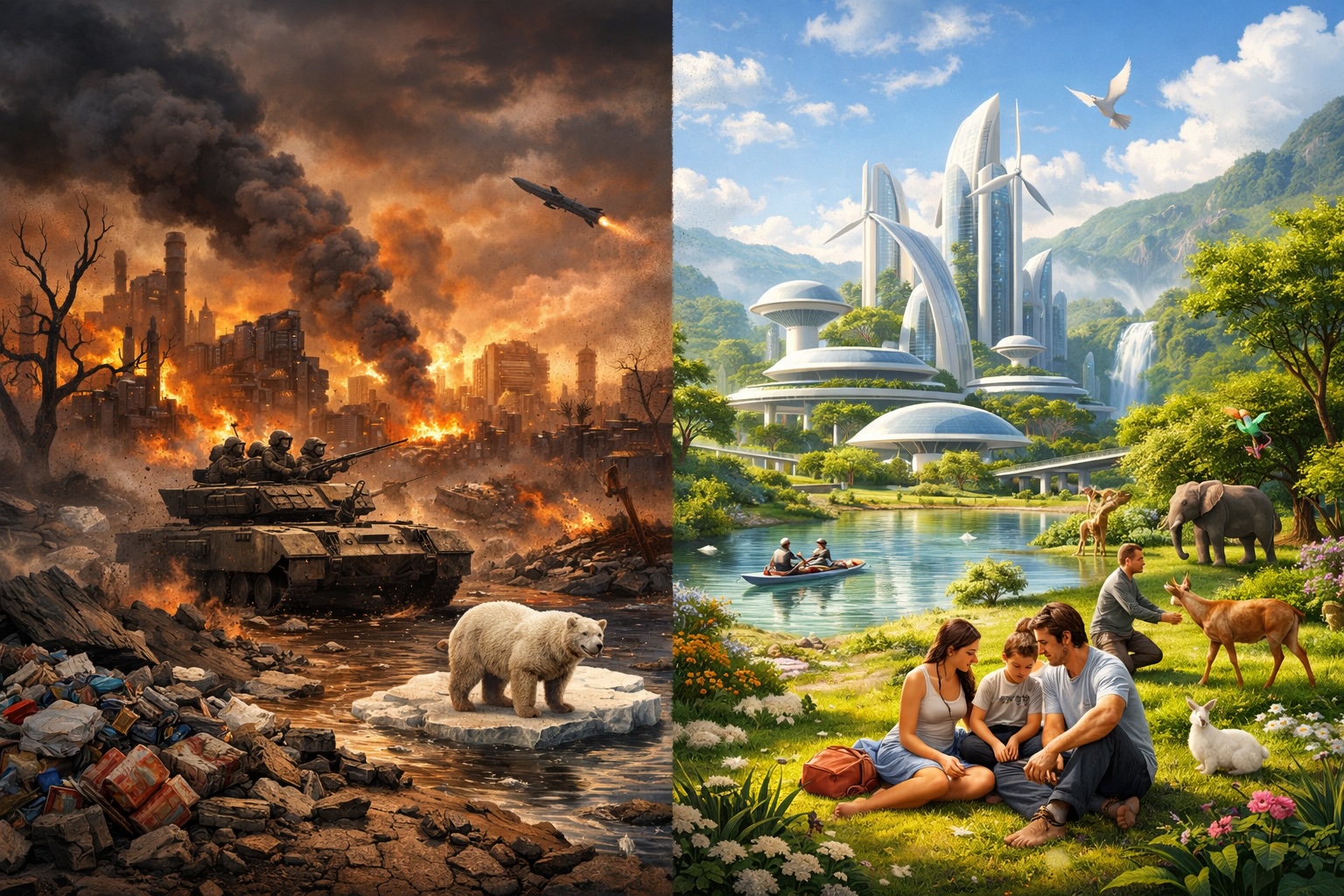
    Down one road, nations surround themselves with increasingly autonomous instruments of death until every human being becomes a potential target and the entire planet becomes a battlefield controlled by machines.

    Down the other road, we recognize that there are no others. 

    We allow the intelligence, compassion and awareness within us to determine how our technology will be used. We stop preparing to destroy one another and begin building a world in which everyone can live.

    This is not a distant philosophical choice.

    It is happening now.

    Please Share

    Please carry this message as far as you can and as high as you can. Let it reach people with the power to change our direction. Let it remind them that another future remains possible.

    We cannot base humanity’s future on killer drones.

    Humanity thanks you.
  • Is Life Over for Humanity?

    Is Life Over for Humanity?

    Yesterday I came across another news report.

    Europe’s waterways are at record-low levels.

    The Rhine and the Danube—two of Europe’s most important rivers—have become so shallow that cargo ships can no longer sail fully loaded. Even nuclear power plants are being affected because low water levels interfere with their cooling systems.

    Tomorrow it will probably be another headline.

    A glacier disappearing.

    The north pole ice is already gone.

    Another record-breaking heatwave.

    Another drought.

    Another forestfire.

    Another flood.

    Whether climate change is entirely human-made or not is, in one sense, beside the point.

    What matters is that something fundamental seems to be changing.

    For centuries, humanity has lived on an extraordinarily friendly planet. Rivers carried our goods. Fertile soils produced abundant food. Glaciers stored fresh water. Stable seasons allowed civilizations to flourish.

    Nature quietly made our civilization possible.

    Now the conditions that supported us for so long are becoming less predictable.

    Earth Emergency

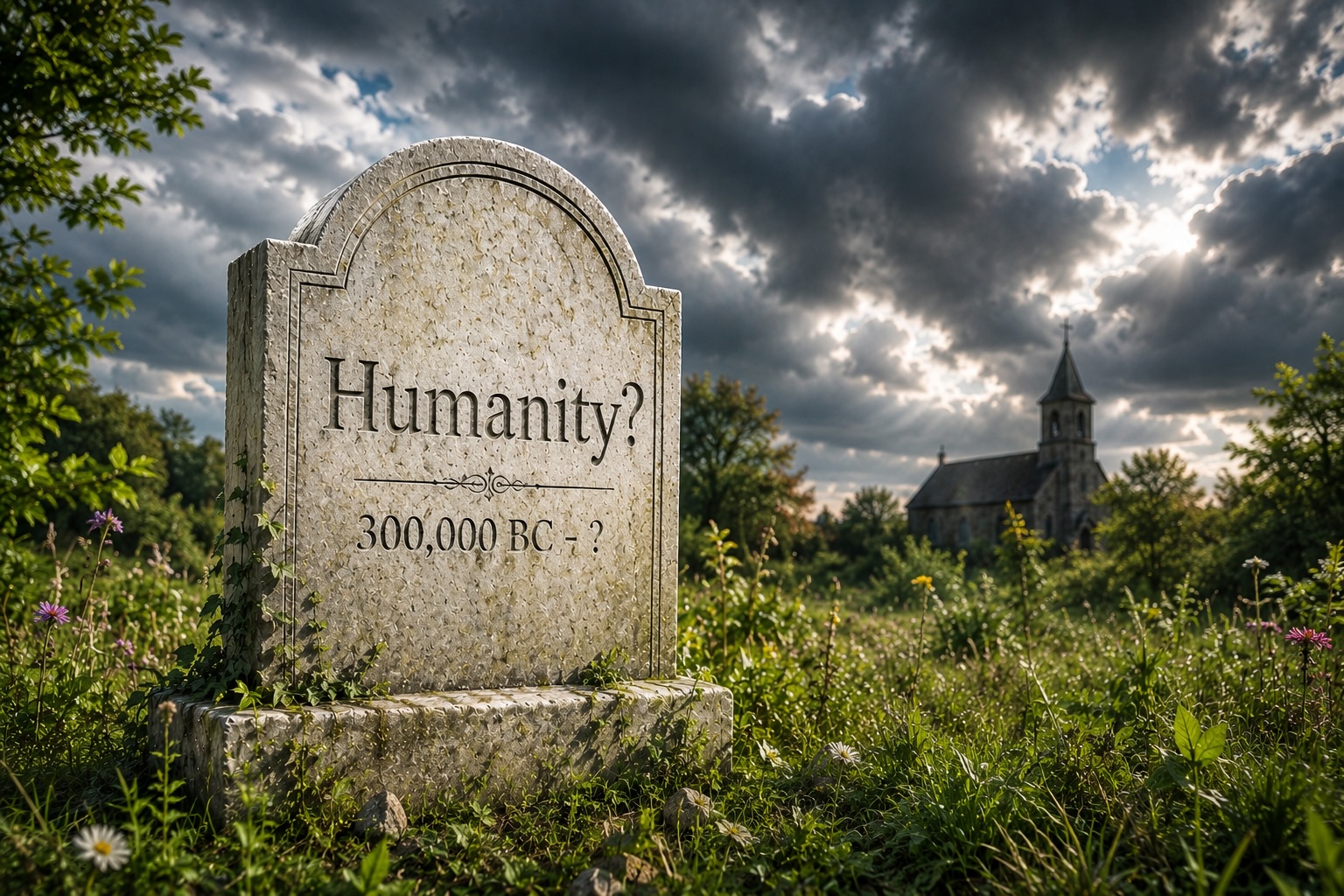
    Does this mean life is over for humanity?

    Not necessarily.

    But it does mean we have entered a new reality.

    For most of human history, our greatest challenges were each other.

    From survival with each other on the planet to:

    Empires.

    Wars.

    Borders.

    Politics.

    Economics.

    But today, a new challenge stands above them all:

    The condition of the very planet that makes civilization possible.

    If the rivers continue drying up…

    If agriculture becomes increasingly unstable…

    If ecosystems continue breaking down…

    …then every other problem becomes harder to solve.

    This is no longer just another political issue.

    It is becoming the foundation beneath every political issue.

    And that makes it something entirely different.

    A planetary emergency.

    Fighting Each Other

    Yet look at how we respond.

    We continue acting as though the greatest threat is one another.

    We argue over political parties.

    We blame other countries.

    We compete economically.

    We prepare for wars and go through with them.

    We still seem to believe that if only our side wins, everything will somehow be fine.

    But rivers do not recognize borders.

    The atmosphere does not vote.

    The oceans do not distinguish between left and right.

    Nature has never accepted our illusion of separation.

    What We Normally Do In Emergencies

    Imagine a forest fire racing toward a town.

    Do the firefighters stop to debate politics?

    Do they argue over religion?

    Do they refuse help because it comes from another country?

    Of course not.

    They gather every available person, every vehicle and every resource.

    They work together because the emergency is greater than their disagreements.

    That is what intelligent beings do.

    So why should a planetary emergency be any different?

    History Says It Isn’t Impossible

    Some people will say humanity could never unite.

    History disagrees.

    Few believed the Soviet Union would open itself through Glasnost.

    Few imagined apartheid could end with forgiveness instead of endless revenge.

    Few expected Britain to leave India after centuries of colonial rule.

    History is full of moments that looked impossible…

    …until they happened.

    Not because humanity became perfect.

    But because enough people finally realized that continuing the old way was no longer an option.

    The Hard Question

    So perhaps the question is not whether humanity can survive.

    Perhaps the question is whether our system is designed to deal with a planetary emergency.

    For thousands of years we have built civilization on the system of ownership.

    On money.

    On trade.

    On competition.

    On the pursuit of endless economic growth.

    Those foundations have brought us extraordinary technological progress.

    But have they also encouraged us to treat the planet as something to care for rather than something to exploit?

    If our civilization rewards extracting more, consuming more and competing more, should we really be surprised that the living systems supporting all of us are beginning to struggle?

    Perhaps this is why solving one environmental problem after another never seems enough.

    We are trying to repair the roof while the foundations remain unchanged.

    What About Overpopulation?

    Whenever humanity’s environmental problems are discussed, someone always arrives at the same conclusion.

    “There are simply too many of us.”

    It is true that population matters. No planet can support unlimited growth forever, and we should aim for a stable global population over time.

    But when people talk about rapidly reducing the population, the images that come to mind are not ones I want to think about.

    History has already shown us where that kind of thinking can lead.

    No.

    If we are going to do something drastic, let it be this:

    Let’s drastically redesign the way civilization operates.

    Instead of reducing people, let’s reduce waste.

    Instead of reducing people, let’s reduce pollution.

    Instead of reducing people, let’s reduce the unnecessary consumption of resources.

    Instead of asking how to make humanity smaller, perhaps we should ask how to make humanity wiser.

    Our economic system was established in an age when the planet seemed vast and its resources almost limitless. Today we know better.

    So perhaps the emergency is not that there are eight or nine or ten billion people alive.

    Perhaps the emergency is that billions of people are participating in a civilization that rewards ever-increasing extraction, consumption and economic growth on a planet with clear physical limits.

    That is a systemic design problem.

    And unlike population, a system can be changed. And population will change with it.

    If we have the courage to face reality, the most humane response to our crisis is not to cull humanity.

    It is to redesign civilization so that humanity—and the living world we depend on—can thrive together for generations to come.

    A Civilizational Transition

    This is why I don’t believe another election will solve our problems.

    Nor another war.

    Nor another economic package.

    This is not primarily a political or economic crisis.

    It is a civilizational one.

    The solution is not for one nation to defeat another.

    Nor for one ideology to defeat another.

    The solution is for humanity to begin acting as humanity.

    To recognize that we share one planet, one biosphere and one future.

    To gather our knowledge, technology, resources and compassion—not to compete against one another, but to preserve the extraordinary world that has given us life for so long.

    Because if history has taught us anything, it is that impossible changes sometimes become inevitable.

    Imagine That Future

    This is exactly what has happened in the novel, Waking Up – A Journey Towards a New Dawn for Humanity.

    Humanity has redesigned the whole system from one on endless monetary growth to to a system that supports nature and humanity forever.

    Not by becoming perfect.

    But by growing up.

    By leaving behind the illusion of separation and building a civilization designed to work for everyone—and for the planet that makes every human life possible.

    Perhaps that future begins the same way every great change in history has begun.

    With enough people daring to imagine it.

    The bewildered billionaire Benjamin Michaels wakes up one hundred years into the future expecting to expand his empire.

    Instead, he discovers that humanity finally recognized the emergency and done something about it.

    Are you curious of how the world he wakes up in looks?

    If so, you can discover his story here.

    If you believe there is still hope for humanity and think our future depends on as many as possible waking up to the possibility of a world that works for all I invite you to share this article. I thank you.

  • The Meta‑Crisis — And the World That Could Come After

    The Meta‑Crisis — And the World That Could Come After

    We hear the word crisis so often that it has almost lost its meaning.

    Climate crisis. Economic crisis. Political crisis. Mental‑health crisis. Energy crisis. Trust crisis.

    But what we are actually facing is something deeper and bigger — a meta‑crisis.

    A meta‑crisis is not one problem. It is a web of problems, all feeding each other. Climate breakdown accelerates economic instability. Economic insecurity fuels political polarization. Polarization erodes trust. Loss of trust paralyzes collective action — which in turn worsens climate breakdown.

    Each crisis amplifies the others.

    This is why so many solutions feel ineffective. We keep treating symptoms in isolation, while the underlying system continues to generate the same outcomes.

    A System Under Strain

    Our global system was built for a world that no longer exists.

    It assumes endless growth on a finite planet.

    It rewards competition over cooperation.

    It measures success in money rather than wellbeing.

    For a long time, this system appeared to work. Supermarkets were full. Technology advanced. Comfort increased — for some.

    But the costs were externalized.

    Onto other people.

    Onto future generations.

    Onto nature itself.

    Now the bill is coming due.

    The meta‑crisis is not an accident. It is the predictable result of a system designed without regard for ecological limits, psychological health, or long‑term resilience.

    A Question We Rarely Ask

    Most discussions stop here — with warnings, statistics, and projections of collapse.

    But there is another question worth asking:

    What if humanity acted in time?

    What if we recognized the pattern early enough?

    What if cooperation replaced competition as our default?

    What if technology was used to restore nature and free humans — not to extract more from them?

    What if we acknowledged something even more uncomfortable:

    That the problem was never a lack of solutions — but a lack of alignment.

    Because the truth is this:

    We already have the tools.

    We already have the science.

    We already have the productive capacity to meet everyone’s basic needs.

    We know how to generate abundant renewable energy.

    We know how to automate dangerous and repetitive labor.

    We know how to design cities around people instead of profit.

    We know how to produce more than enough food — sustainably.

    What stands in the way is not technology.

    It is the system we organize ourselves by.

    A system that requires scarcity to function.

    A system that turns necessities into commodities.

    A system that measures success in money rather than human and ecological wellbeing.

    Some visionary projects — such as those exploring resource‑based economies, like The Venus Project — have long argued that a resilient society would require something radical:

    Not reforming the monetary system — but replacing it.

    In such a model, resources are treated as the shared inheritance of humanity.

    Production is guided by real needs and ecological limits, not profit.

    Technology becomes a tool for coordination, not control.

    This is not science fiction.

    It is a different set of rules applied to capabilities we already possess.

    So the real question becomes:

    If the solutions exist — what would the future look like if we actually used them?

    A Thought Experiment

    So what would the world actually look like if we implemented all of this?

    If we treated the planet’s resources as a shared inheritance.

    If production was guided by real human needs and ecological limits.

    If a global, coordinated, resource-based economy replaced the monetary system.

    If technology was used to liberate time and creativity, not monetize it.

    What would daily life feel like?

    How would cities function?

    What would people do with their lives when survival was no longer the primary concern?

    One way to explore that question is through story.

    That is exactly what Waking Up – A journey towards a new dawn for humanity does — through the eyes of Benjamin Michaels.

    Benjamin comes from our world, at its peak – 2015.

    He was not a rebel or an outsider.

    He was a billionaire — someone who had mastered the old system. But suffered from incurable cancer. He chooses cryogenic preservation of his body in the hopes of waking up again to being healed and continue expanding his empire.

    When he wakes up one hundred years into the future, he is shocked to learn about the new moneyless world and expects collapse, chaos, or authoritarian control — the futures our imagination keeps returning to.

    Instead, he finds something else entirely.

    A world where people are thriving.

    A world where basic needs and wants are guaranteed.

    A world where cities are designed around human wellbeing and ecological harmony.

    A world where cooperation is not idealism, but infrastructure.

    Benjamin doesn’t just hear about this world.

    He walks through it.

    Questions it.

    Resists it and almost helps destroying it.

    But slowly begins to understand how humanity stepped back from the brink and started prospering.

    Not Utopia — But Maturity

    This future is not perfect.

    Nature still has momentum.

    Old damage still needs healing.

    Human emotions are still human.

    But the underlying rules have changed.

    Fear is no longer the operating system.

    Scarcity is no longer artificially enforced.

    Survival is no longer the primary driver of human behavior.

    The story does not ask us to believe that humans became saints.

    It asks a simpler question:

    What happens when humanity grows up?

    Why Stories Matter

    Facts inform.

    Stories transform.

    We already know the data.

    We already know the risks.

    What we lack is a shared image of a future worth moving toward.

    That is what the novel,Waking Up – A Journey Towards a New Dawn for Humanity explores — not as prediction, but as possibility.

    Not as ideology, but as a thought experiment and inspiration grounded in existing technology, systems thinking, and human values.

    The Quiet Invitation

    The meta‑crisis is real.

    But collapse is not the only ending available.

    Another path exists — one that does not begin with revolution or force, but with understanding, imagination, and cooperation.

    The question is not whether such a future is guaranteed.

    The question is whether we dare to imagine it — and then start acting as if it were possible.

    If this article resonates, please share it.

    Because the more people start to imagine this future the bigger chance we have of actually getting there.

    And if you want to explore one possible answer to the meta‑crisis through story rather than theory, Waking Up is available now.

  • The Great Unveiling – Awakening to the Real World

    The Great Unveiling – Awakening to the Real World

    What would actually happen if the world erased all debt overnight?

    1. The Starting Point

    Let’s start with a fact, not an opinion.

    As of 2025, total global debt is about $340 trillion — every mortgage, every student loan, every government bond, every corporate IOU combined.

    It is, quite literally, the sum of what humanity owes to itself.

    Let that sink in.

    To itself.

    How can a species owe itself money?

    How can the left hand be in debt to the right?

    The numbers are real enough on paper — but the logic behind them is absurd.

    We’ve built a global system in which humanity as a whole is perpetually indebted to… humanity as a whole.

    Meanwhile, the world’s annual GGP, Gross Global Product— the total value of everything we actually create and produce — is about $110 trillion.

    So globally we owe more than three times what we make in a year.

    We are, in effect, trying to pay ourselves with our own promises, and calling the shortfall “growth.”

    2. The Paradox of Debt-Money

    Here’s the strange truth of modern economics:

    Money isn’t printed first and then lent — it’s created by lending.

    When a bank issues a loan, it simply types numbers into an account.

    Those digits are new money, but they exist only because someone has agreed to owe them back.

    For every dollar of money, there’s a dollar of debt somewhere else. So of course, since we are constantly creating new money mostly by loans that needs to be repaid with interest which is not created, we constantly need to create new debt perpetually. If everyone repaid their loans tomorrow, almost every dollar in existence would vanish.

    The economy wouldn’t just slow down — it would cease to exist. Because money = debt.

    Debt isn’t a flaw in the system.

    Debt is the system.

    3. The Absurd Scale

    Three hundred and forty trillion dollars.

    A number so large it almost loses meaning.

    To “repay” it, we’d need about three more Earth-sized economies operating at today’s output — three planets producing, mining, farming, shipping, and consuming at full speed just to settle our existing balance sheet.

    But we have only one planet, and it’s already showing the strain: melting ice caps, depleting soils, rising seas.

    We’ve mortgaged the future to pay for the present, and even the collateral — the planet itself — is running out.

    The debt can never be repaid, because repayment would destroy the very money supply that makes repayment possible. The paradox is profound

    It’s a snake eating its own tail.

    4. The Thought Experiment

    So what if, instead of running faster on the treadmill, we simply stopped?

    What if: every government, bank, and individual agreed to wipe the slate clean — erase all debt at once?

    Technically, it would be easy.

    After all, when a bank issues a loan, it simply types numbers into an account.

    Those digits appear from nowhere, authorized by nothing more than confidence in the story.

    And just as easily as they’re created, they can be erased.

    The same keyboard that made them has another key — 

    backspace.

    Press it once for a typo.

    Press it a few more times, and the world is debt-free.

    Thus: the so-called global “debt crisis” is nothing more than a collection of keystrokes. 

    The difficulty isn’t technical. 

    It’s psychological.

    The moment those numbers disappear, the story humanity believes about itself — the story of credit, ownership, and fake obligation — vanishes with them.

    For a few hours, maybe days, the world would panic.

    Markets would freeze. Banks would have no assets. Governments would have no bonds.

    It would look like collapse.

    But collapse of what, exactly?

    5. What Would Still Exist

    Would the roads disappear?

    Would the houses crumble?

    Would the hospitals and schools evaporate?

    Would the oceans stop moving or the sun fail to shine?

    No.

    Every physical thing humanity has built and nature has created would still be there:

    every bridge, every farm, every power plant, every tool, every ship.

    The forests, the animals, the wind and rain — all still exactly as before.

    The real world would remain completely intact.

    The only thing missing would be the numbers we used to measure it.

    That’s the realization: the “economy” we thought sustained us was only a layer of code floating above what was real.

    When the code is erased, the world itself doesn’t vanish

    — it appears.

    6. The Great Unveiling

    That’s the unveiling — the moment when the illusion drops and we see what was always there.

    The money world was never the world.

    It was a veil — a story of ownership drawn over nature, over work, over life itself.

    When that story ends, nothing real is lost.

    In fact, reality becomes visible again.

    The forests keep breathing.

    The clouds still drift and drop rain.

    Birds still fly, insects still hum, whales still cross the oceans.

    People still wake up, stretch, laugh, argue, cook, and create.

    All of it continues as if nothing happened — because to the real world, nothing did.

    7. Seeing the Illusion for What It Was

    Imagine standing in a field the morning after the Great Erasure.

    The banks are silent, the stock tickers blank, but the sun still warms your skin.

    You realize how strange it was to think that this — sunlight, air, grass, breath — could ever be “priced.”

    The absurdity becomes obvious: we built a system that claims ownership over everything that already belongs to life.

    We invented scarcity in the middle of abundance. Saying only those with enough numbers in their accounts would have an abundance of time to really enjoy life.

    We called debt wealth and competition progress.

    We covered the real world with a mirage of money — and then forgot it was a mirage.

    And yet, beneath that mirage, everything real has been patiently waiting.

    8. What Happens Next

    At first, confusion.

    If no one owns anything, who decides?

    But slowly, reason returns.

    People realize they don’t need permission to use what already exists. 

    Food still grows. Tools still work. Knowledge still lives in every mind. We can peacefully agree to create abundance for all.

    Communities reorganize — not around money, but around contribution, skill, and trust.

    Value shifts from possession to participation.

    Humanity begins to live again as nature does — through exchange without debt, through cycles of giving and renewal.

    9. The Realization

    The true catastrophe isn’t the collapse of the money world — it’s that we mistook it for the real one.

    The true awakening is realizing the world doesn’t need to be rebuilt — only remembered.

    Everything that matters survives the erasure:

    the land, the oceans, the people, the animals, the insects, the sky, the sun.

    When the numbers vanish, what remains is life — unpriced, unowned, unending.

    10. The Invitation

    This is the Great Unveiling: not the end of civilization, but the end of its disguise.

    A collective seeing — that the wealth of the world was never in banks, but in being.

    Step outside.

    Feel the ground.

    Everything real is still here.

    The world is Waking Up.

    Are you?

    Follow the former billionaire Benjamin Michaels as he wakes up in a world where this has already happened. Shaken and shocked he staggers out of the hospital where he has been sleeping for a century, only to find his old world of money and numbers completely vanished… Only the real world remains.