
Politics here. Climate change there. Poverty, inequality, corruption, unemployment, immigration, taxation, and war. Everywhere we look, people are arguing about the problems of our world. And almost everywhere, money is involved.
Money here. Money there. Taxes. Not enough money. Too much money. Money in the wrong hands. Money that must be raised, borrowed, invested, redistributed, or saved.
For thousands of years, humanity has become so accustomed to money that we barely notice its presence anymore.
But what if we have been looking at our problems from the wrong perspective all along?
What if the greatest problem is something so familiar that we have become almost incapable of recognizing it?
The Surface
Every day, millions of people discuss the problems of our civilization. On television, in newspapers, on social media, and around dinner tables, we argue about what is wrong with the world and who is responsible.
And there is certainly no shortage of people to blame.
Politicians. Billionaires. Corporations. Governments. Immigrants. Environmentalists. Capitalists. Socialists. The rich. The poor.
Everyone seems to have an explanation, and many explanations are remarkably simple.
The politicians are corrupt. The billionaires are greedy. Climate change is a hoax designed to collect more taxes. Immigrants are taking our jobs. The poor are lazy. The rich are exploiting everyone else.
Simple explanations for enormously complicated problems.
And people love them.
Why? Because they are easy to understand. They require very little investigation, and they often confirm something we already believe.
We read a headline, recognize something that fits our worldview, and conclude that we have understood the issue.
Why bother digging any deeper?
The Simplification
Recently, I came across a discussion on social media about climate change. The original newspaper article was considerably more nuanced than the dramatic headline being shared.
THE CLIMATE FIGHT IS DEAD
But the headline was enough.
People immediately began arguing about taxation, political agendas, and whether climate change was even real.
The complexity of the original article had largely disappeared. What remained was a collection of simplified arguments, many of which seemed to have little to do with the actual condition of our planet.
And this is hardly unique to climate change.
We see it everywhere.
Complicated economic and social problems are reduced to slogans, accusations, and convenient explanations. The easier an argument is to understand, the easier it becomes to repeat.
And repetition can make an argument feel true, even when the evidence is weak.
This doesn’t necessarily mean people are unintelligent. Sometimes they simply don’t want to spend the time and effort required to investigate something more deeply.
After all, if an explanation already seems convincing, why question it?
But perhaps we should.
Digging Deeper
Fortunately, some people do investigate.
Journalists, researchers, whistleblowers, and ordinary citizens sometimes refuse to accept the explanations presented to them.
They dig.
And occasionally, they uncover something spectacular.
Corruption. Fraud. Bribery. Embezzlement. Tax evasion. Secret financial arrangements. Politicians accepting money in exchange for favors. Corporations deliberately deceiving the public to protect their profits.
And people love these revelations!
Another scandal! Another corrupt politician exposed! Another billionaire caught cheating! Another corporation forced to pay an enormous fine!
The newspapers have a field day. Social media explodes with outrage. People demand justice.
And sometimes justice is served.
The guilty are punished, new regulations are introduced, and everyone congratulates themselves on having uncovered yet another rotten part of society.
But have we really reached the bottom?
Or have we merely discovered another layer?
The Wrongdoing
Notice something interesting about most financial scandals.
The outrage is generally directed at people who have used money in the wrong way.
They have broken the rules of the monetary system.
They have stolen money, hidden money, manipulated money, or used money to gain influence they were not supposed to have.
And naturally, we want them stopped and punished.
But what happens next?
We introduce new laws, stricter regulations, greater transparency, and stronger enforcement.
In other words, we try to prevent people from misusing money so that the monetary system can continue functioning as intended.
We investigate the people who break the rules of the system, but rarely question the system itself.
And even when nobody breaks the law, the system can still reward activities that damage the environment, encourage overconsumption, or place financial interests ahead of human needs.
Perfectly Legal
An activity can be perfectly legal, highly profitable, and socially and environmentally destructive at the same time.
This is where the investigation becomes particularly interesting.
Because perhaps the greatest problem isn’t how certain people misuse money.
Perhaps it is what money makes us do even when we use it exactly as intended.
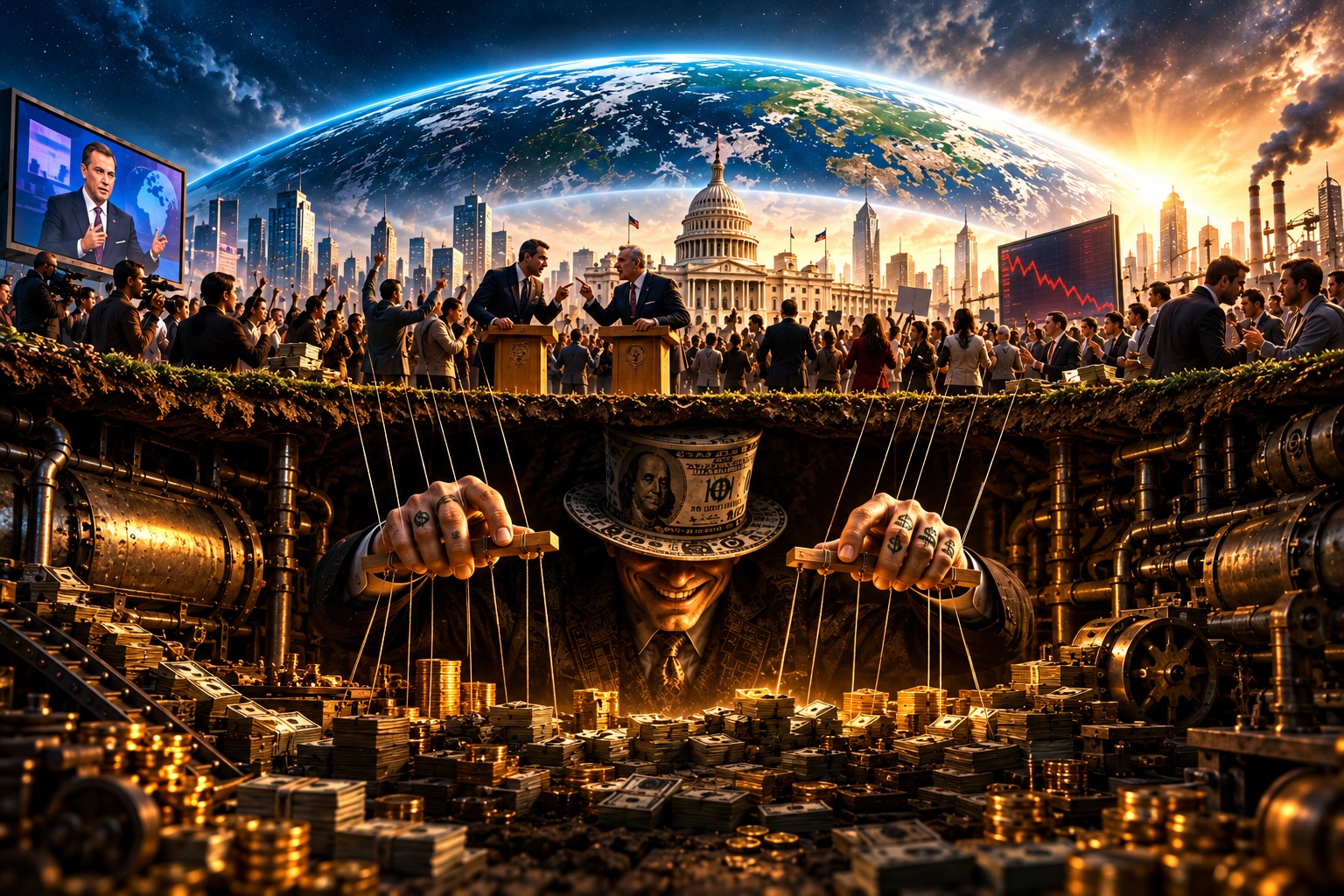
The Political Circus
And then, of course, we have the politicians.
The stars of the greatest show on Earth.
Every day, they provide us with something new to discuss. Another outrageous statement. Another political scandal. Another broken promise. Another election. Another politician who supposedly knows how to fix everything.
And the audience is captivated.
We cheer for our favorites, ridicule their opponents, argue with friends and strangers, and convince ourselves that everything will be better once the right people are in charge.
But in charge of what, exactly?
The monetary system.
Regardless of which political party wins an election, the fundamental structure generally remains the same. Governments must balance budgets, stimulate economic growth, attract investments, create jobs, collect taxes, and manage public debt.
Some politicians want higher taxes. Others want lower taxes. Some want more government spending. Others want less. Some want to redistribute wealth, while others want to encourage its accumulation.
And these differences can have very real consequences for people’s lives.
But notice what they have in common.
They are all arguing about how to operate the same underlying system.
Almost nobody is questioning whether we need that system in the first place. And whether it is actually serving humanity and Earth towards the best possible civilization we can have.
And this is where the political circus becomes such a convenient distraction.
While millions of people argue about the performers on the stage, the machinery behind the stage continues operating.
The audience becomes so preoccupied with deciding which politician is the hero and which is the villain that it rarely questions the theater itself.
And perhaps that is the greatest irony of modern politics.
We believe we are deciding the future of civilization by choosing who should manage the monetary system, while the possibility of replacing that system remains almost entirely outside the discussion.
The politicians don’t even need to be consciously distracting us.
The spectacle does that perfectly well on its own.
The Demon
And somewhere beneath the stage, our little demon is smiling.
“Wonderful! Keep watching the clowns. Don’t look behind the curtain.”
The Invisible Master
Imagine a master of disguise who has been living among us for thousands of years.
He has become so familiar that nobody suspects him anymore.
He is everywhere.
In our homes, our workplaces, our minds, our governments, our schools, our hospitals, and our relationships.
He influences what we produce, what we consume, where we live, what we do for a living, and what opportunities we have.
He determines which projects are considered viable and which are abandoned.
He can make destroying a forest seem perfectly sane in the light of profit while protecting it is considered too expensive.
He can make food inaccessible to hungry people, even when an abundance of food exists.
He can leave houses empty while people sleep on the streets.
And he can make technological advancements that should liberate humanity appear threatening because they might eliminate people’s jobs and incomes.
Yet almost nobody recognizes him as the underlying problem.
Because he has disguised himself as something indispensable.
Something natural.
Something civilization supposedly cannot function without.
His name?
The Monetary System.
The Perfect Disguise
The monetary system has accomplished something extraordinary.
It has convinced us that we need money to solve problems that was created by money in the first place.
We need money to fight poverty.
We need money to protect the environment.
We need money to feed the hungry.
We need money to provide housing.
We need money to develop technology that could make all these things easier.
And when there isn’t enough money, we conclude that these things simply cannot be done.
But consider what this actually means.
We live on a planet with an abundance of physical resources, knowledge, technology, and billions of capable human beings.
The planet doesn’t demand payment for any of its resources. Nature doesn’t issue invoices.
We have created the prices, the financial obligations, the ownership structures, and the rules governing access.
And then we have become so accustomed to those arrangements that we confuse them with reality itself.
A shortage of money is not necessarily a shortage of resources.
A lack of profitability is not necessarily a lack of usefulness.
And something that cannot be afforded is not necessarily something that cannot be accomplished.
These are fundamentally different things.
Yet we routinely treat them as though they were the same.
That is the disguise.
The Smiling Demon
Now imagine our master of disguise as a little demon sitting far beneath the surface of civilization.
Above him, humanity is arguing furiously.
Politicians are blaming other politicians. Billionaires are blaming governments. Governments are blaming economic circumstances. Citizens are blaming corporations. Corporations are blaming regulations.
Investigators are digging everywhere, exposing corruption and wrongdoing.
And every time someone uncovers another scandal, the demon smiles.
“Excellent! They’ve found another villain.”
The public becomes outraged. The guilty are condemned. New laws are passed.
And the demon smiles again.
“Wonderful! They’re fixing my rules.”
Then everyone returns to arguing about taxes, budgets, prices, profits, and economic growth.
And the demon laughs.
“They’ll never think to question me.”
Of course, there is no actual demon.
The monetary system has no consciousness, no evil intentions, and no secret plan.
It is a human invention.
And that is precisely what makes the disguise so remarkable.
We have created a system that now appears to govern its creators.
The Real Question
What would happen if we continued digging?
Not merely into the corruption, the greed, the inequality, or the environmental destruction, but into the economic structure that influences so much of human behavior?
What if we stopped asking only how money should be distributed and started asking why we need money to distribute resources at all?
What if we stopped asking how to create enough jobs and started asking how technology could free us from the necessity of working for survival?
What if we stopped asking how to make environmental protection profitable and started organizing production and consumption according to ecological reality?
What if we stopped treating the Earth as property to be bought and sold, and started treating it as a shared home to be cared for?
These questions lead somewhere very different from the usual political arguments.
They lead toward a resource-based civilization organized around collaboration, sharing, and stewardship rather than money, trading, and ownership.
A civilization in which access to goods and services is based on needs and available resources rather than purchasing power.
A civilization in which artificial intelligence and automation help humanity manage resources intelligently, reduce waste, and provide a high standard of living for everyone.
Not a world without challenges, disagreements, or difficult decisions.
But a world in which we no longer have to make everything financially profitable before we consider it worth doing.
The Unmasking
For thousands of years, humanity has lived with monetary systems in one form or another.
We have changed currencies, governments, laws, institutions, and economic policies.
We have overthrown rulers, fought revolutions, exposed corruption, and demanded fairer distributions of wealth.
Yet the fundamental assumption has largely survived.
That money is necessary.
That trading is necessary.
That ownership of the Earth’s resources is necessary.
But what if these are not eternal truths?
What if they are merely conventions that humanity has become accustomed to?
And what if our rapidly advancing technology is finally making it possible to organize civilization in an entirely different way?
Perhaps the master of disguise is not quite as invisible as he once was.
Perhaps some people have begun to recognize him.
Perhaps they have started asking questions that go deeper than the familiar arguments about who should have more money, who should pay more taxes, and who should control the economy.
And perhaps, for the first time in human history, we are approaching a point where we have the technological capacity to seriously consider leaving the monetary system behind.
Deeply Embedded
The greatest disguise is not one that makes something disappear.
It is one that makes something so familiar that nobody thinks to question its existence.
Money has become so deeply embedded in our understanding of civilization that we struggle to imagine civilization without it.
We see the corruption. We see the inequality. We see the environmental destruction. We see the poverty, the competition, and the conflicts.
And we keep trying to solve these problems within the very structure that helps perpetuate them.
But perhaps the time has come to look beneath the surface.
To question not merely the people who operate the system, but the system itself.
Because the monetary system is not a law of nature.
We invented it.
And we can choose to replace it.
The master of disguise has been hiding in plain sight all along.
But a disguise only works as long as nobody recognizes it.
⸻
What might happen when humanity finally begins to see beyond money?
The novel, Waking Up: A Journey Towards a New Dawn for Humanity, explores precisely that possibility through the story of Benjamin Michaels, a bewildered billionaire who awakens after a hundred years to discover a civilization that has abandoned money, trading, and ownership in favor of collaboration, sharing, and stewardship.
Leave a Reply