
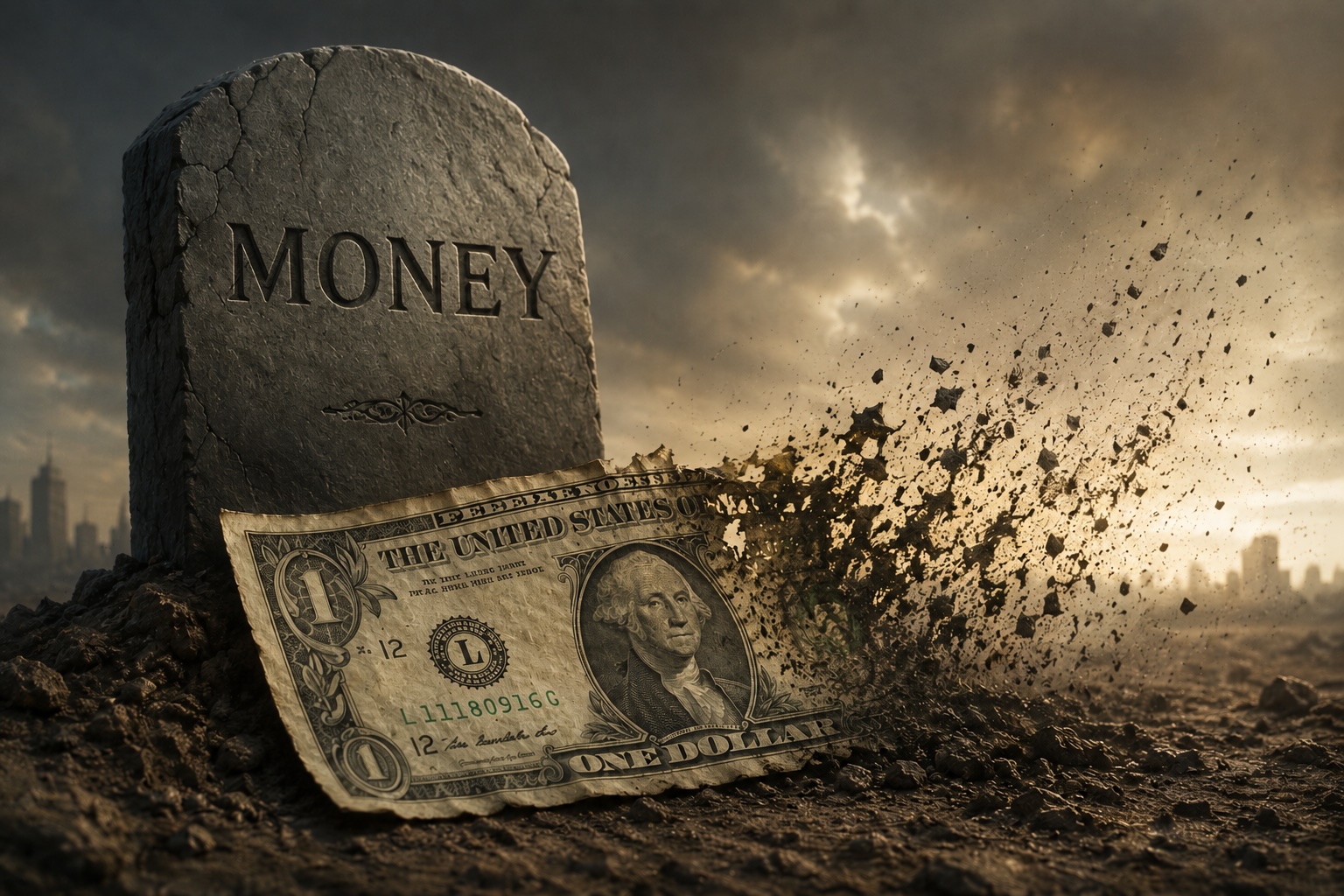
It’s an almost apocalyptic title.
The kind of title that immediately makes you think of empty supermarket shelves, closed banks, worthless banknotes and a world descending into chaos.
Because if money dies…
…what happens to us?
The Book
That is the question at the heart of The Death of Money, a fascinating book by economist, investment banker, lawyer and bestselling author James Rickards(74). Throughout his career, Rickards has advised governments, major financial institutions and even the U.S. defense and intelligence communities on financial risk, economic warfare and the international monetary system.
When someone with that background writes a book with a title like The Death of Money, it is worth paying attention.
Reserve Currency
Rickards argues that the international monetary system has become increasingly fragile. The U.S. dollar has served as the world’s reserve currency since the end of the Second World War, becoming the foundation of international trade and finance.
Confidence
But that foundation rests on something surprisingly fragile.
Confidence.
The only value money possesses comes from only this one thing:
Our confidence in it.
Not from gold.
Not from silver.
Not from the numbers displayed in our online bank accounts.
Not even from the paper it is printed on.
Confidence.
That is all.
The moment that confidence disappears…
…so does the value of the currency.
That simple observation changes everything.
Growing debt, relentless fiat money creation, financial crises, geopolitical tensions, currency wars and increasing challenges to the dollar all place pressure on that confidence. Rickards argues that if confidence in the dollar(or other currencies for that matter) is seriously undermined, the consequences could spread throughout the entire international monetary system because no obvious replacement is waiting in the wings.
Whether or not every prediction unfolds exactly as he expects is almost beside the point.
His book forces us to confront a question most of us never ask.
What happens if that confidence is lost?
The Warnings
Rickards is far from alone.
For years, warnings have come from every direction. The LaRouche movement has long argued that the financial system is fundamentally unstable. Mainstream economists warn about unsustainable debt. Investors warn about bubbles. Governments quietly prepare for financial crises. Newspapers speak of inflation, banking instability, currency wars, de-dollarization, recession and geopolitical conflict.
Different people describe different threats.
Different people propose different solutions.
Yet beneath all the disagreement lies the same uncomfortable feeling.
Something doesn’t feel right.
Something feels increasingly fragile.
Perhaps that explains why The Death of Money resonates with so many readers.
It gives a name to a fear that many people already carry.
The Disaster
Now imagine the warnings are right.
Not every detail.
Not every prediction.
But the central concern.
Imagine confidence suddenly evaporates.
Banks close.
Markets crash.
Currencies collapse.
Savings lose their value.
Governments panic.
Television screens fill with the words nobody ever wanted to hear.
Financial collapse.
Currency collapse.
Economic emergency.
The death of money.
Fear spreads around the world.
Because for centuries we have quietly come to believe that money is civilization itself.
Without money…
there is no food.
No products.
No joy.
No work.
No fun.
No future.
No survival.
One question suddenly becomes more important than every other.
What shall we do??
The Illusion
Will we die??
No.
Because money has never fed anyone.
Money has never grown a single grain of wheat.
Money has never purified a single drop of water, or made it rain.
Money has never generated electricity.
Money has never built a home.
Money has never healed a patient.
Money has never made a movie.
Money has never created wealth.
People do those things.
Nature provides the resources.
Technology transforms those resources.
Human knowledge makes it all possible.
Money has only organized access to them.
It has only kept score.
Somewhere along the way we forgot the difference.
We stopped seeing money as a tool.
We started seeing it as reality itself.
Money became sacred.
Question governments and people will argue with you.
Question capitalism and people will argue with you.
Question socialism and people will argue with you.
Question banks and people will argue with you.
Question money itself…
…and many people think you’ve lost your mind.
That is how deeply the illusion has taken hold.
The Reality
Imagine every currency disappeared tomorrow.
What would actually disappear?
Would the forests disappear?
Would the rivers disappear?
Would fertile farmland disappear?
Would power stations disappear?
Would hospitals disappear?
Would engineers suddenly forget how to build?
Would doctors suddenly forget how to heal?
Would farmers suddenly forget how to grow food?
Of course not.
The real wealth of humanity would still be here.
The Earth would still be here.
Its resources.
Its ecosystems.
Its energy.
Its knowledge.
Its technology.
Its people.
Everything that actually sustains life would remain.
Only the accounting system would have disappeared. And instead of the very unfair accounting system based on confidence in money, our accounting system could simply be based on confidence in each other, technology and Earth itself. Confidence that the Earth provides, technology can optimize and distribute it, and confidence in our own conscience, only taking what we need.
Money has never been wealth.
It has only represented wealth.
The map is not the territory.
The receipt is not the meal.
The price tag is not the product.
And money is not wealth.
A New World
James Rickards asks us to contemplate the death of money.
I think he is asking exactly the right question.
Because once we stop asking how to save money…
…we can finally begin asking how to organize the real wealth of this planet directly.
How do we organize food?
Water?
Energy?
Housing?
Healthcare?
Education?
Knowledge?
Technology?
Without depending upon an accounting system whose only value comes from our collective confidence in it.
If confidence is what gives money value…
…perhaps confidence itself is the real currency.
The only remaining question is where humanity chooses to invest it.
In paper.
In numbers.
In financial markets.
Or in ourselves.
In science.
In technology.
In the Earth.
In stewardship instead of ownership.
In the extraordinary abundance of this planet.
And in each other.
Maybe the death of money is not the death of our world, but rather the birth of a new one…
And this world is exactly the one explored in the novel Waking Up: A Journey Towards a New Dawn for Humanity. It is a novel, not describing yet another post-apocalyptic dystopian future, but rather a future protopia, a world that that works for all and is constantly being improved.
Join the bewildered billionaire Benjamin Michaels as he wakes up one hundred years into the future expecting to expand his empire.
Instead, he discovers something he never imagined possible.
Money is gone.
Ownership is gone.
Yet humanity has never been wealthier.
Not because it created even more money.
But because it finally learned to organize the real wealth of the Earth itself.
Perhaps the death of money will turn out to be the best thing that ever happened to humanity…
Leave a Reply