
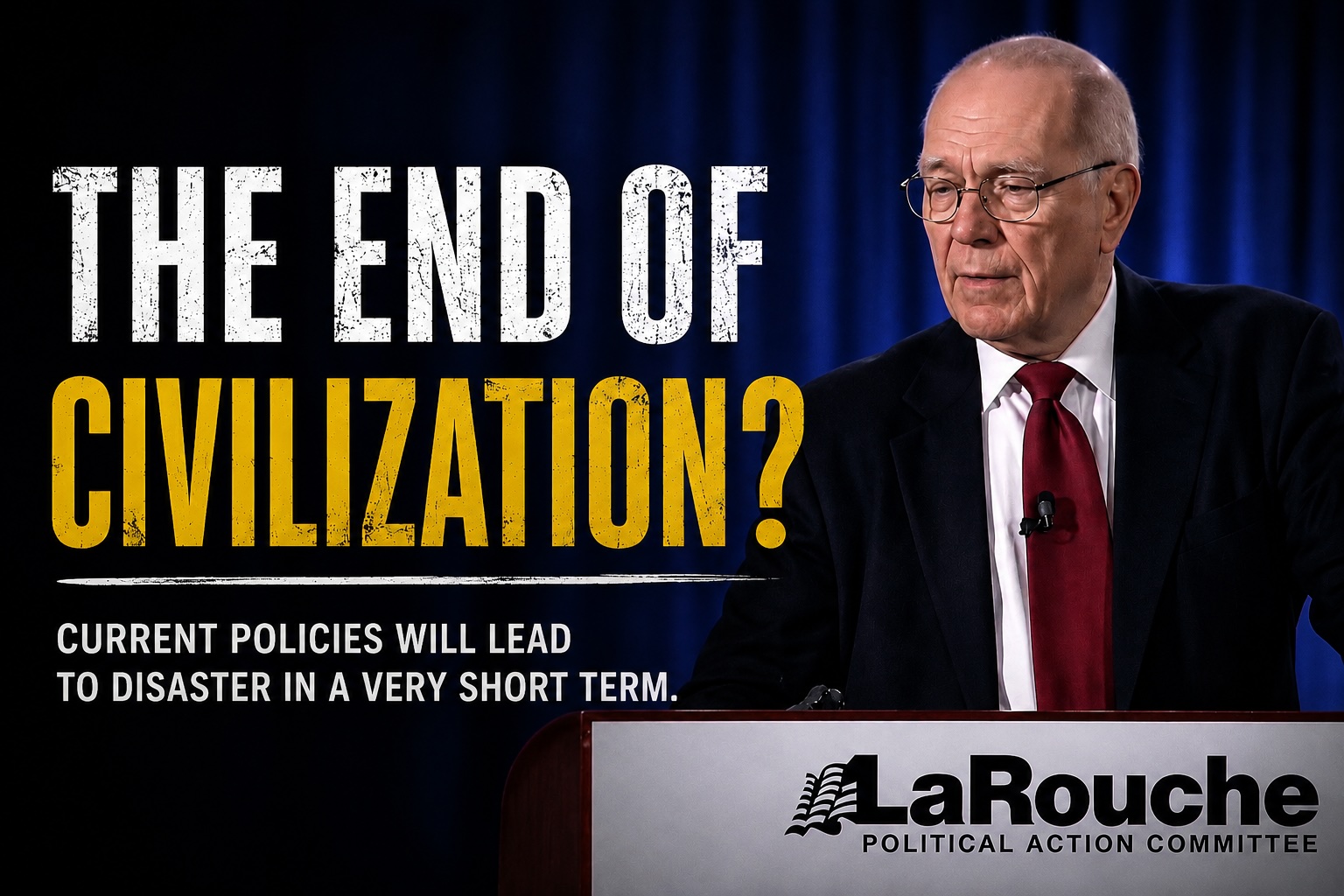
“We have to understand that we are now at the end of civilization.”
Those words were spoken by Lyndon LaRouche in 2008. He warned that the policies being pursued in the United States and Europe were leading humanity towards a global disaster in the near future.
I am not interested here in defending LaRouche’s politics, his economic proposals, or his particular predictions.
But that sentence interests me.
The end of civilization
Because when we hear those words, we instinctively imagine catastrophe.
Cities in ruins. Institutions collapsing. Supply chains breaking down. War, hunger, chaos. Perhaps even the extinction of humanity itself.
But there is another possibility.
What if we really are approaching the end of civilization as we know it?
And what if that is a good thing?
What if what is ending isn’t civilization at all, but an extraordinarily primitive way of organizing it?
Perhaps the end of civilization as we know it could finally become the beginning of civilization as it ought to be.
Are we civilized?
We call ourselves civilized.
It is worth asking why.
We have magnificent cities. We have universities, governments, courts, hospitals, museums and concert halls. We have satellites circling the planet and machines exploring other worlds. We have mapped the human genome. We communicate across continents instantaneously. We have developed artificial intelligence capable of processing amounts of information no individual human could comprehend.
Technologically, our achievements are astonishing.
But technology and civilization are not the same thing.
Imagine describing humanity to an intelligent extraterrestrial visitor without using the word civilization.
There are more than eight billion members of the same species living on a small planet.
They have divided the planet into approximately 200 territories and drawn imaginary lines between them. They compete for resources. They maintain enormous military organizations to defend those lines and their respective interests. Some possess enough weapons to destroy entire cities within minutes.
Members of the species regularly kill other members of the species because they belong to different nations, religions, ethnic groups, political movements or economic interests. Is this truly civilized? Not in my eyes.
Using massive amounts of resources to “defend” one country and attack others only to “secure resources” is not civilized to me. Rather, it is the peak of human stupidity, as instead of doing that we could rather communicate and optimize all resources to the benefit of everyone and thus avoid war completely. Create paradise…?
Meanwhile, access to virtually everything people need to survive is mediated through an artificial accounting system called money.
Food can exist while people remain hungry because they cannot afford it.
Homes can stand empty while people sleep on the street.
Medicine can exist while sick people cannot obtain it.
Useful products can be destroyed because distributing them would not be profitable.
People can be prevented from contributing their abilities because nobody can afford to employ them or they don’t fit in.
Entire industries depend upon persuading people to consume more, replace things sooner and continually increase economic activity, while the physical planet supplying the resources for that activity remains finite and is depleting.
And somehow we have decided that this is civilization.
Perhaps we should reconsider the definition.
Organized madness
The strange thing about our world is that much of its madness isn’t caused by a lack of intelligence.
It is caused by intelligent people operating within systems whose incentives produce vastly unintelligent outcomes.
A corporation can understand perfectly well that endless material extraction and consumption cannot continue indefinitely on a finite planet while simultaneously being compelled to pursue increased sales.
A government can understand that war is catastrophic while simultaneously spending billions preparing for it because other governments are doing the same.
Individually, these decisions can make sense within the rules of the system.
Collectively, they become madness.
That is one of the defining contradictions of our “civilization”.
We have created a system in which rational behavior within the system by individual participants can produce irrational outcomes for humanity as a whole.
And then we spend enormous amounts of effort trying to repair the consequences without questioning the underlying structure producing them.
We redistribute some money.
We regulate some pollution.
We negotiate another treaty.
We impose another sanction.
We create another subsidy.
We hold another climate conference.
We elect another government.
We adjust interest rates.
We increase or decrease taxes.
We move the pieces around the board.
But the board remains.
Let it end
So when somebody tells me that civilization as we know it may be approaching its end, my reaction is not necessarily despair.
Part of me thinks:
Good.
Let the madness end.
Not humanity.
Not our accumulated knowledge.
Not nature.
Not science.
Not technology.
Not medicine.
Not art, music, literature, architecture or culture.
Not friendship, love, curiosity, exploration or everything beautiful human beings have created.
Keep all of that.
Let us preserve the extraordinary achievements of humanity and finally abandon the primitive structures that keep turning those achievements against ourselves.
Let the endless economic competition end.
Let artificial scarcity end.
Let the insane waste end.
Let the obsession with perpetual growth end.
Let the exploitation of people and nature end.
Let the hoarding for the sake of hoarding end.
Let the idea that another human being must lose for me to win end.
And, above all, let us stop killing each other.
Surely that should be the minimum requirement for a species calling itself civilized.
Growing up
Human civilization is remarkably young.
For most of our existence we lived in small groups struggling against scarcity, disease, predators, weather and one another.
Competition was understandable.
Hoarding could mean survival.
Territory mattered enormously.
Resources were difficult to locate, extract, process and transport.
Information moved slowly.
Production required enormous amounts of human labor.
Our economic systems developed under those conditions.
But those conditions have changed.
We now have global communications, advanced automation, robotics, renewable energy, artificial intelligence, sophisticated resource monitoring, global transportation networks and the ability to coordinate human activity on a planetary scale.
For the first time in history, humanity is developing the technological capacity to ask a completely different question.
Not:
How do I secure enough for myself?
But:
How do we organize Earth’s resources so everyone can live well within the ecological limits of the planet?
That is a civilization-level question.
And we are still trying to answer it with institutions largely designed for competition based on the time we lived in tribes.
Perhaps that is the transition we are actually facing.
Not capitalism versus socialism.
Not left versus right.
Not rich versus poor.
Not one country against another.
Something much larger.
A transition from humanity competing over the planet to humanity consciously managing the planet together.
There is no money.
There is no trading.
There is no ownership of Earth’s resources.
There is only stewardship.
People no longer spend their lives competing for the financial means to survive.
Resources are managed according to availability, sustainability and need. Technology and automation are used deliberately to reduce unnecessary human labor rather than threatening people’s livelihoods.
The civilization he knew is gone.
And that is precisely the point.
Humanity survived its end.
People didn’t disappear.
Cities didn’t disappear.
Technology didn’t disappear.
Creativity didn’t disappear.
Human creativity didn’t disappear.
Life didn’t disappear.
Only the madness disappeared.
And what emerged in its place was not the end of civilization.
It was its beginning.
Civilization
Maybe we have been using that word far too generously.
A technologically advanced society is not necessarily civilized.
A society wealthy on money is not necessarily civilized.
A powerful society is not necessarily civilized.
A society capable of building nuclear weapons, manipulating financial markets and producing billions of disposable products is certainly sophisticated.
But civilized?
I would reserve that word for something more meaningful.
A civilization should be capable of ensuring that everyone has what they need while respecting the ecological boundaries of the planet that sustains them.
A civilization should use knowledge for the benefit of everyone.
A civilization should regard resources as something to steward intelligently rather than prizes to capture.
A civilization should make cooperation easier than exploitation.
A civilization should allow human beings to develop their abilities without forcing them to compete for the right to exist.
And a civilization should have learned something so elementary that a child can understand it:
We do not kill each other.
That would be a civilization worthy of the word civilized.
Perhaps we are approaching the end of civilization as we know it.
I hope we are.
Because civilization as we know it has given us extraordinary things, but it has also brought us to a point where our technological power is growing faster than our collective wisdom.
Continuing indefinitely along the same path that we are on is not progress.
It is insanity.
So.
Perhaps our task is not to save civilization as we know it.
Perhaps our task is to save humanity from civilization as we know it.
To preserve everything worth preserving, abandon everything that no longer serves us, and finally build a system designed around the reality that there is only one humanity sharing one planet.
No enemies required.
No winners and losers required.
No endless struggle for survival required.
Just human beings finally learning to live together like the civilized people we have always claimed to be.
If that is the end of civilization, I welcome it.
Because maybe, finally, we can stop all this madness.
And begin a real civilization that works for everyone.
The Beginning
This is the world explored in Waking Up – A Journey Towards a New Dawn for Humanity which is one vision of what that beginning could look like.
The bewildered billionaire Benjamin Michaels goes to sleep in our civilization.
When he awakens a century later, almost everything he regarded as fundamental to society has disappeared.
Cooperation has replaced economic competition as the organizing principle of society.
To Benjamin, this initially seems impossible.
But then he finds out…
:::
Leave a Reply