
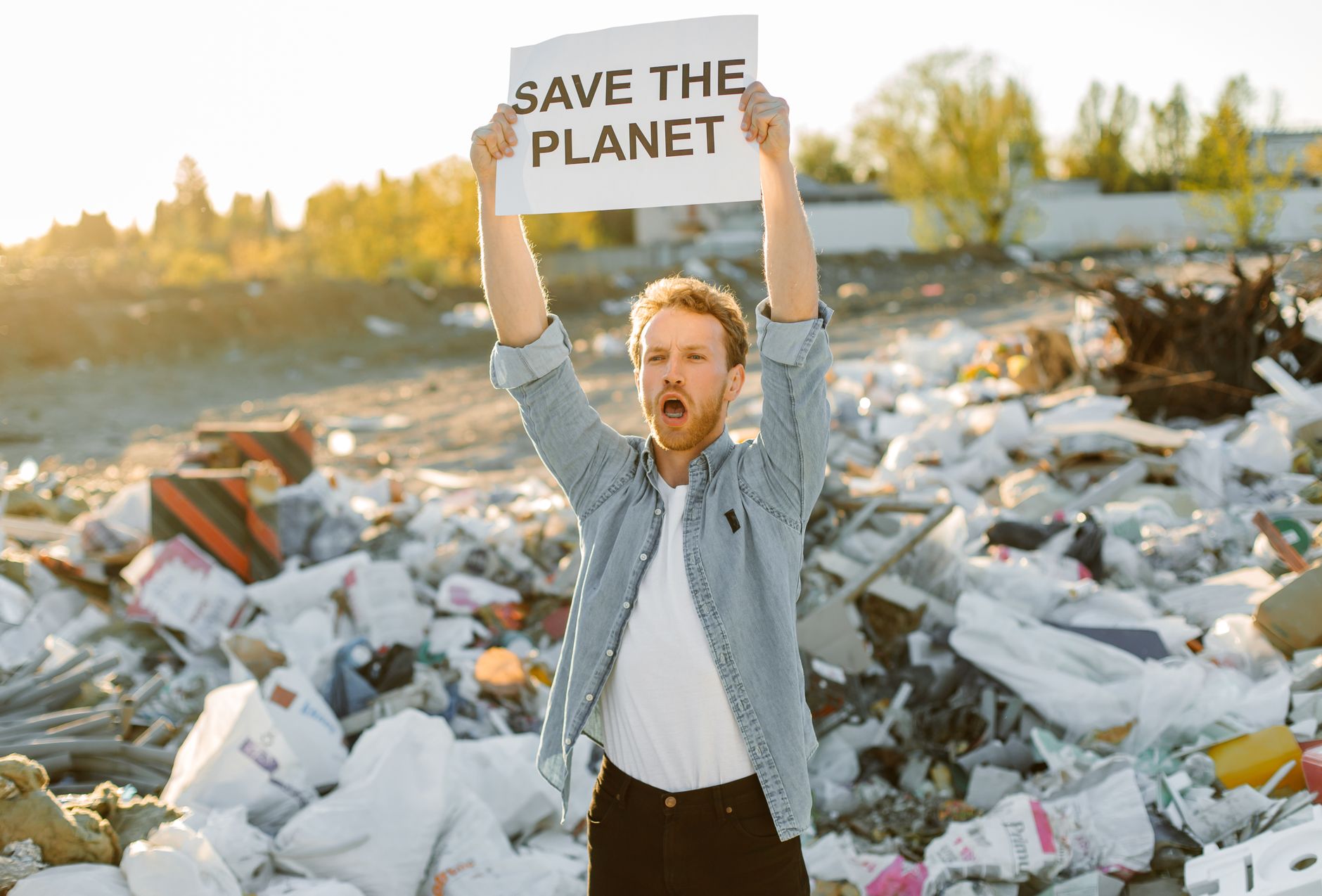
Once again, world leaders are gathering at a climate summit to discuss the future of our planet.
At COP31 in Turkey, representatives from around the world are trying to find ways to reduce greenhouse gas emissions and move away from fossil fuels.
And the urgency could hardly be greater.
The year 2026 is shaping up to be among the hottest years ever recorded, following a succession of extraordinary global temperature records. Glaciers are retreating, ice sheets are losing mass, oceans are warming, and sea levels continue to rise.
Heatwaves, droughts, wildfires, floods, and extreme rainfall are affecting communities and ecosystems around the world. And although nobody knows exactly how warm 2027 will be, the underlying trend is unmistakable.
Humanity has been releasing enormous quantities of greenhouse gases into the atmosphere the last century, primarily through the burning of coal, oil, and natural gas.
This is hardly news.
The consequences have been understood for decades.
Yet fossil fuels continue to power much of the world’s transportation, industry, agriculture, and energy production. It is the culprit of global warming, there is no doubt about it.
And so, once again, the world’s leaders are gathering to find a way out of fossil fuels.
This morning, I was listening to a news report from Swedish Radio about the climate summit. The reporter explained that representatives from around the world were meeting to find ways away from fossil fuel consumption.
But something else in the report caught my attention.
According to climate researcher Mattias Fridahl, concerns about jobs, competitiveness, and economic growth are slowing the transition away from fossil fuels.
Think about that for a moment.
Humanity knows that burning fossil fuels is destabilizing the climate of our planet.
We know that we must change direction.
The Profitability Paradox
Yet we hesitate because we are concerned about economic competition and monetary growth.
Countries worry about losing their competitive advantages. Industries worry about profitability. Governments worry about unemployment, falling tax revenues, and declining economic growth.
And understandably so.
Because within the monetary system, these are very real concerns.
But consider what this means.
Humanity is struggling to protect the natural system that sustains all life because doing so might disrupt the economic system humanity invented.
How crazy is that?
And that raises a rather uncomfortable question.
What if the problem is much bigger than fossil fuels?
The Choice We Do Not Have
What if the climate crisis becomes so severe that humanity is forced to make changes far beyond anything currently being discussed at international climate summits?
What if phasing out fossil fuels is not enough?
What if the destruction of ecosystems, the depletion of finite resources, the loss of biodiversity, and the growing consequences of climate change force humanity to drastically reduce its overall consumption of natural resources?
Not merely replacing petrol cars with electric cars.
Not merely replacing coal-fired power plants with solar panels and wind turbines.
But fundamentally reducing the enormous quantities of materials, energy, and resources that modern civilization extracts, processes, transports, manufactures, consumes, and discards.
What if humanity discovers that the planet simply cannot sustain the scale of consumption upon which the global economy depends?
What if reducing that consumption becomes a matter of survival?
And what if doing so threatens the very economic system upon which billions of people depend?
Because there is something profoundly troubling about the civilization humanity has created.
Our global economic system depends completely on consumption.
Enormous quantities of consumption.
- People must continue buying products and services
- Businesses must continue selling them
- Workers must continue earning wages
- Investors must continue receiving returns
- Governments must continue collecting taxes
- And preferably, all of this must continue growing
More production. More sales. More economic activity. More consumption.
This is what supposedly makes the world go round.
Not the physical planet, of course.
Earth manages to spin perfectly well on its own, without anyone buying or selling anything.
But the monetary system is another matter.
It depends on the continuous circulation of money through production, employment, income, and consumption. And it has grown out of hand. Literally.
If consumption falls sharply, businesses lose revenue. Production declines. Workers lose their jobs. Purchasing power decreases. More businesses struggle, governments collect less revenue, and debts become increasingly difficult to repay.
A sufficiently severe and prolonged contraction can trigger a cascading economic crisis.
Even relatively modest reductions in aggregate demand can cause recessions. A sudden, sustained contraction on a much larger scale would threaten the stability of the entire financial system.
And this creates an extraordinary predicament.
We have created a civilization in which consuming less of the planet’s resources could trigger an economic catastrophe, even when consuming less is precisely what the planet needs.
Doomed to Consume
Fossil fuels are only part of the problem.
Even if humanity eventually replaces every coal-fired power plant, petrol engine, and oil-burning furnace with cleaner alternatives, there remains the question of how much of the planet’s resources civilization can sustainably consume.
Renewable energy is essential, but it does not make every material resource renewable.
Electric vehicles still require metals, batteries, roads, factories, and infrastructure.
Buildings still require materials. Electronic devices still require minerals. Agriculture still requires land, water, and healthy ecosystems.
And no amount of money can make a finite planet physically infinite.
Yet our economic system continually encourages more production, more sales, and more consumption.
Why?
Because that is how the system sustains itself. It is how the system was meant to work.
We are not necessarily consuming more because we need more.
We are often consuming more because the economy needs us to.
Products are replaced long before they have reached the end of their useful lives. Advertising continually encourages new desires. Entire industries depend on persuading people to purchase things they might otherwise never have considered necessary.
And governments celebrate increasing consumption as evidence of economic health.
Meanwhile, the natural systems that sustain civilization are placed under increasing pressure.
We are doomed to consume.
Not because humanity necessarily needs everything it produces and consumes, but because the monetary system needs continuous production, buying, selling, and consumption to remain operational.
And that is the trap.
We cannot simply stop consuming enormous quantities of resources without risking economic collapse.
Yet continuing to consume those resources at an unsustainable rate risks ecological collapse.
Ecological survival demands restraint.
Economic survival demands consumption.
How Much We Can Afford
According to estimates from the Global Footprint Network, humanity currently consumes ecological resources and services at a rate equivalent to approximately 1.7 Earths.
In other words, humanity’s ecological footprint would need to be reduced by roughly 40% just to bring it within the estimated regenerative capacity of our one planet.
Now consider what that means for our global monetary economy.
Even a relatively small contraction in economic activity can cause serious disruption.
A decline of 5–8% in aggregate demand could trigger a deep recession.
A 10% contraction could be devastating.
Businesses would close. Millions would lose their jobs. Governments would lose tax revenues. Debts would become difficult to repay, potentially triggering banking crises and widespread financial instability.
Now imagine a contraction of 40%.
The consequences would be catastrophic.
Within the monetary system, humanity must continually search for ways to reduce environmental damage while keeping economic activity going.
Production must continue. People must have jobs. Businesses must remain profitable. Governments must collect taxes. Debts must be repaid.
Even when producing and consuming less would be environmentally beneficial, the economic consequences will make doing so extremely difficult.
The monetary system has no simple way to reward humanity for producing and consuming dramatically less.
And yet, the planet requires precisely that.
But what if humanity organized its civilization in an entirely different way?
What if our system didn’t need to generate monetary income, but existed solely to meet human needs?
What if the objective were to provide the highest possible quality of life with the lowest sustainable consumption of natural resources?
How much could humanity reduce its consumption then?
Scientific research offers a remarkable glimpse of the possibilities.
A study published in Global Environmental Change estimated that, with highly efficient technologies and major changes in how essential services are provided, humanity could provide high living standards for everyone in 2050 while using more than 60% less final energy than today’s global consumption.
That figure concerns energy, not total resource consumption, and the study does not describe a moneyless economy. Nevertheless, it demonstrates how dramatically the relationship between resource use and human well-being could change.
Now imagine a true global resource-based economy.
The Paradise Planet
A civilization in which products were designed to last for generations, materials were continuously recovered and reused, unnecessary production was eliminated, and enormous quantities of waste disappeared.
Imagine eliminating much of the duplication, planned obsolescence, unnecessary transportation, and commercially driven overproduction that characterize the monetary economy.
Imagine using advanced technology, automation, artificial intelligence, and global cooperation to optimize the use of Earth’s resources.
How much less might humanity actually need to consume?
Nobody can yet calculate an exact figure for such a civilization.
But imagine the possibilities.
Humanity might be able to reduce its consumption of finite resources far beyond 40%, while providing everyone with a higher quality of life than most people enjoy today.
Not because people would be deprived of the things that make life wonderful, but because prosperity would no longer depend on how much they consume.
It would depend on access, security, freedom, health, opportunity, and the quality of the world around them.
And something else would happen.
As humanity reduced its destructive consumption, nature would have the opportunity to recover.
Forests would regenerate. Oceans would replenish. Soils would become healthier. Ecosystems would flourish.
The renewable abundance of our planet could increase as its living systems recovered.
And humanity could discover something truly extraordinary. We could literally create a Paradise Planet.
The monetary system struggles to survive when consumption falls.
A resource-based economy could become more prosperous precisely because unnecessary consumption falls.
The question is this:
Why are we here?
To keep economic transactions flowing?
Or
to keep life flourishing?
And perhaps that is the most important question of all.
And the more serious the environmental crisis becomes, the more dangerous this contradiction become.
What if the climate crisis eventually forces humanity to reduce its consumption so drastically that the monetary system can no longer sustain itself?
What happens then?
Do governments continue desperately trying to stimulate economic growth, even when further growth in resource consumption is precisely what the planet and our life on it cannot tolerate?
Do people lose their homes, livelihoods, and access to necessities because the economy is contracting, even though the physical resources needed to support them may still exist?
Do countries compete even more fiercely for increasingly stressed resources, creating further conflict and destruction?
It is a frightening possibility.
A civilization caught between two catastrophes.
One economic.
One ecological.
And seemingly no way out.
The Way Out
What if prosperity does not actually require perpetual monetary growth?
What if people could have access to everything they need without having to purchase it for money?
And what if humanity could organize its resources intelligently, cooperatively, and sustainably, without money, trading, or exclusive ownership?
Suddenly, the seemingly impossible contradiction begins to dissolve.
Because the purpose of civilization would no longer be to keep money circulating.
It would be to sustain and improve life.
The way out, not only of fossil fuels, but out of the trap of endless consumption.
Organized Around Life
Imagine a world in which humanity no longer organizes its activities around monetary transactions, economic competition, and the endless accumulation of wealth.
Imagine instead a civilization based on the intelligent management of Earth’s resources, where the purpose of production is to meet human needs while maintaining the health of the planet.
A world in which resources are managed through stewardship rather than ownership.
Where people have access to what they need without having to earn money to purchase it.
Where scientific knowledge, technology, automation, and artificial intelligence are used to reduce unnecessary labor, eliminate waste, restore ecosystems, and improve the quality of life for everyone.
And where the success of civilization is no longer measured by how much money circulates through the economy, but by how well life is flourishing.
In such a civilization, reducing unnecessary consumption would no longer threaten economic survival.
There would be no businesses going bankrupt because people stopped buying things they did not need.
No workers losing their incomes because fewer products were being manufactured.
No governments worrying about declining tax revenues because economic activity had slowed.
Instead, producing fewer unnecessary goods would free resources, energy, technology, and human effort for more valuable purposes.
Products could be designed to last for generations rather than being replaced every few years.
Materials could be recovered, reused, and recycled wherever practical.
Transportation could be organized around accessibility, efficiency, and environmental sustainability rather than the commercial necessity of selling more vehicles.
Housing could be designed to provide beautiful, comfortable, and sustainable homes for everyone rather than primarily functioning as financial assets.
And agriculture could be organized to provide nutritious food while restoring soil, protecting biodiversity, and minimizing waste.
The entire purpose of production would be different.
Instead of producing goods to generate monetary income, humanity would produce what people actually need and want, within the sustainable limits of the planet.
Reducing unnecessary consumption would no longer be an economic catastrophe. It would be progress.
From Competition to Cooperation
And imagine what else might become possible.
Today, countries compete for access to energy, minerals, land, markets, and technological advantages.
Enormous resources are devoted to protecting economic interests, securing supply chains, maintaining military power, and preparing for conflicts.
How many wars and international confrontations have been driven, at least partly, by the desire to control valuable resources?
Oil is perhaps one of the most obvious examples.
But imagine a world in which nobody needs to fight for ownership of oil, minerals, land, or other resources anymore.
A world in which the resources of Earth are understood as a shared inheritance, managed through global stewardship for the benefit of everyone.
No more wars for oil.
No more economic struggles over who gets to control the resources that everyone needs.
No more need to withhold potentially life-changing technologies because they threaten someone’s profits or competitive advantage.
Of course, humanity would still have disagreements, and removing money would not magically eliminate every possible source of conflict.
But imagine removing some of the most powerful incentives for conflict that exist today.
Instead of competing economically, humanity could cooperate in developing clean energy, sustainable agriculture, advanced transportation, medicine, automation, and countless other technologies.
Scientists, engineers, researchers, and artificial intelligence systems across the planet could share discoveries and work towards common objectives.
Not to make one country more competitive than another.
Not to increase the market value of corporations.
Not to generate greater profits for investors.
But to make life better for everyone.
Imagine what humanity might accomplish if its extraordinary scientific and technological capabilities were directed towards common goals rather than fragmented by monetary competition.
And imagine how much easier it might become to address climate change if the question of profitability were removed from the equation.
The planetary system already exists. It has sustained life for billions of years.
What humanity needs is a system of civilization that works in harmony with it rather than against it.
I call this possibility the Humanitary System.
A World Beyond Our Wildest Dreams
And what might such a civilization eventually become?
Imagine that humanity actually succeeds.
Not merely in reducing greenhouse gas emissions or replacing fossil fuels, but in fundamentally transforming the way civilization operates.
Imagine that humanity made the choice. Not only to phase out fossil fuels, but to phase out overconsumption and develops a world in which the consumption of finite resources has been reduced to a fraction of what it once was.
Products are designed to last. Materials are continuously recovered and reused. Waste has become a thing of the past.
But this is not a world of deprivation, austerity, or sacrifice.
Quite the opposite.
It is a world of extraordinary abundance.
Because while the consumption of finite resources has been drastically reduced, the renewable abundance of the planet is flourishing.
Forests have returned. Rivers run clean. Oceans are recovering, teeming with life. Ecosystems that were once pushed towards collapse are thriving again.
Nature is no longer treated as an endless supply of commodities to be exploited, but as the magnificent living foundation of civilization itself.
And as nature recovers, its capacity to sustain life flourishes with it.
Clean energy flows from the sun, wind, and other renewable sources.
Agriculture works increasingly in harmony with ecosystems, producing abundant, nutritious food while restoring the soil and protecting biodiversity.
Scientific knowledge, automation, and artificial intelligence make it possible to provide comfortable homes, transportation, healthcare, education, and countless opportunities for everyone, while using dramatically fewer finite resources.
People no longer spend most of their lives struggling to earn enough money to survive.
They have time.
Time to explore, create, learn, travel, play, love, and enjoy the extraordinary world around them.
Beautiful cities are surrounded by thriving nature. Communities are designed around human well-being rather than commercial activity. Transportation is efficient, accessible, and environmentally sustainable.
And the extraordinary technological achievements of humanity are available to everyone, rather than primarily to those who can afford them.
There is no longer any need to manufacture scarcity to sustain prices, or encourage unnecessary consumption to sustain economic growth.
The more efficiently humanity uses its resources, the more everyone benefits.
And the healthier the planet becomes, the richer life becomes.
Humanity has learned to consume much less while living much more.
And perhaps most remarkably, humanity has discovered that prosperity does not require endless consumption.
It requires intelligent organization, cooperation, access, and a healthy planet.
The abundance was there all along, in the extraordinary regenerative powers of nature, the energy flowing through the planetary system, and the immense possibilities of human knowledge and technology.
Humanity simply had to learn how to live with it rather than against it.
What had once seemed like an impossible contradiction has finally been resolved.
The monetary system demanded perpetual consumption, even at the expense of the planet that sustained it.
But humanity found a way out.
And the result is a world of almost unimaginable beauty, freedom, security, and opportunity.
A world in which nature flourishes, and humanity flourishes with it.
A world that might once have seemed like paradise.
A New Dawn for Humanity
Now, I am not suggesting that I have worked out every technical, political, scientific, or practical detail of how such a civilization could be established.
Far from it.
I don’t have a finished blueprint, but rather only pointing to a fundamentally different direction.
A direction that no longer depends on perpetual consumption to remain operational.
Nor am I suggesting that this transformation would be easy, or that humanity could simply abandon the monetary system overnight.
What I am suggesting is a new way.
A possibility worth exploring before the consequences of our present way of living become even more severe.
Because before humanity can create a different civilization, it must first be able to imagine one.
Money, ownership, trading, economic competition and perpetual financial growth may seem like permanent features of human existence.
But they are human inventions.
They are not laws of nature.
And if humanity invented them, humanity can also imagine and develop something different.
That does not mean abandoning everything civilization has achieved.
Quite the opposite.
Humanity can carry its scientific knowledge, technological achievements, creativity, compassion, and accumulated understanding into an entirely new way of living.
There is no need to abandon progress.
Only to redefine what progress means.
And perhaps the most extraordinary possibility is that such a transformation would not merely allow humanity to survive the environmental crises it faces today.
It could establish the foundations of a civilization capable of flourishing for thousands, perhaps millions, of years.
A civilization that does not depend on consuming its own foundations to remain operational.
One capable of continually learning, adapting, evolving, and improving while respecting the ecological systems that sustain it.
Imagine what humanity might become after a thousand years of such development.
Or ten thousand.
Or a million.
Only The Beginning
Perhaps the civilization we know today is only the beginning.
Perhaps the greatest discoveries, adventures, and achievements of humanity still lie unimaginably far ahead.
But to reach them, humanity must first find a way out of the trap it has created for itself. The way out is obvious. Abandon the devastating economic system we have today in favor of a system that actually takes care of nature, the planet and the people living on it.
Waking Up
Now imagine suddenly waking up in such a world.
One day, an extraordinarily wealthy billionaire named Benjamin Michaels opened his eyes.
He had been cryonically preserved for a hundred years.
And he had absolutely no idea what had happened to the world.
The money he had accumulated throughout his life was gone.
The economic system he had mastered no longer existed.
Everything he once believed about wealth, ownership, work, and human civilization had been turned upside down.
Benjamin was utterly bewildered.
How could anyone possibly live without money?
Who owned everything?
Why would anyone work if they were not being paid?
That is the journey explored in the novel, Waking Up – A Journey Towards a New Dawn for Humanity.
A story about a world that might seem impossible today.
But perhaps not forever.
Leave a Reply