
At first glance, the question sounds absurd.
Money feels neutral — just a tool for exchange. Environmental destruction is usually framed as a technological problem, a political failure, or a lack of individual responsibility.
But what if it’s none of those?
What if the primary driver of ecological collapse is a system that requires endless growth on a finite planet?
And what if, by following that logic honestly, we discover something even more unsettling:
That the same system destroying Earth is also quietly destroying our lives and our dignity.
⸻
Growth is not a flaw — it is a requirement
In a monetary system, growth is not optional.
• Companies must grow to survive.
• Nations must grow GDP to remain stable.
• Debt requires interest, which requires expansion.
But Earth does not grow.
Forests regenerate slowly.
Soils take centuries to rebuild.
Oceans absorb damage silently — until they don’t.
The collision is inevitable:
Infinite economic growth meets finite ecological limits.
This is not a moral failure.
It is a design conflict.
⸻
Money turns living systems into profit
In a monetary framework, nature has value only when it can be priced.
A living forest is “unused land.”
A cut forest is “economic activity.”
Clean air, biodiversity, climate stability, and future generations do not appear on balance sheets — so they are systematically ignored.
What cannot be monetized is treated as expendable.
The result is not stewardship, but liquidation.
⸻
Profit rewards destruction faster than care
Today, it is often cheaper to pollute than to protect.
It is more profitable to extract than to regenerate.
It is easier to destroy than to repair.
Environmental damage is labeled an “externality” — a cost pushed onto nature, communities, or the future.
This doesn’t happen because people are evil.
It happens because the system reward the wrong behavior.
As long as money is the scoreboard, the fastest destroyers tend to win.
⸻
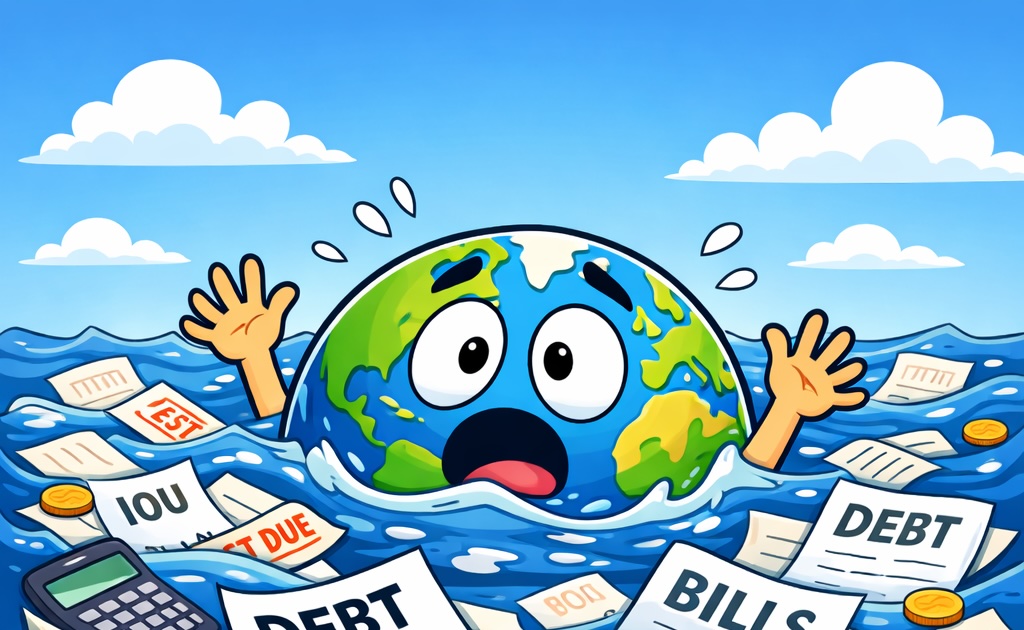
The planet is indebted to itself — and it is still not enough
Here is the absurdity, stated plainly:
The entire planet is in debt to itself. It’s basically bankrupt.
Total global debt now equals more than three years of the planet’s entire yearly output — everything humanity produces in one year, multiplied by three, already promised away.
And even that is still not enough.
Because if we stop borrowing — the system breaks.
If we stop growing — the system collapses.
If we stop expanding — debt becomes unpayable, which it is already, as the money we use ARE debt. “Paying it back” will mean we don’t have any money anymore.Still, governments think debt can actually be paid back. But even trying means creating more debt and more environmental destruction.
So even while drowning in debt, we are told we must take on more.
More loans.
More growth.
More extraction.
More pressure on land, oceans, climate, and people.
Debt is not just money owed. It is a demand placed on the future and the planet itself.
It is a claim that tomorrow must produce more than today — forever.
But the planet does not know debt.
The planet does not grow GDP.
The planet does not compound interest.
Forests do not grow faster because markets demand it.
Oceans do not replenish on quarterly schedules.
Soils do not regenerate on balance-sheet timelines.
This is the core insanity:
We have built a system that treats Earth as an infinite credit card —
and even after maxing it out, demands a higher limit.
That is why this is not a problem that can be fixed with better regulation, greener growth, or smarter finance.
A system that requires endless expansion on a finite planet is not malfunctioning.
It is doing exactly what it was designed to do.
⸻
Artificial scarcity fuels overconsumption
Money-based systems depend on scarcity.
Not natural scarcity — manufactured scarcity.
There is enough food, yet people starve.
More than enough homes, yet people sleep outside.
An abundance of energy from the sun, yet we burn the planet for fuel.
Scarcity is no longer a condition of nature.
It is a condition of design.
And scarcity doesn’t just damage ecosystems — it damages people.
⸻
A wounded humanity consumes to compensate
Much of modern overconsumption is not driven by greed.
It is driven by emptiness.
When work is disconnected from meaning,
when time is stolen from life,
when worth is measured numerically,
people compensate.
With status.
With possessions.
With distraction.
The planet pays the price for a wound we rarely name.
⸻
The same system erodes human dignity
In a monetary world, your value becomes conditional.
You are valued when you are:
• productive,
• efficient,
• competitive,
• profitable.
Rest must be earned.
Care must be justified.
Illness becomes a liability.
Aging becomes a problem.
Your right to exist quietly shifts from being human to being useful.
That shift happens slowly — until exhaustion feels normal.
⸻
Ending money changes the question
Without money, society stops asking:
“Is this profitable?”
And begins asking:
“Is this necessary?”
“Is this sustainable?”
“Does this improve life — for people and the planet?”
Production becomes needs-based.
Technology serves life, not return on investment.
Durability replaces planned obsolescence.
This is not idealism.
It is systems logic.
Why saving the planet without ending the monetary system is almost impossible
It is not that people aren’t trying to save the planet within the monetary system today — they are.
But every serious environmental effort is forced to operate against the system’s underlying logic. Renewable energy must compete with fossil fuels on price. Ecosystem protection must justify itself in economic terms. Climate action must promise growth, jobs, and returns to be considered “realistic.”
In other words, nature is allowed to survive only if it can be made profitable.
This creates a constant contradiction: we try to heal the planet while preserving the very engine that requires its continued destruction. As long as money, debt, and growth remain the organizing principles of society, ecological protection will always be partial, fragile, and reversible — tolerated only until it threatens profits. That is why saving the planet without ending the monetary system is not just difficult; it may be structurally impossible.
⸻
But what can we have instead? This is the only system we’ve got. Or is it…?
⸻
Stewardship replaces ownership
When land, water, and ecosystems are no longer owned for profit:
• extraction loses its incentive,
• care becomes collective,
• long-term thinking becomes natural.
The guiding question shifts from:
“How can we extract as much as possible?”
to:
“How do we keep this system healthy for generations?”
That shift alone rewrites humanity’s relationship with Earth.
⸻
Saving the planet is not only about the planet
A humanity stripped of dignity will compete, consume, and destroy.
Not because it is evil — but because it is wounded.
A humanity that feels safe, valued, and meaningful does not need to dominate its environment.
Healed people make good ancestors.
⸻
The deeper truth
Money is not neutral.
It is a behavioral engine.
And as long as that engine requires scarcity, competition, and endless growth, ecological collapse is not a failure.
It is the expected outcome.
Ending the monetary system does not magically save the planet.
But it removes the root incentive that is currently destroying it —
and gives both Earth and humanity a chance to recover.
⸻
Call to action
This is the core vision explored in Waking Up – A Journey Towards a New Dawn for Humanity — a story that doesn’t ask whether such a world is perfect, but whether it becomes possible once the old rules are removed.
The question is no longer whether we can afford to imagine a world beyond money.
The question is whether we can afford not to. If you want to be inspired, dive into this new world with Benjamin Michaels:
Leave a Reply