
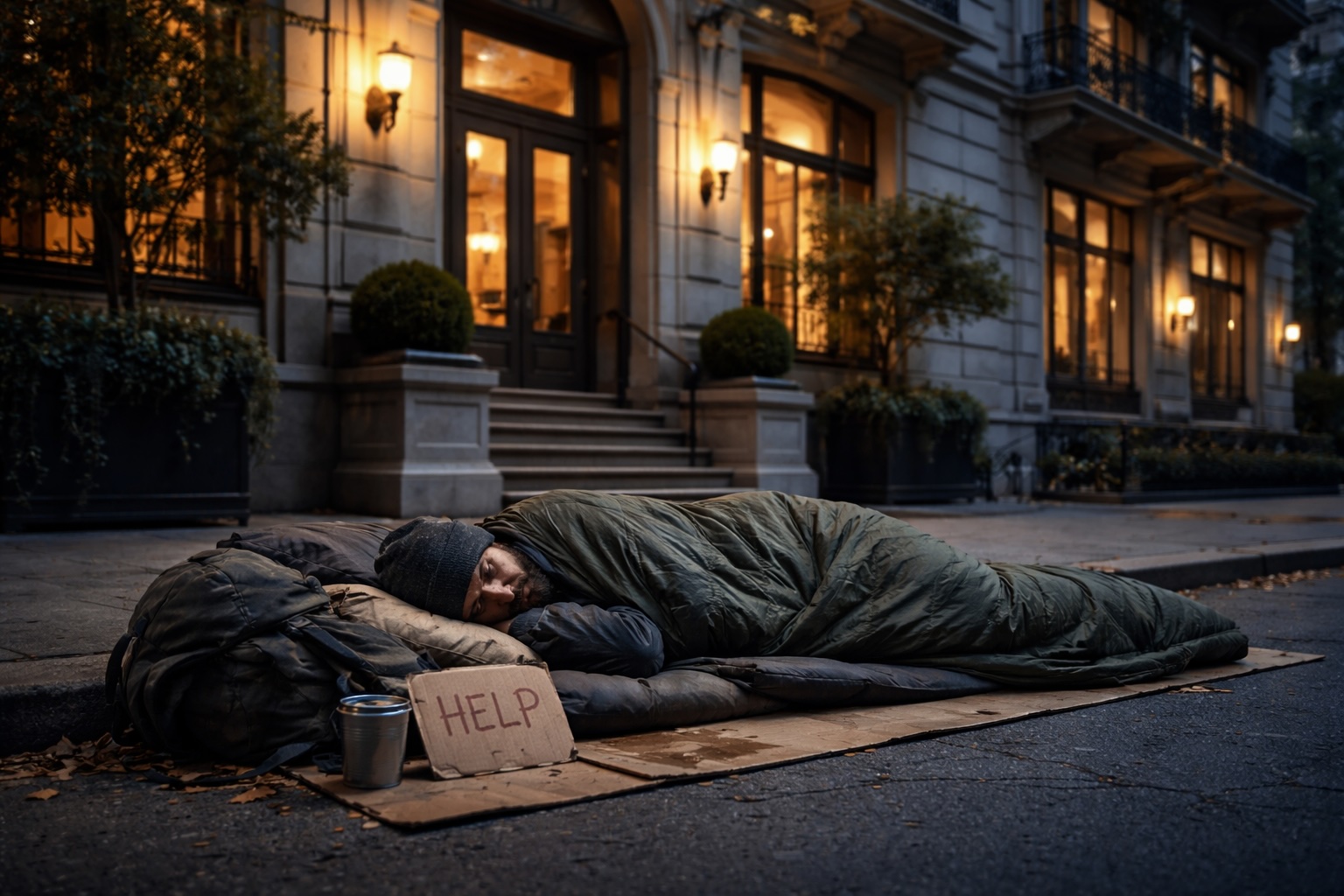
In Norway — one of the richest countries on Earth — homelessness is now rising sharply.
A country with vast wealth, strong institutions, and a well-functioning welfare system is seeing more and more people without a place to live.
Pause for a moment and let that sink in.
This is not happening in a failed state or a poor country.
It is happening inside one of the most successful systems we have ever built.
Now zoom out.
200 million homes
Around the world today, roughly 150 million people are homeless. At the same time, an estimated 200 million homes sit vacant.
In simple numerical terms, humanity actually has more empty homes than homeless people.
Yet the two groups rarely meet.
Why?
⸻
The Strange Paradox
If we looked at the world purely from a practical or engineering perspective, the problem might seem straightforward.
We have vacant homes.
People need shelter.
Connect the two.
Problem solved.
But the real world does not operate according to that logic. Instead, housing is governed by a very different architecture — the architecture of money, ownership, and markets.
Within that system, a house is not just shelter. It is also:
• an investment
• a store of wealth
• a speculative asset
• a tradable commodity
Once housing takes on these financial roles, something unfortunate happens: a home no longer needs to be lived in to have value.
In fact, it can sometimes be more valuable when it is empty.
This became especially visible after the financial crisis of 2008, where failed property investments left entire developments standing unused — something still visible today in places like the Costa Blanca in Spain, where rows of houses built for speculation never found residents.
⸻
When Shelter Becomes an Asset
In many cities around the world, property prices rise year after year. Investors buy homes not primarily to live in them, but to hold them while their value increases.
Second homes, vacation homes, speculative apartments, and investment properties accumulate.
Meanwhile, people without sufficient income cannot access those same homes — even if they are standing empty.
The market does not ask who needs shelter.
It asks who can pay — and ignores everyone else.
This is how a strange situation emerges:
• Homes exist.
• People need homes.
• Yet access is blocked by purchasing power.
The result is the paradox we see today: an abundance of buildings, yet scarcity of access.
⸻
A System Designed for trade
To be fair, the monetary system was not originally designed to distribute housing based on human need. It was designed to organize trade and exchange.
In that framework, property belongs to owners, and owners decide how and when it is used.
From the perspective of the system, nothing is broken.
An empty house still has value. It can be sold, rented later, inherited, or held as an asset.
But from a human perspective, the contradiction becomes obvious.
When people sleep without shelter while homes stand empty, the question naturally arises:
Is the problem a lack of resources — or a flaw in how we organize access to them?
⸻
Rethinking the Question
The homelessness crisis is often framed as a shortage of buildings. But the numbers suggest something different.
Humanity clearly has the technical ability to house everyone.
The deeper challenge may lie in the structure we have built to manage resources.
A ystem that prioritize ownership and financial return can produce outcomes that appear irrational from a human perspective — even while functioning exactly as designed.
And this is why what is happening in Norway matters.
Because it shows that even at the highest level of wealth and development, the same pattern appears. The monetary system is ruthless and does not care about the general standard of living in a country. It works the same everywhere.
⸻
A Thought for the Future
Perhaps one of the most important questions humanity faces is not simply how to build more houses.
It may be how to design a system that ensure the basic necessities of life — food, shelter, water, healthcare — are accessible to everyone, not just to those who can successfully compete within the marketplace.
If we are capable of building cities, skyscrapers, and entire global supply chains, surely we are also capable of building systems that make sure no human being is left without a safe place to sleep.
The empty houses are already there.
The question is no longer whether we can solve the housing problem.
It is whether we are willing to.
But is this how it must be forever?
Is this the peak of our civilization?
Or are we even civilized when people sleep on the streets while homes stand empty?
Maybe there is another way.
And that is exactly what Benjamin Michaels discovers when he wakes up after 100 years of cryonic sleep…
Through his journey, the question is no longer theoretical. It becomes lived experience: what happens when stewardship and access replaces ownership, and when a civilization decides that no one should be left without a place to call home?
If this reflection resonates with you, I urge you to please consider sharing this article so more people can join the conversation.
You can also explore the ideas above as story in the novel Waking Up – A Journey Towards a New Dawn for Humanity.
Leave a Reply