Tag: PARADOX

  • The Paradox of Our Time

    The Paradox of Our Time

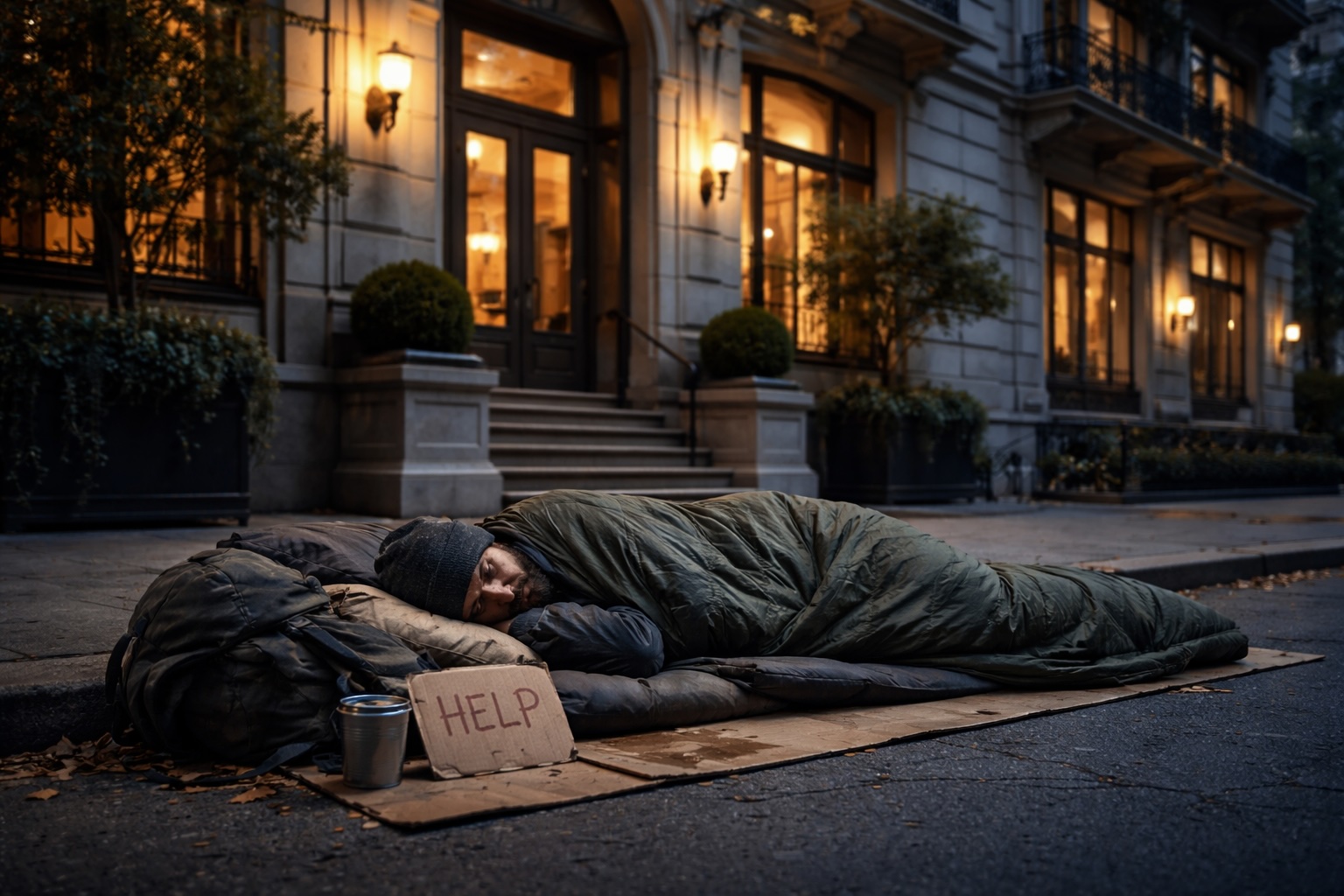
    In Norway — one of the richest countries on Earth — homelessness is now rising sharply.

    A country with vast wealth, strong institutions, and a well-functioning welfare system is seeing more and more people without a place to live.

    Pause for a moment and let that sink in.

    This is not happening in a failed state or a poor country.

    It is happening inside one of the most successful systems we have ever built.

    Now zoom out.

    200 million homes

    Around the world today, roughly 150 million people are homeless. At the same time, an estimated 200 million homes sit vacant.

    In simple numerical terms, humanity actually has more empty homes than homeless people.

    Yet the two groups rarely meet.

    Why?

    The Strange Paradox

    If we looked at the world purely from a practical or engineering perspective, the problem might seem straightforward.

    We have vacant homes.

    People need shelter.

    Connect the two.

    Problem solved.

    But the real world does not operate according to that logic. Instead, housing is governed by a very different architecture — the architecture of money, ownership, and markets.

    Within that system, a house is not just shelter. It is also:

    • an investment

    • a store of wealth

    • a speculative asset

    • a tradable commodity

    Once housing takes on these financial roles, something unfortunate happens: a home no longer needs to be lived in to have value.

    In fact, it can sometimes be more valuable when it is empty.

    This became especially visible after the financial crisis of 2008, where failed property investments left entire developments standing unused — something still visible today in places like the Costa Blanca in Spain, where rows of houses built for speculation never found residents.

    When Shelter Becomes an Asset

    In many cities around the world, property prices rise year after year. Investors buy homes not primarily to live in them, but to hold them while their value increases.

    Second homes, vacation homes, speculative apartments, and investment properties accumulate.

    Meanwhile, people without sufficient income cannot access those same homes — even if they are standing empty.

    The market does not ask who needs shelter.

    It asks who can pay — and ignores everyone else.

    This is how a strange situation emerges:

    • Homes exist.

    • People need homes.

    • Yet access is blocked by purchasing power.

    The result is the paradox we see today: an abundance of buildings, yet scarcity of access.

    A System Designed for trade

    To be fair, the monetary system was not originally designed to distribute housing based on human need. It was designed to organize trade and exchange.

    In that framework, property belongs to owners, and owners decide how and when it is used.

    From the perspective of the system, nothing is broken.

    An empty house still has value. It can be sold, rented later, inherited, or held as an asset.

    But from a human perspective, the contradiction becomes obvious.

    When people sleep without shelter while homes stand empty, the question naturally arises:

    Is the problem a lack of resources — or a flaw in how we organize access to them?

    Rethinking the Question

    The homelessness crisis is often framed as a shortage of buildings. But the numbers suggest something different.

    Humanity clearly has the technical ability to house everyone.

    The deeper challenge may lie in the structure we have built to manage resources.

    A ystem that prioritize ownership and financial return can produce outcomes that appear irrational from a human perspective — even while functioning exactly as designed.

    And this is why what is happening in Norway matters.

    Because it shows that even at the highest level of wealth and development, the same pattern appears. The monetary system is ruthless and does not care about the general standard of living in a country. It works the same everywhere.

    A Thought for the Future

    Perhaps one of the most important questions humanity faces is not simply how to build more houses.

    It may be how to design a system that ensure the basic necessities of life — food, shelter, water, healthcare — are accessible to everyone, not just to those who can successfully compete within the marketplace.

    If we are capable of building cities, skyscrapers, and entire global supply chains, surely we are also capable of building systems that make sure no human being is left without a safe place to sleep.

    The empty houses are already there.

    The question is no longer whether we can solve the housing problem.

    It is whether we are willing to.

    But is this how it must be forever?

    Is this the peak of our civilization?

    Or are we even civilized when people sleep on the streets while homes stand empty?

    Maybe there is another way.

    And that is exactly what Benjamin Michaels discovers when he wakes up after 100 years of cryonic sleep…

    Through his journey, the question is no longer theoretical. It becomes lived experience: what happens when stewardship and access replaces ownership, and when a civilization decides that no one should be left without a place to call home?

    If this reflection resonates with you, I urge you to please consider sharing this article so more people can join the conversation.

    You can also explore the ideas above as story in the novel Waking Up – A Journey Towards a New Dawn for Humanity.
  • The Greatest Paradox of Our Time

    The Greatest Paradox of Our Time

    We all know it. We all live inside it. But almost no one dares to speak it out loud.

    Consumerism is killing our planet.


    Every year we consume more, extract more, burn more, dump more, and waste more.
    Forests fall, oceans choke, temperatures rise and our spirit shrink as we are reduced from human beings to consumers — and still we consume, consume, consume and consume.

    We know it can’t go on. We know it’s unsustainable.
    And yet…

    To stop consuming is to threaten collapse.

    Because our entire economic system is built on endless consumption.
    Jobs depend on it.
    Pensions depend on it.
    Government budgets depend on it.
    Even “green growth” depends on it.

    It’s a trap.
    A loop.
    A paradox.

    To keep consuming is to destroy our planet and ourselves.
    To stop consuming is to destroy the system.

    This is the greatest paradox of our time.


    And it explains why, despite all the climate conferences, all the UN targets, all the inspiring nonprofits and planetary visions — nothing truly changes.

    The machine keeps running.

    🔥 The Extreme Paradox We Live In

    We are trapped in a system where the only way to keep society running… is to destroy the very foundation it stands on: Planet Earth.

    To keep people employed, companies profitable, governments funded, and pensions paid — we must keep buying things we don’t need, with money we often don’t have, at the cost of a planet we can’t replace.

    It’s not enough to have a TV — we need to want a bigger one next year.
    It’s not enough to have a car — we need to upgrade it every few years.
    Phones, fashion, furniture, kitchen appliances — the system doesn’t just want us to consume.
    It requires us to consume.

    Because if we stop spending, even for a little while, the machine begins to crack:

    • Shops close.
    • Jobs vanish.
    • Stocks fall.
    • Panic spreads.
    • Governments intervene — to make sure we start buying and consuming again.

    It’s estimated that just a 10% sustained drop in global consumption could send the world economy into freefall. That’s how fragile the system is. That’s how dependent we are.

    And yet — continuing on this path guarantees collapse.
    Not just economic collapse.
    But ecological, spiritual, and civilizational collapse.

    We are trapped between two forms of destruction — and the clock is ticking.

    We throw away a plastic wrapper after five minutes — but it stays on the Earth for 500 years.
    This is not just waste. It’s madness disguised as normality.
    And we call it progress.

    🛠️ “But What About the Workers?”

    It’s a fair question.

    Because it’s not just Apple or Amazon that need you to buy new gadgets — it’s the millions of people down the supply chain who depend on that consumption to survive.

    • The cobalt miner in Congo.
    • The factory assembler in China.
    • The truck driver, warehouse packer, and store clerk.
    • The app developer, marketing intern, and customer service rep.

    We are told we’re “supporting jobs.”
    And we are.
    Because we’re locked in a global machine where livelihoods depend on destruction.

    But it’s not just the worker who’s trapped.

    ⚙️ Not Even the Corporations Are Free

    Corporations aren’t inherently evil.
    They’re designed to do one thing: grow.

    • Maximize profit.
    • Outcompete rivals.
    • Please shareholders.

    If a CEO said,

    “Let’s prioritize planetary healing over quarterly growth,”
    they’d be replaced by Monday.

    Even the most ethical companies are stuck.

    If they reduce consumption, they die.
    If they keep pushing consumption, we all die — because the planet dies.

    It’s not a moral failure.
    It’s a failure of choice. Choice of the wrong system.

    🌍 The Planetary Awakening

    And yet, something is shifting.

    Movements like COPLAN, The Venus Project, Ubuntu Contributionism, Zeitgeist, and gift economies are rising.
    They may speak different languages, but they share the same truth:

    The system must evolve. Or rather, be replaced.
    Or we won’t survive.

    This paradox can’t be solved by better shopping.
    Or green labels.
    Or more efficient waste sorting.

    It can only be solved by transformation.

    By designing a new system where:

    • Needs are met without trade and overconsumption.
    • Nature is not a resource, but a relative.
    • Work is expression, not survival.
    • Giving is the foundation, not the exception.

    That world is not a fantasy.
    It’s a choice.

    Yes, we have to consume to live — we need food, water, shelter, connection, joy.
    But we do not need to consume in order to prove our worth, maintain the GDP, or keep an insane system alive.

    We no longer live in order to consume.
    We consume in order to live — simply, sustainably, and sanely.

    In my novel Waking Up: A Journey Towards a New Dawn for Humanity, this transformation is not theory — it is lived reality.
    A society has emerged that hasn’t reformed the monetary system, but transcended it.

    Experience this new world through the confused and surprised eyes of Benjamin Michaels, the former multi-billionaire that tries to escape cancer through cryogenic preservation. He dreamt of awakening in a world where he could be healed and continue the expansion of his trillion dollar empire. Awaken he does, and healed he is, but the world? It’s not what he expected…

    The whole system he depended on for his empire is gone.

    There is no trade.
    No price tags.
    No ownership.

    No money.
    Only joyful giving and receiving and a global relative abundance.

    🌱 The Resolution of the Paradox has happened.

    💡 A Call to Courage

    We don’t have to solve everything today.
    But we do have to name the paradox.
    We do have to break the silence.
    We do have to imagine something truly new.

    Because behind the fear of collapse…
    is the opportunity for emergence.

    If you’re ready to explore that world, Waking Up is one possible inspiration.
    Not as fiction. But as a seed.

    🟣 And maybe that seed has already been planted in you. If this vision resonates with you, feel free to order the book and spread the vision.