
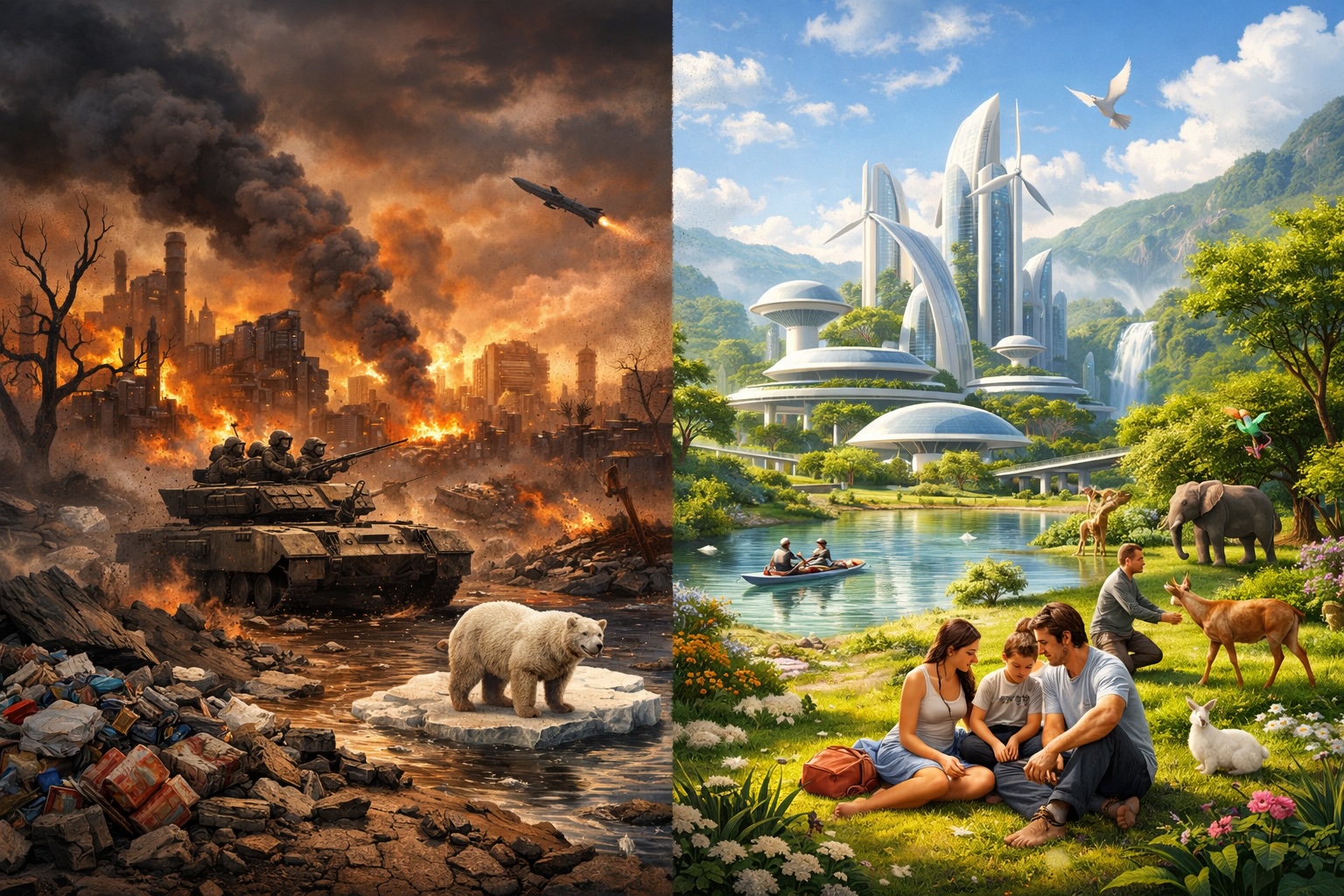
We hear the word crisis so often that it has almost lost its meaning.
Climate crisis. Economic crisis. Political crisis. Mental‑health crisis. Energy crisis. Trust crisis.
But what we are actually facing is something deeper and bigger — a meta‑crisis.
A meta‑crisis is not one problem. It is a web of problems, all feeding each other. Climate breakdown accelerates economic instability. Economic insecurity fuels political polarization. Polarization erodes trust. Loss of trust paralyzes collective action — which in turn worsens climate breakdown.
Each crisis amplifies the others.
This is why so many solutions feel ineffective. We keep treating symptoms in isolation, while the underlying system continues to generate the same outcomes.
⸻
A System Under Strain
Our global system was built for a world that no longer exists.
It assumes endless growth on a finite planet.
It rewards competition over cooperation.
It measures success in money rather than wellbeing.
For a long time, this system appeared to work. Supermarkets were full. Technology advanced. Comfort increased — for some.
But the costs were externalized.
Onto other people.
Onto future generations.
Onto nature itself.
Now the bill is coming due.
The meta‑crisis is not an accident. It is the predictable result of a system designed without regard for ecological limits, psychological health, or long‑term resilience.
⸻
A Question We Rarely Ask
Most discussions stop here — with warnings, statistics, and projections of collapse.
But there is another question worth asking:
What if humanity acted in time?
What if we recognized the pattern early enough?
What if cooperation replaced competition as our default?
What if technology was used to restore nature and free humans — not to extract more from them?
What if we acknowledged something even more uncomfortable:
That the problem was never a lack of solutions — but a lack of alignment.
Because the truth is this:
We already have the tools.
We already have the science.
We already have the productive capacity to meet everyone’s basic needs.
We know how to generate abundant renewable energy.
We know how to automate dangerous and repetitive labor.
We know how to design cities around people instead of profit.
We know how to produce more than enough food — sustainably.
What stands in the way is not technology.
It is the system we organize ourselves by.
A system that requires scarcity to function.
A system that turns necessities into commodities.
A system that measures success in money rather than human and ecological wellbeing.
Some visionary projects — such as those exploring resource‑based economies, like The Venus Project — have long argued that a resilient society would require something radical:
Not reforming the monetary system — but replacing it.
In such a model, resources are treated as the shared inheritance of humanity.
Production is guided by real needs and ecological limits, not profit.
Technology becomes a tool for coordination, not control.
This is not science fiction.
It is a different set of rules applied to capabilities we already possess.
So the real question becomes:
If the solutions exist — what would the future look like if we actually used them?
⸻
A Thought Experiment
So what would the world actually look like if we implemented all of this?
If we treated the planet’s resources as a shared inheritance.
If production was guided by real human needs and ecological limits.
If a global, coordinated, resource-based economy replaced the monetary system.
If technology was used to liberate time and creativity, not monetize it.
What would daily life feel like?
How would cities function?
What would people do with their lives when survival was no longer the primary concern?
One way to explore that question is through story.
That is exactly what Waking Up – A journey towards a new dawn for humanity does — through the eyes of Benjamin Michaels.
Benjamin comes from our world, at its peak – 2015.
He was not a rebel or an outsider.
He was a billionaire — someone who had mastered the old system. But suffered from incurable cancer. He chooses cryogenic preservation of his body in the hopes of waking up again to being healed and continue expanding his empire.
When he wakes up one hundred years into the future, he is shocked to learn about the new moneyless world and expects collapse, chaos, or authoritarian control — the futures our imagination keeps returning to.
Instead, he finds something else entirely.
A world where people are thriving.
A world where basic needs and wants are guaranteed.
A world where cities are designed around human wellbeing and ecological harmony.
A world where cooperation is not idealism, but infrastructure.
Benjamin doesn’t just hear about this world.
He walks through it.
Questions it.
Resists it and almost helps destroying it.
But slowly begins to understand how humanity stepped back from the brink and started prospering.
⸻
Not Utopia — But Maturity
This future is not perfect.
Nature still has momentum.
Old damage still needs healing.
Human emotions are still human.
But the underlying rules have changed.
Fear is no longer the operating system.
Scarcity is no longer artificially enforced.
Survival is no longer the primary driver of human behavior.
The story does not ask us to believe that humans became saints.
It asks a simpler question:
What happens when humanity grows up?
⸻
Why Stories Matter
Facts inform.
Stories transform.
We already know the data.
We already know the risks.
What we lack is a shared image of a future worth moving toward.
That is what the novel,Waking Up – A Journey Towards a New Dawn for Humanity explores — not as prediction, but as possibility.
Not as ideology, but as a thought experiment and inspiration grounded in existing technology, systems thinking, and human values.
⸻
The Quiet Invitation
The meta‑crisis is real.
But collapse is not the only ending available.
Another path exists — one that does not begin with revolution or force, but with understanding, imagination, and cooperation.
The question is not whether such a future is guaranteed.
The question is whether we dare to imagine it — and then start acting as if it were possible.
⸻
If this article resonates, please share it.
Because the more people start to imagine this future the bigger chance we have of actually getting there.
And if you want to explore one possible answer to the meta‑crisis through story rather than theory, Waking Up is available now.
Leave a Reply