
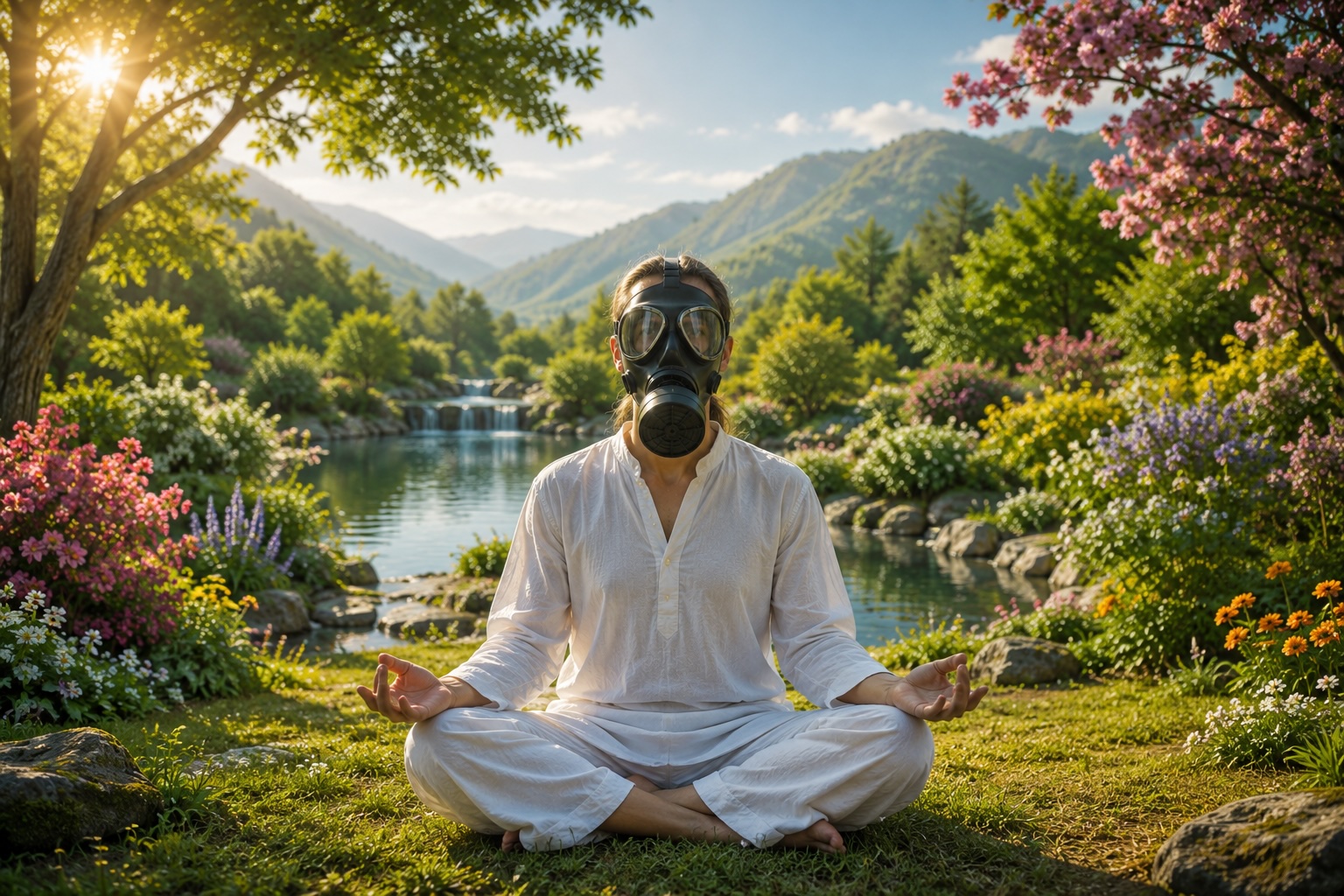
The sun is shining.
A gentle breeze moves through the trees.
The birds are singing.
The sky is blue.
The air feels fresh.
Everything is fine.
Or is it?
I’m sorry to interrupt this idyllic moment, but here is the reality…
Everything is not fine
Under the surface activities are happening that slowly undermines our seeming idyll.
Oil
Every single day, humanity burns approximately 103 million barrels of oil.
Much of it fuels the cars that carry us to work, the trucks that stock our supermarkets, the ships that move goods across oceans and the aircraft that fill our skies.
It keeps our modern civilization moving.
It also fills our atmosphere.
Coal
Every day, humanity burns approximately 24 million tonnes of coal.
Mountains are excavated.
Entire landscapes are transformed.
Gigantic furnaces reduce ancient forests—compressed over hundreds of millions of years—into heat, electricity and smoke.
The carbon that nature stored over geological time is released back into the atmosphere in a matter of hours.
Natural Gas
Humanity also burns roughly 12 billion cubic meters of natural gas every single day.
Although often described as the cleanest fossil fuel, it still releases enormous amounts of carbon dioxide when burned, and methane leaks during extraction and transport further contribute to warming.
The result
The result is an unprecedented pollution of our planet.
Carbon Dioxide
Together, these fossil fuels release more than 100 million tonnes of carbon dioxide into the atmosphere every day.
You cannot see it.
You cannot smell it.
You cannot taste it.
Yet it quietly accumulates year after year, trapping more of the Sun’s heat and slowly changing the climate that made human civilization possible.
But CO2 is not all.
Sulfur Dioxide
Around 78,000 tonnes of sulfur dioxide are released every day.
It reacts with moisture in the atmosphere to form acid rain, damaging forests, lakes, soils and crops, while also irritating the lungs of those who breathe it.
Nitrogen Oxides
Every day, approximately 52,000 tonnes of nitrogen oxides enter the atmosphere.
These gases help create smog and ground-level ozone, making it harder to breathe, especially for children, the elderly and people with asthma.
Fine Particles
More than 5,000 tonnes of microscopic particulate matter (PM₂.₅) are released every day globally.
These particles are so small that they bypass the body’s natural defenses, travel deep into the lungs and can even enter the bloodstream.
From there, they contribute to inflammation throughout the body, increasing the risk of heart attacks, strokes and chronic lung disease.
Carbon Monoxide
Around 45,000 tonnes of carbon monoxide are emitted every day, together with thousands of tonnes of the other harmful pollutants.
While outdoor concentrations are usually diluted, this pollution adds to the complex mixture of contaminants that millions of people breathe every day.
The consequences
The consequences are staggering.
Human Health
Air pollution contributes to around seven million premature deaths every year.
Behind that number are real people.
A child struggling to catch a full breath during an asthma attack.
An elderly person whose weakened heart can no longer cope with polluted air.
A family sitting in a hospital room while a loved one slowly loses the ability to breathe.
A patient with lung cancer enduring months of coughing, chest pain, exhaustion and treatment, hoping each scan will bring better news than the last.
Statistics are easy to read.
Living them is something entirely different.
The Climate
The atmosphere remembers everything we release.
Every day, another hundred million tonnes of carbon dioxide are added.
The oceans absorb part of it.
Forests absorb part of it.
Nature does everything it can to soften the impact.
But not all of it disappears.
The result is a gradual warming of the atmosphere and the oceans, melting glaciers and polar ice, rising sea levels, changing rainfall patterns, stronger heatwaves, more severe droughts in some regions, heavier floods in others and increasing pressure on agriculture and water supplies.
Nature
Wildlife cannot negotiate with climate.
Forests cannot relocate.
Coral reefs cannot simply swim to cooler waters.
Species that evolved over thousands or millions of years are being forced to adapt within decades.
Some can.
Many cannot.
And Yet…
The Illusion
Tomorrow morning…
The sun will shine again.
A gentle breeze may once again move through the trees.
The birds will still sing.
The sky may still be blue.
The air may still feel wonderfully fresh.
Everything might still look fine.
That is the illusion.
Nature is working around the clock to hide the consequences from us.
The wind disperses pollution.
Rain washes particles from the air.
Forests absorb carbon.
The oceans absorb heat.
Earth is constantly cleaning up after us.
Until one day, it can no longer keep pace.
So Why Don’t We Simply Stop?
We would like to change this, wouldn’t we?
Most of us would.
But how?
Our entire civilization has been built on abundant fossil energy.
Our transportation depends on it.
Our industries depend on it.
Global trade depends on it.
Much of modern agriculture depends on it.
Our monetary system has grown around this enormous flow of concentrated energy. Fossil fuels are the core of the monetary system, and without them we will basically have no monetary system. No jobs, no transportation, no trade, no money, which in this system means no food or any products of any kind…
Replacing it is not as simple as turning off one machine and switching on another.
It means transforming the foundations of how our civilization operates.
That is why the transition seems so impossible. If we can’t have a monetary system, what system can we have?
Fortunately, there is another way to imagine the future. A future with a true economy, heeding the original meaning of the word “economy”: proper household management.
In Waking Up, Benjamin Michaels awakens in a civilization that has abandoned the monetary system altogether. It no longer depends on fossil fuels to sustain its way of life. Humanity has reorganized society around stewardship, intelligent resource management, renewable energy, automation and cooperation rather than endless growth driven by the old system.
It is not simply a future with different technology.
It is a future built on different foundations.
Perhaps that is what we should really be asking ourselves.
Not merely how to replace fossil fuels…
But what kind of civilization we want to power.
If you want a glimpse into a world where this has happened, the novel Waking Up – A journey towards a new dawn for humanity is for you.
Leave a Reply