
For most of human history, labor was inseparable from survival.
Food was foraged by foot and fields were cultivated by hand.
Buildings were raised by muscle.
Empires were constructed on the backs of slaves, serfs, and the working poor.
Brutal Work
For centuries, it seemed obvious that a ruling class required a laboring class. That some would command and others would toil. That hard, repetitive, and often brutal work was simply the price of civilization.
In ancient societies, this labor was enforced through slavery.
In feudal systems, through serfdom.
In early industrial capitalism, through exhausting factory work. The structure changed, but the necessity of large-scale human labor did not.
Even well into the 20th century, most people assumed that civilization would always require millions of people to perform monotonous, dangerous, or degrading tasks. The debate was about wages and rights — not about whether such labor could disappear altogether.
Automation was expected to assist human workers, not replace drudgery itself.
The idea that machines could eliminate the need for unwanted labor sounded utopian — or naive.
Yet here we are.
Artificial Intelligence
In just the past few decades — and especially in the last ten to fifteen years — automation, robotics, and artificial intelligence have advanced at a speed few predicted. Machines no longer merely assist human labor; in many domains, they perform it independently.
What once required forced labor, then industrial labor, can now increasingly be handled by systems that do not tire, suffer, or demand wages.
This historical shift forces a serious question.
The Fundamental Questions
If we no longer need human beings to perform the most dangerous, exhausting, or monotonous tasks — what kind of civilization becomes possible?
We have already asked two fundamental questions in previous articles:
What do we actually want?
What do we actually have?
Now we arrive at the question that determines everything:
What is actually possible?
Because between desire and reality lies possibility.
And possibility is not fixed. It expands with knowledge, courage, and imagination.
⸻
Technological Possibility
If we look honestly at humanity’s technological capacity today, something remarkable becomes clear.
For the first time in history, we possess the tools to produce abundance without requiring mass human drudgery.
We can:
• Automate most portions of repetitive and dangerous labor.
• Coordinate global supply chains in real time.
• Monitor ecosystems, climate patterns, soil health, and material flows with extraordinary precision.
• Manufacture goods with extreme efficiency using robotics and advanced fabrication systems.
• Process and distribute information globally in milliseconds.
And we must add something that would have sounded like science fiction only a decade ago:
Artificial intelligence and advanced robotics have progressed at extraordinary speed.
Tasks once believed to require uniquely human perception, judgment, and adaptability are now performed by machines.
Factories operate with minimal human presence.
Warehouses move autonomously.
Robots assist in surgery, maintain infrastructure, explore hazardous environments, and handle toxic materials.
Only a short time ago, many believed it would take generations before machines could perform most necessary but undesirable labor.
Today, in many sectors, they already can.
The limiting factor is no longer technological capability.
It is how we design the economic and governance structures around that capability.
From a purely technical standpoint, we now have the ability to eliminate most compulsory drudgery. Human labor could increasingly shift from survival-driven necessity to voluntary contribution, creativity, research, care, and exploration.
And this changes everything.
⸻
Solar Power: An Overlooked Revolution
Energy has always been the backbone of civilization.
For centuries, societies relied on muscle, wood, coal, oil, and gas. Energy scarcity shaped hierarchy and conflict. Control over fuel meant control over civilization.
But the Earth receives an astonishing amount of energy every single day.
Every hour, more solar energy hits the planet than humanity currently consumes in an entire year. And that is a fact.
In other words: The total amount of energy humanity use in one whole year hits earth in ONE HOUR. This extreme energy abundance is often overlooked.
We do not need to capture all of it.
We do not need deserts covered in panels from horizon to horizon.
We only need to harness a fraction of what already arrives freely to power humanity completely.
Modern photovoltaic technology is no longer experimental or marginal — it is mature, scalable, and already widely deployed. Even at today’s efficiency levels, existing solar panel technology could generate more than enough electricity to power global civilization if installed at sufficient scale. Large-scale solar farms, rooftop installations, and integrated infrastructure systems are not future concepts; they are operating right now across continents. Storage technology, smart grids, and decentralized energy systems are already capable of balancing variable supply, and while they continue to improve, the current level of technology alone is sufficient to create large-scale renewable energy abundance if prioritized and deployed intelligently.
The technical challenge of powering humanity sustainably is no longer insurmountable. It is an engineering and deployment question — not a physics limitation.
When energy is abundant and renewable, the foundation of scarcity thinking begins to weaken. Energy underlies water purification, manufacturing, transportation, communication — nearly every essential system. In many cases, it does not even need to pass through electricity: solar thermal systems can directly power water heating, desalination, industrial heat processes, and sanitation infrastructure, reducing complexity while increasing efficiency and resilience.
Abundant clean energy changes the economic equation at its root.
And that shift alone makes entirely new civilizational models possible.
⸻
⸻
Land and Physical Resources
Another common objection is: “There isn’t enough.”
But enough of what? Because there is.
There is enough agricultural land to feed humanity. Roughly half of the planet’s habitable land is already used for agriculture, and the majority of that is devoted to livestock and feed production rather than direct human nutrition. Even without expanding farmland, more efficient crop use, regenerative practices, and dietary shifts could feed billions more people on existing land.
There is enough renewable energy potential to power civilization many times over.
There are sufficient raw materials — if used intelligently, recycled efficiently, designed for durability, and embedded in circular production systems instead of disposable ones.
And we should acknowledge something important:
Even with our present system that is clearly unsustainable, humanity is already feeding many billions of people and housing many billions of people. We have already proven there is enough, albeit unsustainably.
The problem is not that we lack resources.
The problem is that we use them inefficiently, wastefully, and unevenly.
We produce enough food for everyone — yet food is wasted while others go hungry.
We build enough housing — yet some own multiple properties while others sleep outside.
We generate enormous wealth — yet access depends on purchasing power rather than human need.
The Earth is finite, yes.
But finite does not mean insufficient.
A well-managed finite system can support long-term stability. A poorly managed system collapses even if resources are abundant.
So the real task is not to invent abundance from nothing.
It is to make what we already produce sustainable.
To align production with ecological limits.
And to ensure that everyone receives what they need — not only those who have enough money to claim it.
Already today, humanity has the technical and material capacity for every person on Earth to live in what previous generations would have called luxury — safe housing, clean water, abundant food, clean energy, healthcare, education, and global connectivity.
Beyond material comfort, we also possess the productive power to free enormous amounts of human time — time to create, to learn, to explore, to rest, and to do what genuinely pleases us.
And in principle, we even have the logistical capacity to offer mobility and choice of location — the option to live in the climate and environment one prefers, rather than being confined by economic necessity.
The barrier is not capacity.
It is how we organize access, distribution, and the value we assign to human life beyond labor.
⸻
The Human Mind
Here is where the conversation becomes deeper.
Even if technology allows it.
Even if resources allow it.
Do we allow it?
For thousands of years, humanity has operated inside a monetary habit. We measure value in currency. We organize life around earning, competing, accumulating, and securing.
Money has shaped our psychology.
It has trained us to think in scarcity terms:
• Not enough jobs.
• Not enough profit.
• Not enough growth.
• Not enough security.
But habits are not destiny.
Human beings have shifted paradigms before.
We moved from tribal structures to agricultural civilizations.
From monarchies to democracies.
From slavery to abolition.
From isolated tribes to global networks.
Each shift once seemed impossible.
Until it wasn’t.
The deeper question is this:
can we expand our sense of identity — from isolated individuals competing for survival to participants in a planetary system that must be cared for collectively?
That shift is psychological before it is economic.
⸻
The Monetary Habit
The monetary system is not merely a tool. It is a pattern of thought.
It rewards short‑term gain over long‑term stability.
It converts living ecosystems into financial assets.
It turns access to life’s necessities into permission tokens.
Is it possible to move beyond that?
Technically — yes.
Practically — it would require transition, experimentation, and courage.
We would need:
• Local and regional prototypes that demonstrate new coordination models.
• Governance systems rooted in transparency and contribution rather than ownership and accumulation.
• Education that prepares people for participation, creativity, and stewardship instead of narrow competition.
• Technological systems aligned with ecological limits.
None of this violates physics.
None of this violates biology.
None of this violates human potential.
It only challenges habit.
And habits can change.
⸻
A Global Classless Society
For thousands of years, societies were structured around necessity.
Those who controlled land, tools or force commanded everything.
Those without access labored.
Class was not merely ideology.
It was a structural consequence of scarcity and labor intensity.
If survival required large populations performing exhausting physical work, then hierarchy followed almost automatically. Control the land, control the energy source, control the tools — and you controlled people.
But if production can be largely automated…
If energy can be abundant…
If coordination can be managed intelligently at scale…
Then the material foundation of class hierarchy weakens.
For the first time since organized civilization began, humanity has the technological capacity to build a global society where survival does not depend on belonging to a laboring class — and where access to life’s necessities is not restricted to those who accumulate financial tokens.
This does not mean uniformity.
It does not mean sameness.
It does not mean the end of diversity, ambition, creativity, or excellence.
It means the end of structural dependency.
The end of a permanent underclass required for others to live comfortably.
In principle, we now possess the tools for the first truly classless civilization in history — not enforced by ideology, but enabled by automation, energy abundance, and intelligent coordination.
For most of modern history, attempts at equality have been framed through competing ideologies — communism, socialism, capitalism — each proposing different mechanisms to manage scarcity, ownership, and power. But all of them were designed in eras where large-scale human labor and energy limitation were structural realities.
For the first time, we may not need an -ism to force equality or justify hierarchy. If survival and production are no longer constrained in the same way, sharing the planet becomes a design question rather than an ideological battle.
No previous era could even seriously contemplate this.
Ours can.
The question is not whether it is technically possible.
The question is whether we have the maturity to build it.
⸻
The Real Boundary
The boundary of possibility is rarely material.
It is cognitive.
When people believe something is impossible, they stop exploring.
When they believe it may be possible, creativity awakens.
A moneyless or post‑monetary civilization sounds radical because we are inside the monetary habit.
But from the outside, future generations may look back at debt‑driven growth on a finite planet and find that era far more radical than anything we are proposing.
So what is actually possible?
More than we think.
Less than we fantasize.
Exactly as much as we are willing to mature into.
The future is not predetermined.
It is designed — consciously or unconsciously — by the systems we maintain and the ones we dare to build.
Interestingly, we already know how to set money aside when conditions demand it. In war rooms, disaster zones, space missions, submarines, or tightly coordinated survival environments, systems are not organized around shopping, price tags, or profit. They are organized around coordination. Resources are allocated. Roles are assigned. Systems are stabilized. Competition quietly steps aside because it is no longer the most efficient organizing principle. This reveals something crucial: the monetary habit is not hard‑wired into human nature — it is context‑dependent. When circumstances change, we adapt immediately. The real question, then, is not whether humanity can coordinate beyond money, but whether we are willing to recognize that planetary stability and technological abundance may justify doing so — not from fear in a bunker, but from conscious design on a global scale.
Imagine This
You fall asleep in a world driven by debt, deadlines, and division.
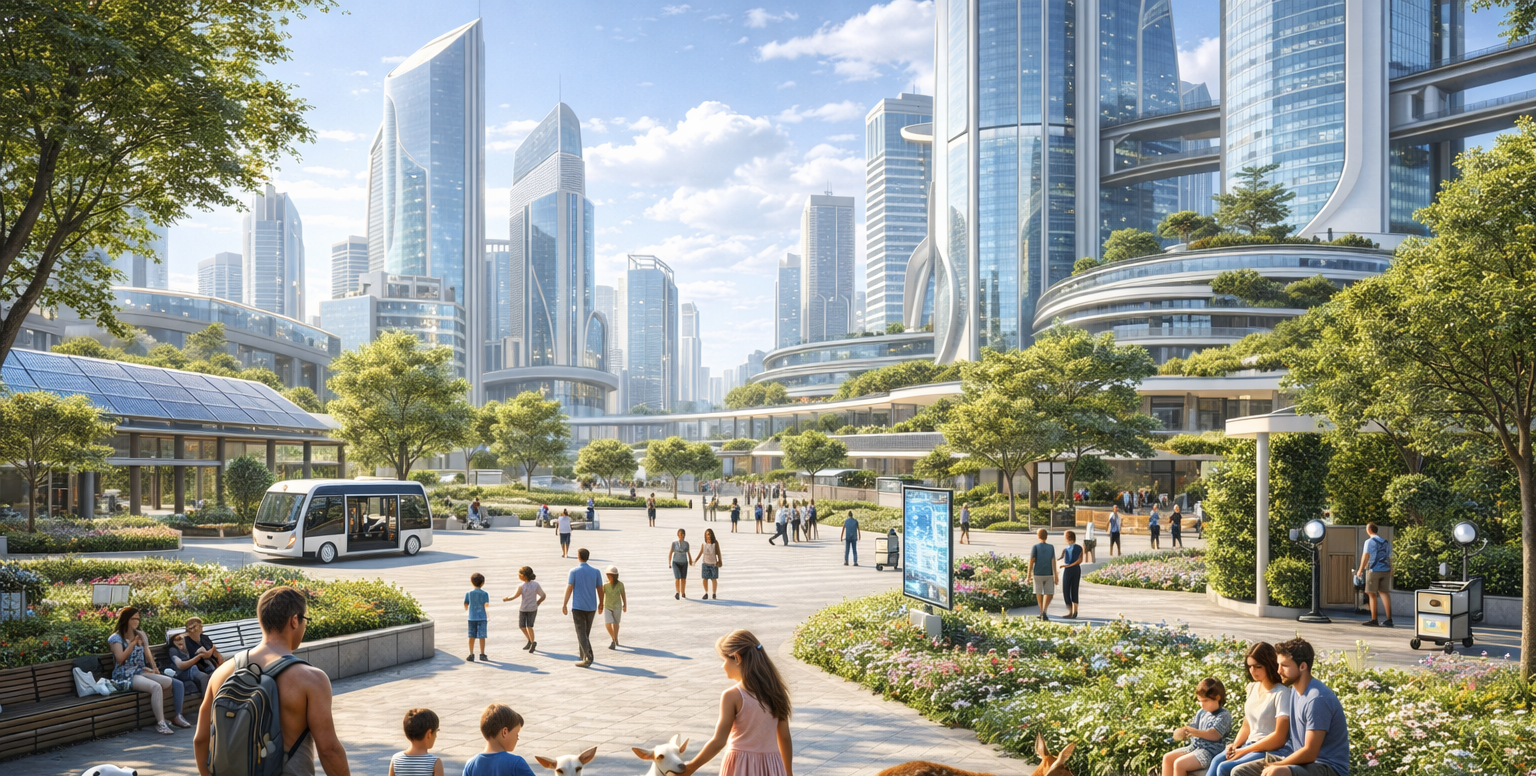
You wake up in a world where survival is guaranteed, energy is harnessed freely from the sun, machines handle the dangerous work, and no child is born into a permanent underclass.
You wake up and everything you thought was “just the way it is”… isn’t.
That is the shock Benjamin Michaels experiences in Waking Up – A Journey Towards a New Dawn for Humanity.
He doesn’t read about the future.
He opens his eyes inside it.
Through his awakening, you walk through cities without price tags, systems without poverty, and a civilization that has matured beyond ideological battles over scarcity.
Not as a manifesto.
Not as theory.
But as lived reality.
Could this world exist?
Step into it.
Wake up with Benjamin Michaels.
And if this vision matters to you, please share this article. The conversation itself is part of the transition.
And don’t forget, the free companion book is out now.
Leave a Reply