
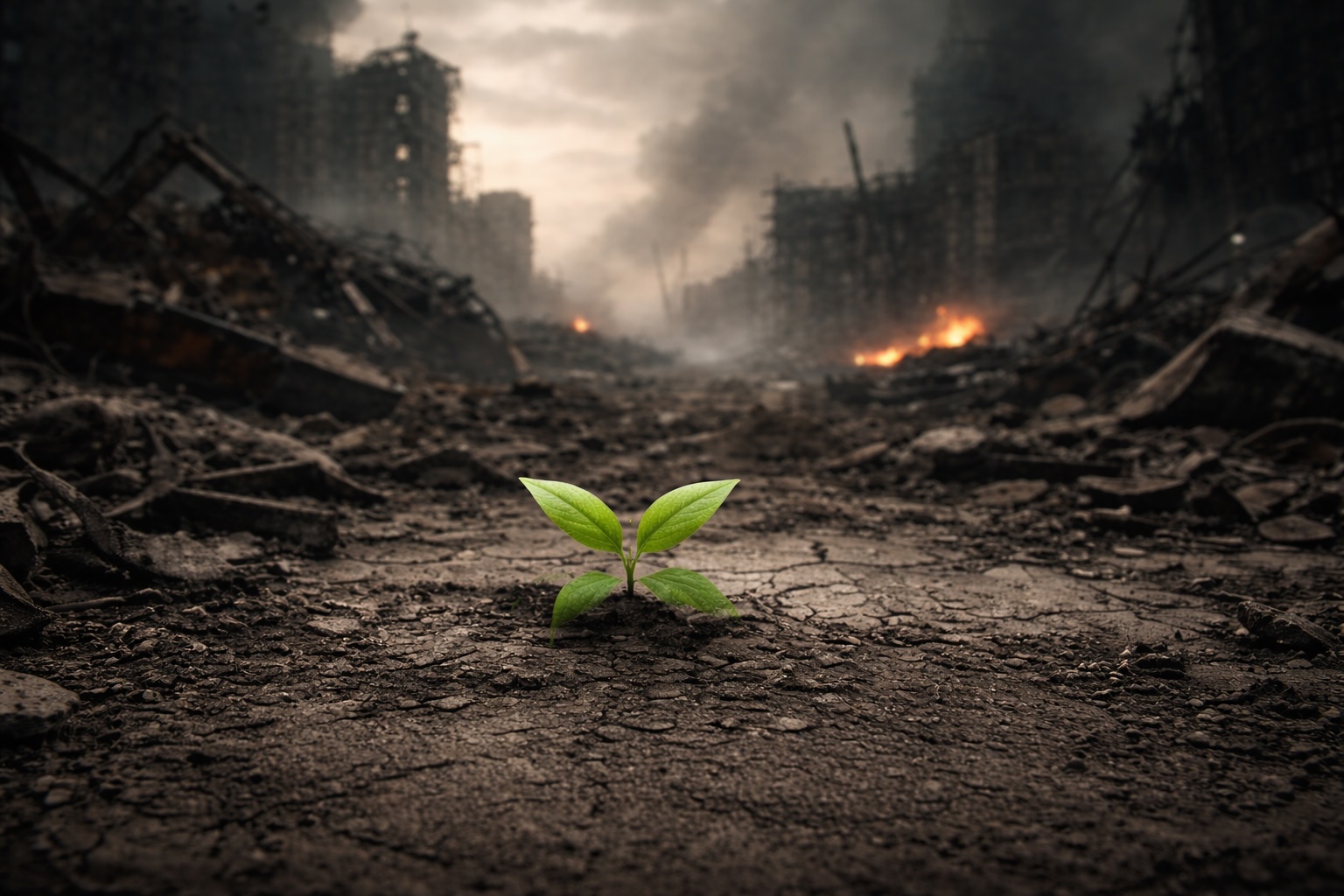
Inspired by Buckminster Fuller
“You never change things by fighting the existing reality.
To change something, build a new model that makes the existing model obsolete.”
Buckminster Fuller (1895–1983) was an American architect, inventor, systems thinker, and futurist who devoted his life to one central question: how humanity could live well on Earth without destroying its life‑support systems. He was not a politician, economist, or activist in the usual sense. He approached global problems as design challenges.
Revolutions are usually imagined as loud events.
Crowds in the streets. Raised fists. Collapsing statues.
One side winning, another losing.
But the most profound changes in human history have rarely arrived that way.
They arrived quietly
They began when people stopped believing the old story — not because they were forced to, but because something inside them simply said: this no longer makes sense.
While the world today appears increasingly loud, polarized, and frantic, a different kind of transformation is unfolding beneath the surface. It does not announce itself. It does not trend. It does not demand allegiance.
It spreads calmly, person by person.
This is the quiet revolution.
⸻
When Systems Fade Instead of Falling
History reveals a recurring pattern: systems do not disappear when they are attacked. They disappear when they are outgrown.
Absolute monarchy did not end because kings were stormed everywhere at once. Across Europe, royal authority slowly became symbolic as constitutions, parliaments, and civic institutions made divine rule unnecessary. Power migrated away from bloodlines toward shared governance — quietly.
Slavery did not collapse from rebellion alone. Long before its legal abolition, it was becoming morally indefensible and economically inefficient. Public consciousness shifted through writing, debate, and refusal. The institution withered as society outgrew it.
The Soviet Union did not fall because it was militarily defeated. It collapsed because people quietly stopped believing in it. By the time the flags came down, the system was already hollow.
Even the digital revolution arrived without confrontation. Email did not overthrow postal services. Messaging apps did not protest landlines. They simply worked better. People migrated — and old infrastructures faded into the background.
Again and again, history tells the same story:
systems end not through conflict, but through obsolescence.
⸻
Buckminster Fuller’s Radical Insight
This pattern was deeply understood by Buckminster Fuller.
He was not a politician or activist in the conventional sense, but an architect, inventor, and systems thinker who approached humanity’s problems as design challenges rather than moral failures.
His central question was disarmingly simple:
How can humanity live well on Earth without destroying the systems that support life?
Fuller believed that humanity already possessed the scientific knowledge and technological capacity to provide a high quality of life for everyone on the planet. The obstacle, in his view, was not human nature — but obsolete systems designed for scarcity, competition, and inefficiency.
His guiding principle was doing more with less: intelligent design that increases human well-being while reducing material and ecological cost.
From this came his most misunderstood idea:
You do not change the world by fighting the existing reality.
You change it by building something better.
⸻
Obsolescence Is Gentle
The brilliance of this insight lies in its softness.
You don’t need to destroy the old system.
You don’t need to convince everyone.
You don’t need to force compliance.
You simply build a model that works better.
When a new system meets real needs more effectively — materially, socially, emotionally — people move toward it naturally. Not through collapse, but through migration. Not through revolution, but through relevance.
No one protested the fax machine.
No one rioted against cassette tapes.
They simply stopped being useful.
This is how real change happens.
⸻
Why This Matters Now
Today, we are trying to solve planetary crises using tools designed for a very different era:
• an economic system that require perpetual growth
• structures built on artificial scarcity
• incentives that reward extraction over regeneration
• competition framed as human nature rather than a design choice
Attempts to “fix” these problems from within the same framework often reproduce the problem itself. Growth must continue. Scarcity must be maintained. Profit must be protected — even if ecosystems are not.
This creates a deep sense of frustration and paralysis. People feel that something is fundamentally wrong, yet every proposed solution seems to reinforce the same destructive logic.
Buckminster Fuller pointed elsewhere:
Don’t repair the old world.
Don’t moralize it.
Outgrow it.
⸻
A Different Kind of Revolution
And perhaps this is where something unprecedented becomes possible.
Until now, most revolutions in history has produced winners and losers. Power shifted. Property changed hands. One group rose as another fell. Even the most just revolutions carried loss, resentment, and trauma in their wake.
This next quiet revolution may be different.
When change happens through obsolescence rather than conquest, no one needs to be defeated. No one needs to be stripped of dignity. No one needs to be declared “on the wrong side of history.”
When a system fades because it no longer makes sense, there are no enemies — only alternatives.
In that sense, this may be the first non-zero-sum revolution humanity has ever known. A transition where no one has to lose for others to gain. Where security does not depend on domination. Where fear is no longer the organizing principle of society.
Not a political revolution.
A design transition.
⸻
The Quiet Revolution Today
A different model is beginning to take shape — not as a single blueprint, but as a shared direction:
• stewardship and shared access instead of ownership
• contribution rather than coercion
• planetary boundaries instead of endless expansion
• cooperation replacing manufactured competition
• human dignity treated as foundational, not conditional
This shift does not need to defeat money, power, or hierarchy.
They simply lose their function.
Because it does not arrive with anger, it does not trigger the usual defenses. Algorithms don’t flag it. Institutions don’t recognize it as a threat. It passes through the machinery of the old system largely unnoticed.
But humans notice.
A reader pauses mid-scroll.
Someone shares something quietly.
A conversation starts — not to persuade, but to understand.
Nothing explodes. Nothing trends.
And yet something moves.
⸻
A Revolution of Relief
This is not a revolution of rage.
It is a revolution of relief.
No leaders to overthrow.
No enemies to defeat.
No slogans to chant.
Just a growing number of people arriving at the same calm realization:
There may be another way to live.
And once that realization takes root, it doesn’t need to shout. It spreads naturally — quietly, patiently, inevitably.
⸻
The Question That Follows
Which brings us to the question history always asks next:
What will the next quiet revolution look like?
Perhaps it will be the moment humanity outgrows senseless trading systems that require endless extraction and ecological destruction.
Perhaps it will be the moment we recognize that treating Earth as property is incompatible with survival.
Perhaps it will be the moment we stop organizing society around fear and scarcity, and start organizing it around care, sufficiency, and shared responsibility.
Not through collapse.
Not through conquest.
But through better design.
A global culture that understands humanity as one family.
That treats the planet not as a resource, but as a home.
That makes money and trading gradually irrelevant — not forbidden, but unnecessary.
If history is any guide, this transition will not arrive with noise.
It will arrive quietly.
⸻
Why Stories Matter
I cannot build an entirely new global system from scratch.
But I can do the second-best thing.
I can build an inspirational model of one.
A world not presented as theory, but as experience — a place you can step into, live in for a while, and feel what it might be like when fear is no longer the organizing principle of society.
That world exists in the form of a story.
Waking Up – A Journey Towards a New Dawn for Humanity follows Benjamin Michaels — a man from the old world who wakes up inside a new one. Not a utopia. Not a dystopia. But a carefully designed society that has quietly made the old system obsolete.
No conquest.
No collapse.
Just better design.
Because the fastest way to change the world
is not to fight it —
but to make the old one unnecessary.
⸻
The quiet revolution doesn’t announce itself.
It’s already underway.
Leave a Reply