
There is a growing feeling that something is wrong.
Even people who have benefited from the current order are now saying it out loud.
Going Backwards
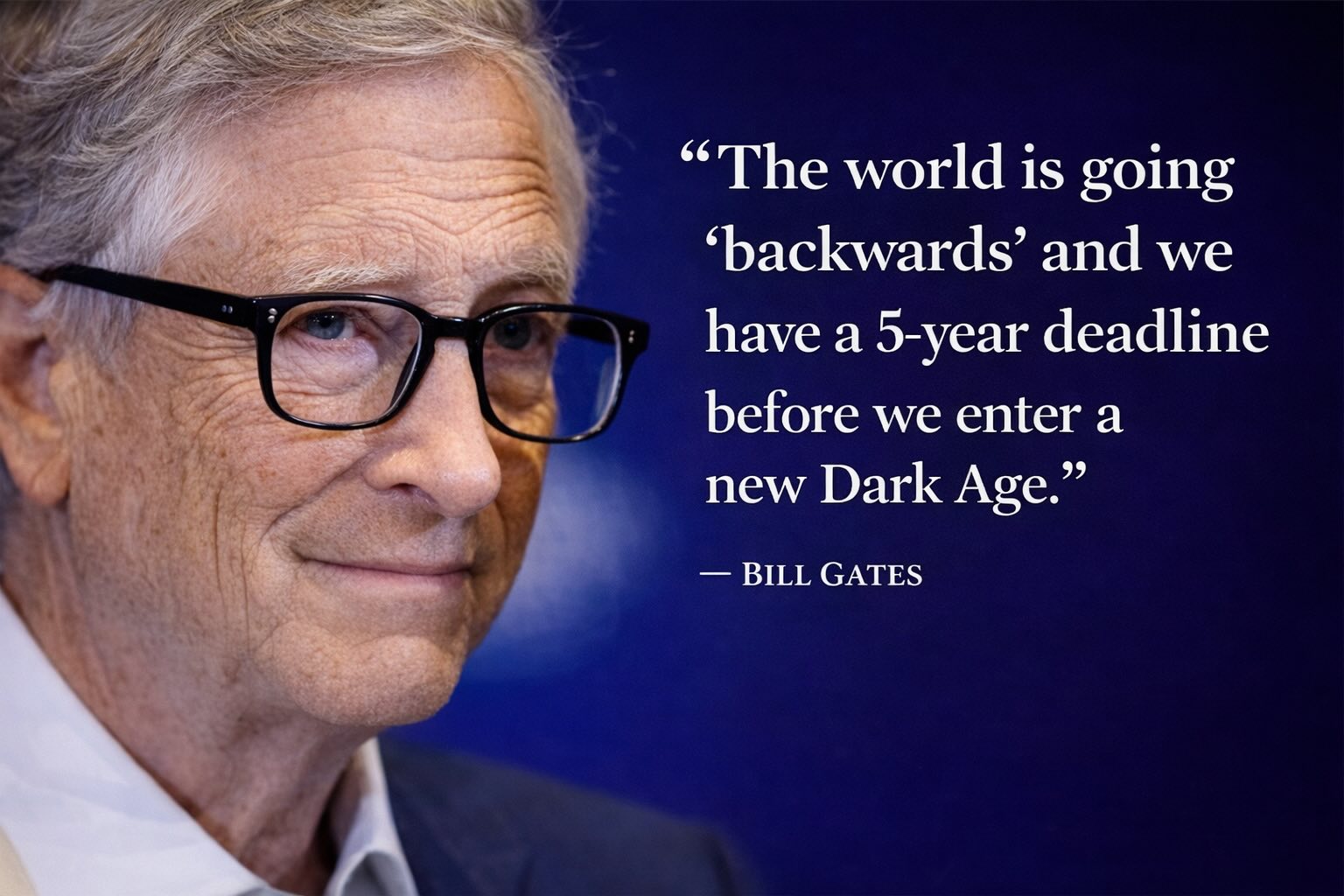
Recently, Bill Gates warned that the world is in danger of going backwards — that decades of progress could be undone, and that we may be entering something resembling a new dark age if global cooperation continues to erode.
That kind of statement matters, not because it is dramatic, but because it comes from inside the system.
When figures like this start questioning direction rather than performance, it usually signals something deeper than a temporary crisis.
That feeling is real — but the conclusion many jump to may not be.
The world is not on the brink of an overnight collapse. But we can’t continue in this direction for much longer either.
What we are experiencing is something far more familiar, and far more human.
⸻
Collapse Is the Wrong Metaphor
When we say “collapse,” we imagine sudden failure: systems breaking, lights going out, everything stopping at once.
History almost never works like that.
Civilizations don’t collapse — they linger.
They grow internally inconsistent. They contradict their own values. They keep running long after their original logic has stopped making sense.
What ends is not the world, but a way of organizing it.
⸻
The Pattern We Keep Repeating
Look closely at past transitions and a clear pattern appears:
• The Roman Empire functioned for centuries after it had already begun decaying.
• Feudalism overlapped with early capitalism for generations.
• Absolute monarchies financed the ideas that would later dismantle them.
• Industrial capitalism educated the masses who would go on to critique and reform it.
• Even rigid ideological systems survived long enough to raise the thinkers who outgrew them.
But there is an important difference between then and now.
In earlier transitions, it was kings, courts, churches, or states that unknowingly financed the ideas that replaced them — through patronage, printing, universities, or protected intellectual classes.
Today, that role has shifted.
It is not monarchs or institutions financing new ideas.
It is people.
Every book bought, every film watched, every idea shared is paid for inside the monetary system — and yet many of those ideas quietly question the very logic of that system.
In this sense, the monetary system is doing something remarkable.
It is financing its own transcendence.
Old systems don’t disappear when they are exposed as flawed.
They disappear only after a new story exists that enough people can imagine living inside.
⸻
The Overlap Window
We are currently living in the most confusing phase of any transition: the overlap window.
The old logic still dominates institutions, laws, and incentives.
The new logic already exists — but mostly in fragments, experiments, stories, and intuitions.
This is why the present feels unstable without being fully broken.
Two worlds are running at the same time.
⸻
The Quiet Irony
Here is the part we often miss.
The same system accused of destroying the future is still doing something essential.
It is printing books and selling ebooks.
It is streaming films.
It is distributing ideas across the planet.
In other words, it is unknowingly financing the imagination of what comes next.
This is not hypocrisy. It is how transitions work.
⸻
A Gentle Ending
Old worlds do not end with explosions.
They end with contradictions.
They end when enough people quietly stop believing that the old rules work.
That loss of belief does not look dramatic.
It looks like hesitation.
It looks like confusion.
It looks like people sensing that something is over, even if they cannot yet name what comes next.
⸻
A Small Invitation
Some stories try to fix the old world.
Others simply show that another one is possible.
If you find yourself feeling that we are living through a long goodbye — not a sudden collapse — you are not alone.
That question, and what might come after, is the quiet terrain explored in Waking Up – A journey towards a new dawn for humanity.
Not as a warning.
But as an invitation to imagine what follows the goodbye.
If you think a story from a possible hopeful future sounds interesting, you can find it here.
And if you found this article interesting I ask you to share it.
Thank you.
Leave a Reply