
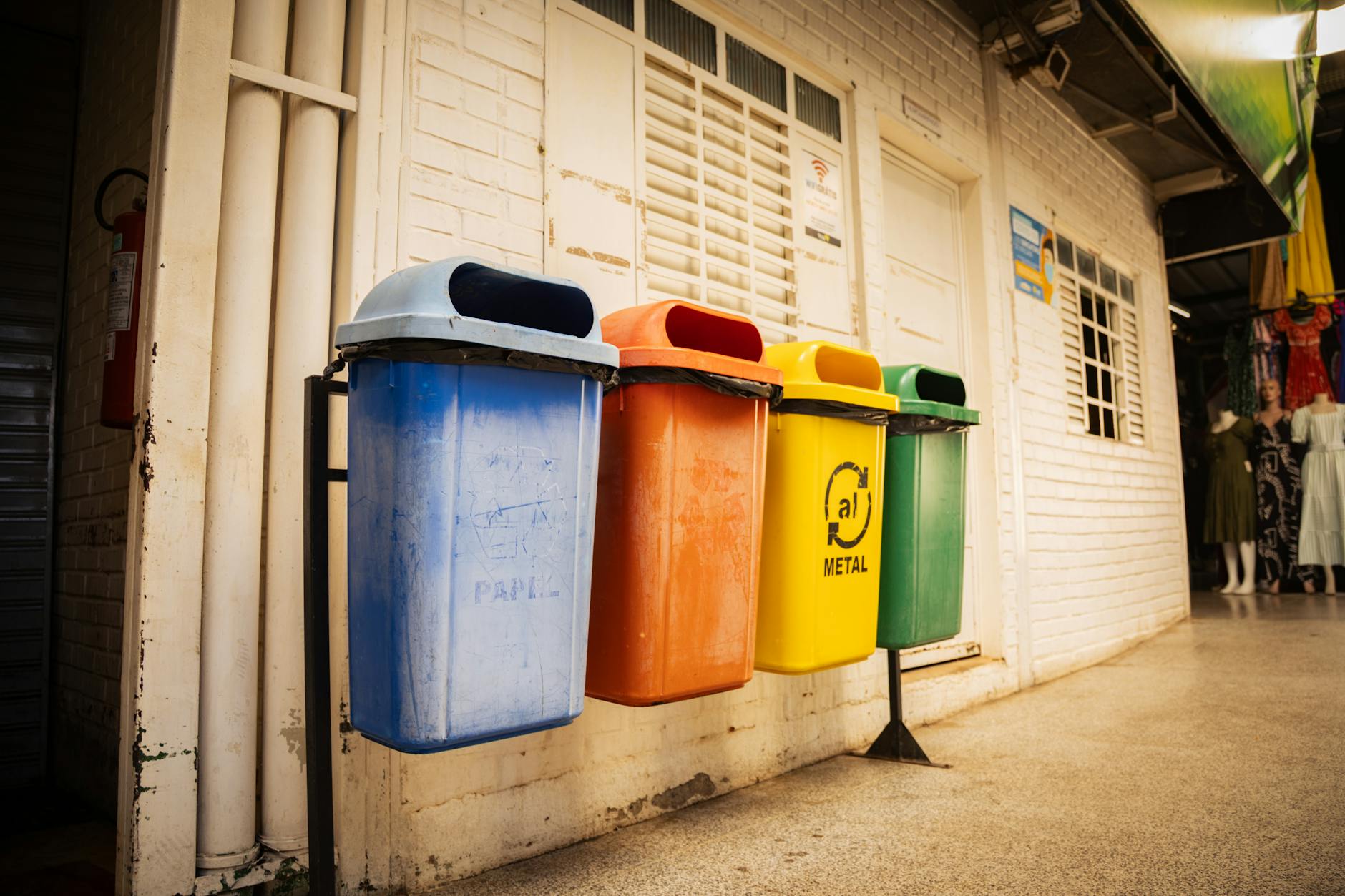
We are told, again and again:
Recycle!
Sort your waste!
Do your part!
And many of us do.
We rinse containers. We separate plastics. We fold cardboard. We carry glass to the bins.
It feels responsible. It feels right.
But there is a quiet truth beneath all of this:
Recycling has a hard ceiling.
The 6.9% Reality
Globally, only about 6.9% of all materials are cycled back into use.
That includes everything:
- Recycling
- Reuse
- Repair
- Refurbishment
- Remanufacturing
Everything that comes back into the system and is used again.
Which means:
More than 93% is not reused in any meaningful way.
Not because people don’t care.
But because the system is not designed for it.
Recycling Happens Too Late
Recycling is the final step.
It deals with what is already:
- Produced
- Used
- On its way to becoming waste
But the real decisions happen much earlier:
- How long a product lasts
- Whether it can be repaired
- Whether it can be taken apart
- Whether it is designed for reuse at all
If those decisions don’t change, recycling is always trying to catch what is already falling.
The Hidden Engine: Replacement
Our current system depends on one thing above all:
Continuous replacement.
Products must:
- Wear out
- Become outdated
- Be discarded
Otherwise, new products are not needed.
And when replacement and consumption slows down:
- Sales drop
- Production drops
- Entire industries feel it
This is not a moral issue.
It is a structural one.
The Hard Ceiling
The real ceiling is not technical.
It is systemic.
Our current monetary system depends on:
- Continuous extraction
- Continuous consumption
- Continuous replacement
Throughput is how it stays alive.
So when recycling and reuse start to reduce the need for new production,
👉 the system loses momentum.
Too much circularity means:
- Fewer new products sold
- Lower resource extraction
- Slower turnover
And that conflicts with the system’s core logic.
High levels of recycling don’t just reduce waste — they reduce throughput.
The Profit Problem
There is also another, often overlooked constraint:
Recycling is often less profitable than producing new materials.
In many cases:
- Extracting raw resources is cheaper than recovering them
- Sorting, transporting, and processing waste is complex and costly
- Recycled materials can be lower quality or harder to standardize
So even when recycling is technically possible,
👉 it is not always economically attractive
This means the system tends to favor:
- New production over recovery
- Volume over longevity
- Simplicity over circularity
Which helps explain why global circularity remains so low.
Not because we lack the ability
But because the incentives point in another direction.
So recycling improves things.
But it cannot change the the system itself.
Even if everyone recycles perfectly, several limits remain:
- Materials degrade over time
- Many products are not designed to be recycled
- Complex products are difficult to separate
- Energy is required to process materials
And most importantly:
The system keeps producing more than can ever be recovered.
But What If We Pushed It to the Limit?
Let’s flip the question.
What if we recycled, reused, repaired, and circulated as much as physically possible?
Not 6.9%.
But 70%. 80%. Maybe even 90%.
What kind of world would that create?
Nature Already Solved This
Before we talk about the future, it’s worth noticing something simple:
Nature already runs on near-perfect circulation.
Take water.
It evaporates, forms clouds, travels across the planet, and returns as rain.
Over and over again.
No ownership.
No waste.
No landfill.
The same is true for nutrients:
- Leaves fall and become soil
- Soil feeds plants
- Plants feed animals
- Waste becomes nutrients again
Everything flows.
Everything is reused.
Everything stays in the system.
👉 That is how life sustains itself on this planet
Not through extraction and disposal
But through continuous cycling
The Emergence of Abundance
In such a world, something remarkable happens:
We stop constantly needing new resources.
The materials already extracted:
- Stay in use
- Flow between people
- Are upgraded instead of replaced
Suddenly:
- Homes are not built once and forgotten — they are maintained and improved
- Products don’t disappear — they evolve
- Materials don’t vanish — they circulate
👉 The same resources serve far more people, for far longer
That is abundance through circulation
Less Extraction, More Availability
When materials are kept in use:
- Mining drops dramatically
- Land use pressure decreases
- Energy demand stabilizes
And here is the key shift:
👉 What we already have becomes enough
Not because we lowered our expectations
But because we stopped wasting what we already have extracted from Earth
Access Expands Naturally
When things are no longer constantly discarded:
- More people can use the same assets
- Idle capacity becomes visible and usable
- Sharing becomes efficient, not ideological
👉 Availability increases without producing more
This is where abundance becomes tangible:
Not more stuff
But more access to what already exists
When Waste Becomes the Exception
In a high-circular world:
- Landfills disappear
- Pollution drops
- “Throwing away” becomes rare
Waste is no longer normal
It becomes a design failure
The System Problem Revealed
And this is where the deeper insight emerges.
What we call “economy” today behaves very differently from ecology.
But what if it didn’t?
What if our economic system behaved more like a living system?
In nature:
- Nothing is owned
- Everything flows
- Outputs become inputs
- Nothing becomes useless waste
It operates with near-perfect circulation.
What we are beginning to see is that a system that truly works for all beings would not fight this logic.
It would align with it.
👉 An economy that behaves like ecology
Where:
- Resources are stewarded, not owned
- Materials circulate instead of being discarded
- Access expands instead of accumulation
- Waste is designed out from the beginning
This is not an invention.
It is a return to alignment with how functional systems already operate. Like nature.
And this is where the tension becomes clear.
Because a world like this does not fit easily inside our current system.
Why?
Because the current system depends on:
- Continuous production
- Continuous replacement
- Continuous consumption
But a high-circular world depends on:
- Longevity
- Maintenance
- Circulation
👉 These are fundamentally different logics
The Real Constraint
So the problem is not that recycling is wrong.
It is that:
Recycling operates inside a system that depends on replacement.
And replacement inevitably creates waste.
The Turning Point
If we truly push recycling and reuse as far as physically possible,
we don’t just reduce waste.
We begin to reveal a different kind of world:
- One where materials stay in use
- One where access expands
- One where abundance comes from circulation, not extraction
A Simple Realization
We went from living within nature as hunter-gatherers,
to trying to control it as savages,
and are now beginning to align with it as the Mankind of Earth.
Conclusion
Recycling matters.
It reduces harm. It recovers value. It is worth doing.
But it has a limit.
A hard ceiling.
And beyond that ceiling lies something else entirely.
Not just better recycling.
But a different system.
A world where we no longer depend on things being thrown away.
This world can be hard to imagine from today’s perspective. But it is not impossible.
In the novel Waking Up, you can get a completely new perspective from inside a world where Mankind made the choice of living as a part of nature with technology that enhances life for all beings instead of continuing with a system headed for doom.
If this perspective resonates, please share this article. I thank you.
Call to Action
And if you’re curious about this world where almost nothing is wasted, follow the journey of Benjamin Michaels in the novel Waking Up – A Journey Towards a New Dawn for Humanity.
Imagine waking up in a world where what we already have… is enough.
Leave a Reply