We think that money is the solution to everything. Pouring more of it over problems should make them go away, right?
A Billionaire’s Promise
When Bill Gates pledged to give away 99% of his fortune — over $200 billion — to be spent by 2045, headlines called it one of the greatest philanthropic commitments in history. Health, hunger, education, climate: the problems are massive, and Gates believes that with enough money, the right science, and smart management, they can be solved.
But can they?
The Promise of Money
At first glance, it’s hard not to be impressed. $200 billion could vaccinate entire regions, build schools, fund green energy projects, and support struggling farmers. Money, in this sense, looks like a universal key — a tool that can unlock progress wherever it is directed. That’s the belief that fuels philanthropy on this scale: the more dollars we mobilize, the faster we can fix the world.
The Contradiction at the Core
Yet beneath the surface lies a contradiction too big to ignore. If money created these problems, can money really be the solution?
Poverty Is Built Into the System
Consider poverty. Philanthropy can deliver food, medicine, or shelter to people in need — and it does save lives. But poverty itself is not a shortage of money; it is the direct result of how money organizes society.
Money only works when it is scarce. If everyone had an abundance, it would stop functioning altogether. Its value comes from the fact that not everyone has it, and that you must trade your time, labor, or resources to get it. If everyone suddenly had “enough,” prices would simply rise until scarcity returned.
In other words, poverty is not a tragic accident of the system — it is a requirement. For money to keep its value, some people must always be excluded. The system itself ensures that wages are kept low, debts are enforced, and resources are concentrated, not because there isn’t enough food, housing, or energy, but because without inequality, money itself would collapse. Wealth and poverty are not opposites; they are two sides of the same coin.
Climate Change and Profit Logic
The same is true of climate change. Gates has invested in carbon capture, nuclear power, and green innovation. But climate chaos is not only an energy problem — it is a system problem. Our economy thrives on extraction, waste, and endless growth. Injecting more money into cleaner versions of the same system does not change its core logic: profit above planet.
The problem is not that we lack the technology to live sustainably, but that our economic model rewards short-term gain and punishes restraint. As long as money drives the logic, even philanthropy cannot stop industries from consuming the Earth in pursuit of growth.
Power and Inequality
And then there’s power. When one man, no matter how well-intentioned, can decide how hundreds of millions of people will live, we face another paradox. The very act of giving away billions reinforces the inequality it claims to fight.
We still live in a world where the fate of the poor depends on the choices of the ultra-rich. This is not justice — it is benevolence within the boundaries of a system that demands inequality to exist. Charity may soften the edges, but it leaves the structure untouched.
The Scarcity Trap
As mentioned above, there is the deeper truth of money itself: it only has value when it is scarce. History shows us what happens when everyone suddenly has “enough.”
In Weimar Germany in 1923, and again in Zimbabwe in the 2000s, governments flooded their economies with banknotes. Very quickly, everyone had them — bundles, wheelbarrows, even trillions of dollars in salaries. But prices rose just as fast, until the money became worthless.
Or take a thought experiment: tomorrow, every person on Earth receives ten million dollars. At first it feels like paradise, right? — no one is poor, no one needs to struggle. But within days, no one will grow food, clean streets, or drive buses. Why would they? Prices for essentials skyrocket, demand outstrips supply, and within weeks the “universal millionaire” dream collapses. The currency itself becomes meaningless, and people return to barter or invent a new token of scarcity.
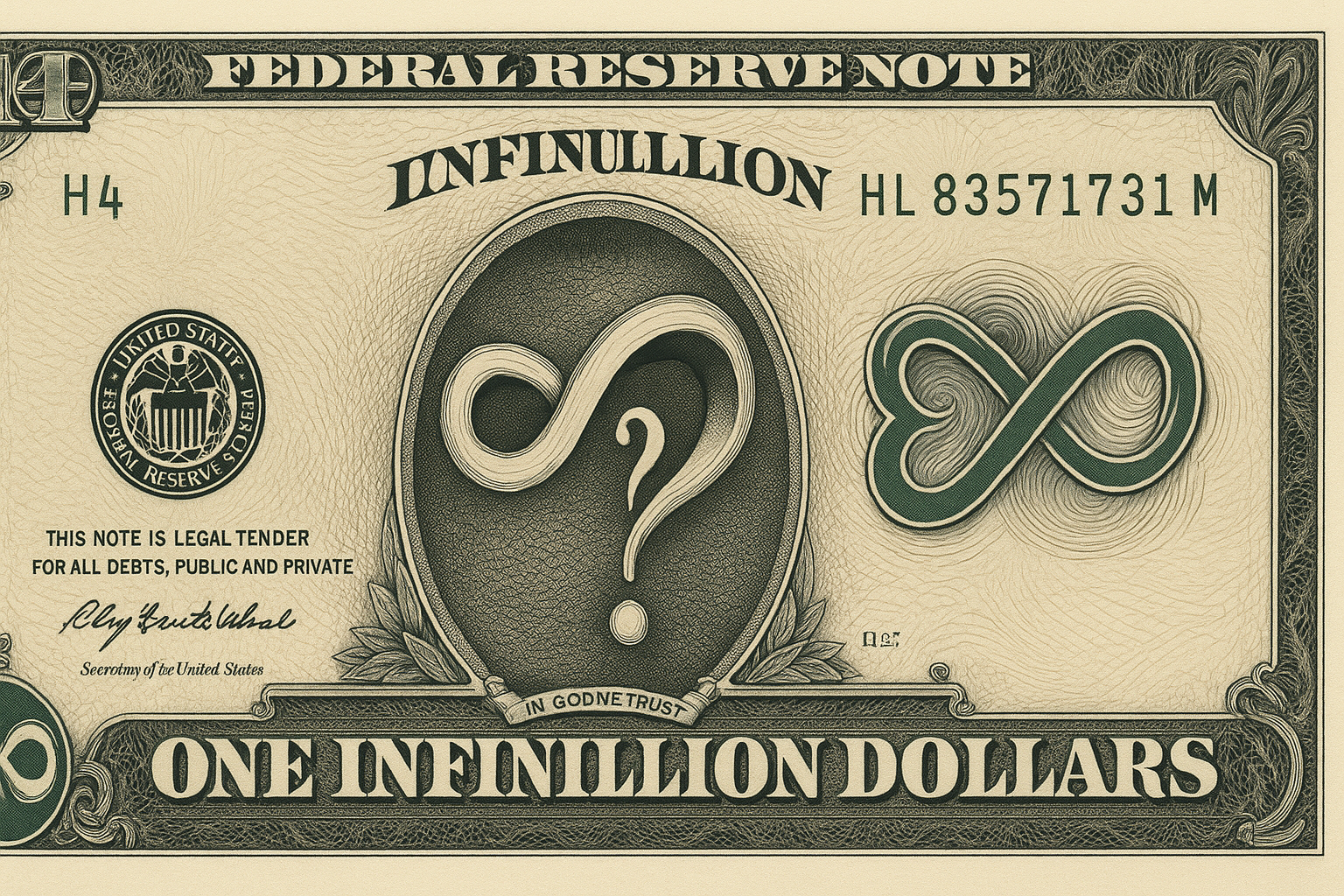
The logic is unavoidable: money only has value when NOT everyone has it. Its purchasing power depends on someone else not having it. If everyone did, it would be impossible to buy or sell anything at all.
This is why poverty never disappears in a money-based system. It isn’t a flaw to be fixed with more philanthropy. It is the very mechanism that keeps the system alive.
Treating Symptoms, Not the Cause
So while philanthropy can ease suffering, it cannot cure the disease. It can treat symptoms, but it cannot touch the root. More billions will not change the fact that the monetary system itself depends on exclusion, competition, and scarcity. And we are talking about THE MONETARY SYSTEM here, not capitalism, socialism or any other -ism. As long as the basis is money it will always be like this.
A Glimpse Beyond Money
And this is where fiction becomes a mirror.
In the novel Waking Up – A journey towards a new dawn for humanity, Benjamin Michaels opens his eyes in a world one hundred years in the future. He expects the familiar battles of wealth and survival. Instead, he finds something shocking: money itself is gone.
The Human Shock of Abundance
At first, his instincts betray him. He looks for a wallet, wonders who is profiting, suspects that someone must be in control. But slowly, the reality dawns: the old logic is gone. Here, life is organized not by money but by access, collaboration, and care.
Two Paths Forward
And so the real question emerges: if this world is possible in fiction, why not in reality?
Bill Gates believes more money can save the world. But what if the opposite is true? What if the world can only be saved when money itself is no longer the measure of value?
Philanthropy looks noble, but it is still locked inside the paradigm that created the problems. Ben’s awakening suggests another path: one where humanity organizes around need, not profit; where innovation is driven by curiosity, not patents; where survival is a birthright, not a market exchange.
The Choice Before Us
Imagine if even a fraction of Gates’ billions were not used to patch up the old system, but to prototype the new — communities, technologies, and models of living that no longer depend on money at all. The change would not just be charitable; it would be transformational.
So we return to the question: can more money save the world? Or will we only truly wake up when we dare to imagine a future beyond money itself? If you want to experience a world of abundance without money I invite you to read the book: