
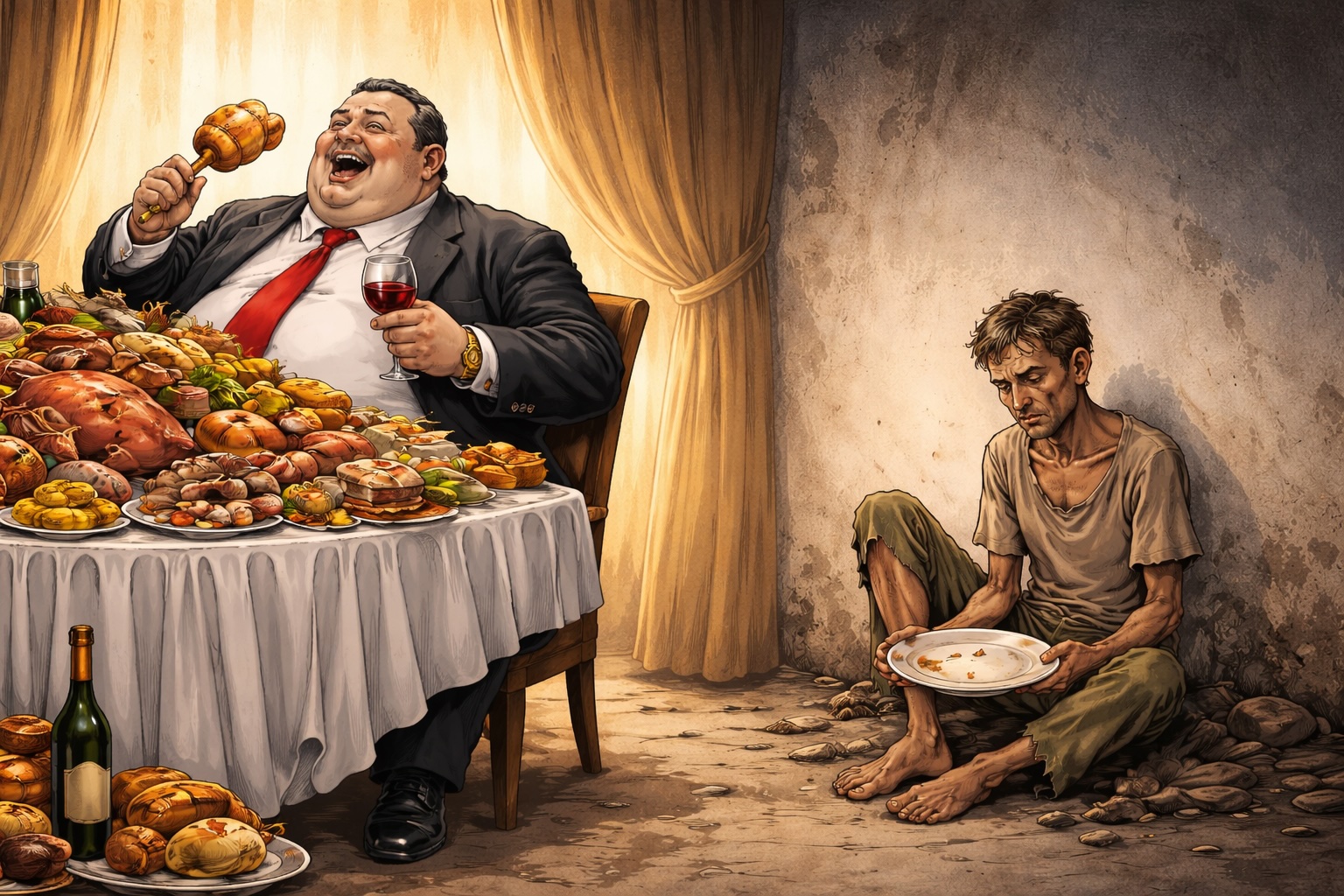
We hear it everywhere:
“There is too much inequality.”
“We need a fairer world.”
“Reduce inequality within and among countries.”
The United Nations has even made it a global objective — Sustainable Development Goal 10: Reduced Inequalities — not merely as a moral gesture, but because persistent inequality is linked to political instability, social unrest, fragile economic growth, migration pressure, and declining trust in institutions. In other words, reducing inequality is viewed as a way to preserve systemic stability at both national and global levels.
That sounds noble. Necessary. Urgent.
But here is the deeper question:
What is inequality actually a symptom of?
The Surface Debate
Most public conversations about inequality focus on distribution of money.
- Tax the rich more.
- Strengthen welfare systems.
- Introduce Universal Basic Income.
- Improve access to education.
All of these operate within the existing structure.
They assume the architecture itself is sound — it just needs adjustment.
But what if inequality is not merely a distribution issue?
What if it is a hardwired structural outcome?
The Systemic Mechanism
Our modern economy is built on three core principles:
- Hoardable tokens (money).
- Legally protected ownership claims that almost can be infinite.
- The ability for assets to compound over time.
When tokens can be stored indefinitely,
When ownership rights can be accumulated without upper bound,
And when returns on assets generate further returns,
concentration and inequality is not an accident. It is a predictable mathematical outcome.
This is not a moral accusation.
It is system dynamics.
If returns on capital outpace overall economic growth, wealth will consolidate. If wealth consolidates, influence consolidates. If influence consolidates, opportunity narrows.
Inequality then becomes structural.
Inequality vs. Diversity
There is another confusion in the debate that deserves clarity.
Equality of rights does not mean sameness of people.
A world in which every human being has secure access to food, shelter, healthcare, education, and safety would not become uniform or grey. Quite the opposite.
When people are fed and safe, survival anxiety decreases. When survival anxiety decreases, creativity expands. And when creativity expands, diversity flourishes.
Art, science, entrepreneurship, philosophy, culture — all blossom more freely when basic insecurity no longer dominates attention.
Reducing structural exclusion is not about making everyone identical.
It is about removing artificial barriers so human variation can express itself without fear.
True diversity requires security.
True equality of rights enables difference.
Inequality vs. Exclusion
Two people being unequal is not automatically a crisis.
The destabilizing threshold appears when inequality turns into exclusion.
When large portions of a population:
- Lack secure access to essentials.
- Experience frozen mobility.
- Feel the system is rigged.
- Lose trust in institutions.
Then inequality shifts from statistical difference to systemic fracture.
Global institutions acknowledge this. High inequality correlates with political instability, social unrest, polarization, and fragile growth.
In other words:
Inequality destabilizes systems.
But notice the subtlety.
The official response is not to question the architecture of ownership.
The response is to manage inequality so the system remains stable.
The Structural Question
Here is the uncomfortable possibility:
What if the very permission structure of exclusion — the ability to accumulate almost unlimited claims over finite resources — is the generator of recurring inequality?
If that is true, then redistribution of tokens can soften symptoms, but cannot remove the underlying dynamic.
The debate then shifts from:
“How do we reduce inequality?”
to:
“What kind of system generates secure access without requiring exclusionary accumulation?”
That is not a small reform.
It is a total design change.
Beyond Redistribution
History shows that pressure has shaped humanity.
Ownership and trade accelerated development, coordination, and innovation.
But systems evolve.
At some point, a structure that once created growth may begin to generate instability.
If we are now facing ever widening gaps, environmental overshoot, political polarization, and systemic fragility, perhaps the question is no longer how to manage inequality — but whether the architecture itself needs to change.
A mature civilization will not eliminate all differences.
But it would ensure universal sufficiency.
It would guarantee secure access allowing everyone to thrive.
It would treat planetary resources as shared inheritance rather than infinite private claims.
The Real Conversation
This is not about resentment.
It is not about class war.
It is not about punishing success.
It is about structural coherence.
If inequality repeatedly destabilizes the system,
then perhaps inequality is not the disease.
Perhaps it is the signal.
The real question is not:
“Who has too much?”
The real question is:
“What kind of architecture produces recurring exclusion — and what would a post‑exclusion system look like?”
That is the conversation we have barely begun.
If you like this article, please share it.
And if you want to explore what a structurally different civilization might look like, you can begin with the novel Waking Up – A Journey Towards a New Dawn for Humanity.
The story is only just beginning.
And don’t forget, the free companion book is out now.