This is one of the most honest and important questions I get from readers of Waking Up – A Journey Towards a New Dawn for Humanity.
People ask:
“But what can we actually have in a world like that?”
And it’s a fair question.
Because when you hear about a world beyond both capitalism and communism, this is exactly where your mind goes.
So here, I’ll try to answer it.
Because let’s be clear:
- In communism, everything was collected, measured, and distributed by the state.
- In capitalism, we can accumulate as much as we can manage to control — money, land, resources — often far beyond what we could ever use.
And many people instinctively reject both.
They don’t want to stand in line for a ration.
They don’t want to live in a world where a few own everything either.
So the real question becomes:
What can we actually have in the new kind of world described in the novel?
The False Choice
We have been taught that there are only two options:
- Central control → where someone else decides what you get
- Unlimited accumulation → where individuals compete to take as much as possible
But both models share the same flaw:
They disconnect access from actual use.
- In communism, access is restricted regardless of abundance
- In capitalism, access is expanded regardless of need — yet still restricted for many despite abundance
Neither asks the most important question:
What is actually needed, possible, and sustainable?
A Different Starting Point
In a resource-based, post-monetary world — like the one explored in Waking Up — the question shifts entirely.
Instead of asking:
“What are you allowed to have?”
We ask:
“What can be provided — for everyone — without harming the environment that supports us?”
This is not ideology.
This is engineering.
In Waking Up, Aweena — a guide in the future world — puts it simply when guiding Benjamin, the protagonist who has awakened into it and is made of questions:
That’s it.
But What About Unlimited Desire?
Today, voices like Elon Musk suggest that in the future, technology — AI and robotics — may be able to fulfill almost any human desire.
And that raises a natural question:
What if I want something extreme?
What if I want a gold-plated castle… just for me and my family?
Clearly, not everyone can have that in the physical world.
So does that mean we go back to limitation, rationing, or hierarchy?
Not necessarily.
Two Layers of Reality
In Waking Up, this challenge is approached differently.
There is a distinction between:
- Physical reality (what actually consumes resources)
- Experienced reality (what we perceive and feel)
Through advanced nano-lens technology, people can experience environments that feel completely real — including living in a golden castle, if they wish.
It looks real.
It feels real.
But it does not require vast physical resources.
Meanwhile, the actual physical world is designed intelligently and sustainably.
So instead of forcing reality to match every fantasy…
we expand experience —
while keeping physical systems in balance.
The Real Constraints
When it comes to the physical world, the limits are not political — they are practical.
How much land do we actually have?
The world has about 104 million km² of habitable land.
But not all of that should be used by us.
We want to preserve:
- natural reserves
- as much forest as possible
- biodiversity and ecosystems
So instead of looking at all habitable land, let’s focus on what is already part of human use:
- cities and settlements
- agricultural land (which in many cases can be regenerated and optimized)
And let the rest remain for nature.
It’s also worth noting that some currently barren or desert areas are already in the process of being regenerated — for example in parts of Africa and China — meaning that over time, additional land could become both habitable and productive again. This also means that the percentage of land available for dwellings could increase over time, without encroaching on forests or natural reserves.
So let’s do a simple thought experiment
If we kept the global population stable at 10 billion people, and we assume an average of 4 people per household, that would mean about 2.5 billion families. The UN’s household database defines household size as the average number of usual residents per household, which is the basis for this kind of estimate. (unstats.un.org)
If we reserved:
- 5% of habitable land for homes, gardens, and local community space, that would give about 2,080 m² per family
- 10% of habitable land for that purpose, it would give about 4,160 m² per family
Those figures are simple arithmetic based on global land area and assumed household size. They are not a prescription, but they show something important:
even with 10 billion people, the question is not only whether there is space — but how intelligently we choose to use it.
So what does this actually mean in real terms?
Let’s take a clear, tangible example:
What if every family on Earth had around 4,000 m² of land?
Let that sink in.
EVERY FAMILY ON EARTH could have this if we simply divided land and distributed resources intelligently.
And of course — not every family would even want or need this much.
And that’s the point.
In a world designed around reality instead of scarcity and competition, we could actually have what we want — at least, for the most part.
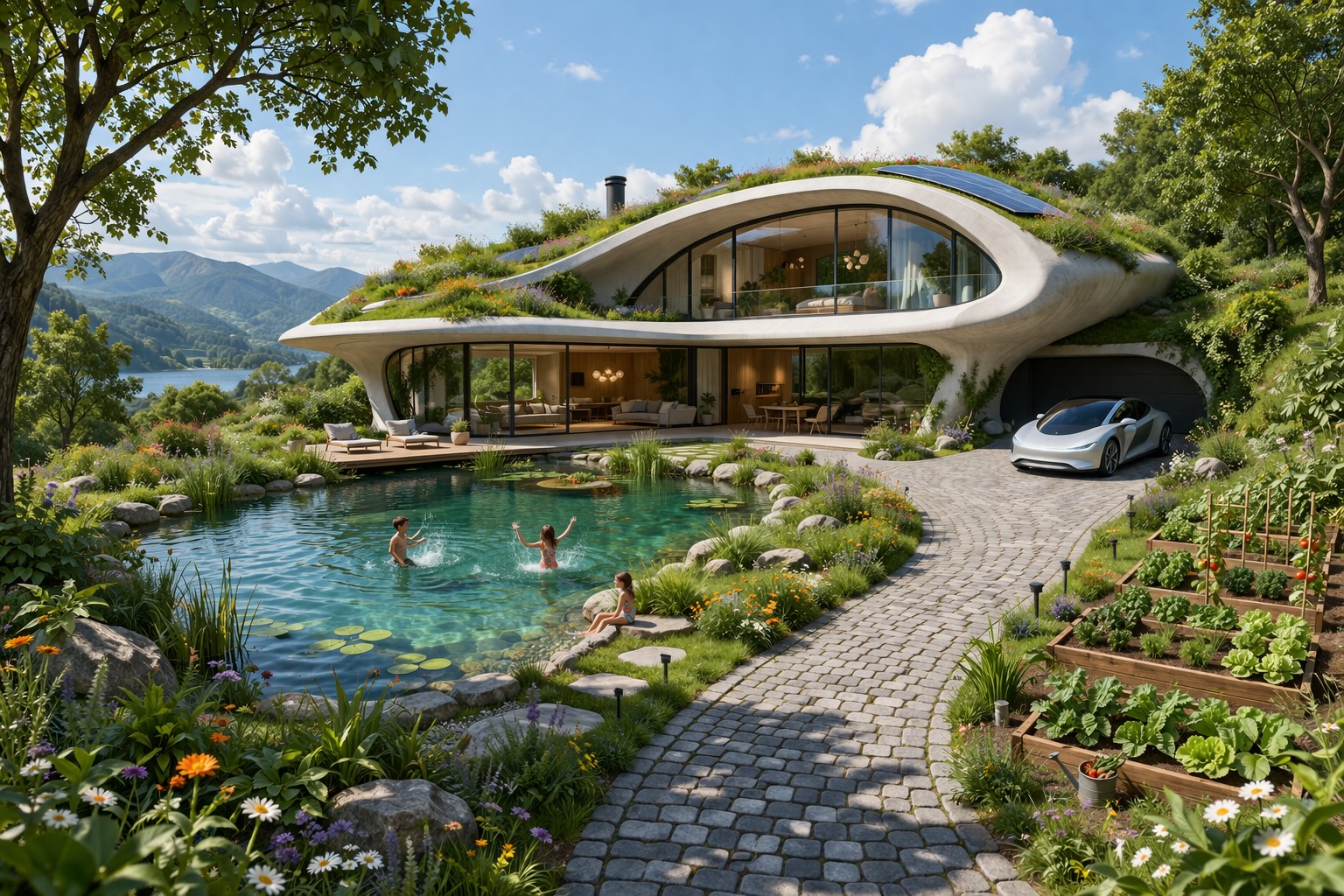
On that land, a family could have:
- a 500 m² house — spacious, well-designed, lasting quality and highly functional
- built to stay cool in the summer and warm in the winter
- with room for the whole family — and guests
And still have:
- a large garden with trees, food production, and open space
- privacy, swimming pool, nature, and room to breathe
And this is not an extreme scenario.
It fits within a framework where we:
- preserve natural reserves
- keep large forest areas intact
- maintain efficient agriculture
- and even expand usable land over time through regeneration
So the real realization is this:
we are not lacking land.
We are lacking intelligent distribution and use of it.
That is the difference.
What About Location?
Of course, this raises another very human question:
What about where people live?
We would have to be adults about this — not fall back into fighting over the most desirable locations.
A fair approach could combine belonging and chance:
- If a family is native to a place, or has lived on a piece of land for generations, they should have first choice to remain there.
- For new allocations, or when multiple families want the same location, there could be a transparent draw.
If two families want the exact same spot, a simple, fair draw resolves it — not wealth, not power, not influence.
This may feel unfamiliar at first.
But compare it to today:
Access to the best locations is already decided — just by money.
A fair system would simply replace that with belonging, transparency, and equality of opportunity.
Available Resources
If we stop wasting, hoarding, and duplicating unnecessarily, the equation changes dramatically.
We must look at:
- Food production
- Materials
- Energy
- Manufacturing
And ask:
What is truly possible when everything is designed for efficiency instead of profit?
From Ownership to Access
Today, we ask:
“Who owns this?”
In the new model, we ask:
“Who needs this — and how do we provide it intelligently?”
You don’t need to own ten houses. You need access to the space you actually use.
You don’t need to hoard goods.
You need reliable access to what improves your life.
When systems are designed properly:
Access becomes more abundant than ownership ever was.
An Example From Reality
Think about it this way:
Today, a billionaire might own five tropical islands — but only has access to those five.
In a system based on shared access instead of ownership, that same person could potentially enjoy thousands of tropical islands.
In other words, when we share, everyone will have more.
Less ownership.
More access.
And in the end — more freedom.
So… What Can You Have?
You can have everything that can exist:
- within physical limits
- without harming ecosystems
- without depriving others
And beyond that?
You can experience far more than physical reality alone could ever provide.
What You Cannot Have
Let’s be equally honest.
You cannot have:
- Unlimited private control over shared resources
- Excess that comes at the expense of others
- Systems that degrade the planet for personal gain
Not because of ideology.
Because it simply doesn’t work.
The Real Answer
So what can you actually have?
You can have:
Everything that can be created, sustained, and shared — without taking it from someone else or from the future.
That’s the boundary.
And within that boundary:
There is far more available than we have ever allowed ourselves to imagine.
A Final Thought
This is not about less.
It is about alignment with reality.
Because when access is based on what is possible — rather than what can be bought or controlled —
we stop fighting over pieces…
and start building a world that actually works.
Curious what such a world could really look like, what it would be like to live in one?
If so, read Waking Up – A Journey Towards a New Dawn for Humanity
And if this article resonates with you — feel free to share it. I would appreciate that immensely, and thank you.