Tag: Redesign

  • Life After Redesign

    Life After Redesign

    In the previous article, Redistribution vs. Redesign, I suggested that many of the challenges humanity faces today may not be solved by redistributing wealth within the current system, but by redesigning the system itself. Redistribution attempts to adjust the outcomes of the existing structure, while redesign asks a deeper question: whether the structure itself is what creates the problems in the first place.

    The Question

    That idea often leads to an immediate question:

    What would life actually look like after such a redesign — a redesign that leads to a world without money and ownership?

    Would shops disappear?
    Would production collapse?
    Would society fall into chaos?
    Or could everyday life actually become simpler and more human?

    The Confusion

    For many people, the idea of a world without money or trading sounds confusing at first. But that confusion mainly comes from looking at the question through today’s mindset, where the planet is divided into ownership and access depends on money. If no one owned the planet and no one could claim exclusive ownership over parts of it, there would be nothing to trade in the first place. Money would simply have no role. Instead, the question would shift to something much more practical: how humanity can organize the most intelligent and fair ways of sharing this planet as one global family.

    The Production

    But the assumption of chaos also comes from confusing money with the systems that actually produce and distribute the things we need.

    The farms that grow food would still exist.
    Factories would still produce tools, clothes, and technology.
    Logistics networks would still move goods around the world.
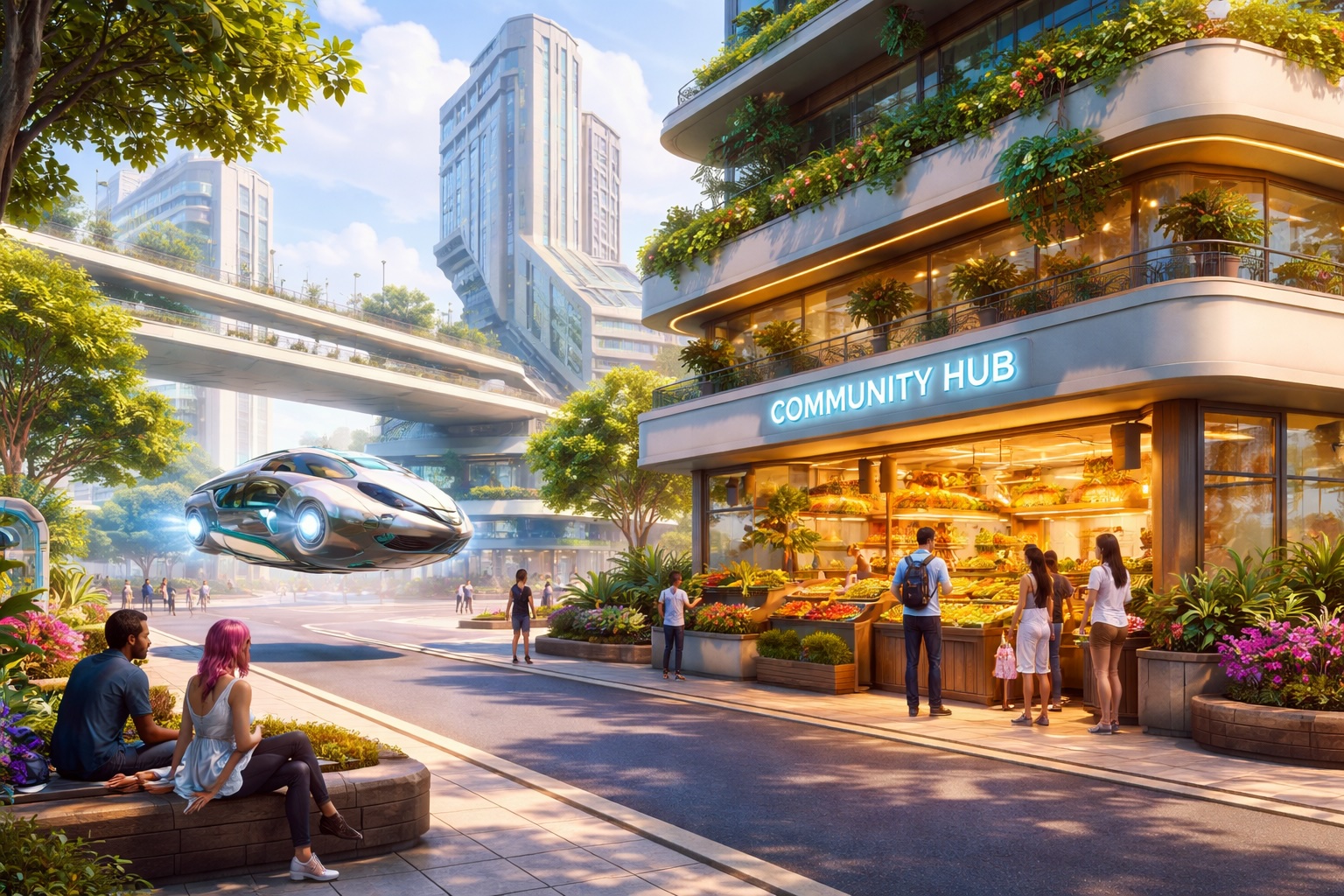
    And places where people collect what they need — shops, distribution centers, or community hubs — would still be there.

    What would disappear is not production or distribution.

    What would disappear is simply the payment step.

    Instead of the chain looking like this:

    Production → Transport → Shop → Payment → Access

    It could simply look like this:

    Production → Transport → Distribution → Access

    In other words, people would still walk into a place where food and everyday goods are available. The difference is that access would no longer depend on having the right amount of money.

    The Trust Based Economy

    At this point many people ask a very practical question: what would stop someone from simply emptying the store and taking far more than they need?

    The impulse to hoard usually comes from fear of scarcity. In a system designed around continuous access to goods, hoarding quickly becomes pointless. If you know you can return tomorrow and find the same items available, there is little reason to take more than you need today.

    Human societies have always relied not only on rules but also on social norms, trust, and simple practicality. Even today we constantly trust each other to honor agreements and to act in good faith. When we buy something in a store, we trust that the contents of the package are actually what the label says they are. We trust each others to heed agreements that we have made. We trust that the money we pay with are not counterfeit. Most people already take what they need in shared situations — at buffets, public spaces, libraries, or community resources. Physical limits also apply: a person can only carry so much, store so much, and consume so much. What can easily be hoarded today is not products themselves but money — a compact, abstract unit that can be accumulated without practical limits. Especially when they are only numbers in an account.

    In smaller, human-scale communities, where people feel connected to the places they live and to each other, social responsibility often becomes a natural regulator. Taking wildly excessive amounts would quickly become visible and socially questioned. And practical limits apply as well — how many bananas could someone realistically hoard anyway? Most fresh food spoils quickly, which naturally discourages stockpiling. Physical good take up space and are not always easily transported.

    In other words, the system would not rely on money to regulate behavior, but on a combination of abundance, transparency, trust, and human social norms.

    Would There Be Enough?

    Another question people often ask is: would there actually be enough for everyone?

    This question also comes from the experience of living inside a system where access depends on money and where scarcity is often artificially created by price, marketing, and competition.

    In reality, modern production systems are already capable of producing enormous quantities of goods. The challenge today is not primarily production or resources, but distribution and the economic rules that control access.

    Food is often destroyed while people go hungry. Houses stand empty while people need housing. Warehouses are full of products waiting for buyers.

    A redesigned system would simply focus production on meeting real human needs rather than maximizing sales. That alone would likely make abundance far easier to achieve.

    Product Design

    Another interesting question is how products themselves might look in such a world — and here too it would largely be up to our own creativity how we design and decorate packaging.

    Today many products are designed primarily to compete for attention. Packaging is colorful, flashy, and optimized for marketing because companies must constantly fight for visibility in stores.

    In a system where products are simply available rather than competing for sales, packaging could become far simpler and more practical.

    A toothpaste tube might indeed look very simple — perhaps mostly white, with a clear label that simply says:

    TOOTHPASTE

    But that does not necessarily mean the world would become dull or boring. Quite the opposite. When products no longer need to scream for attention in order to sell, design can focus on durability, usability, beauty, and sustainability rather than marketing—and it could still be colorful and expressive if that is what people enjoy.

    If we prefer simple black-and-white toothpaste tubes, we can design them that way. If we prefer colorful and playful products on the shelves, we can create that too. Colors and aesthetics would still exist — but they could serve human enjoyment rather than commercial competition.

    The result might actually be environments that are calmer, less visually noisy, and more thoughtfully designed.

    Communities

    Another likely change is how we organize our living environments.

    Today many people live in enormous megacities largely shaped by economic forces. But humans tend to function better in environments that are more human-scale.

    It is easy to imagine communities of perhaps a few thousand to around ten thousand people — large enough to support schools, healthcare, culture, and local production, yet small enough that people feel connected to the place where they live.

    Food could be grown locally where possible, supported by regional and global logistics networks that distribute what cannot be produced close by.

    Contribution

    In such a world, people would no longer need to choose their activities primarily based on what pays the bills.

    Instead, people could contribute in areas where their interests, talents, and curiosity naturally lead them.

    Some people genuinely enjoy farming.
    Some love engineering.
    Some enjoy teaching, cooking, building, researching, or creating music.

    Human beings are naturally curious and creative. When basic survival is secured, contribution often becomes something people want to do, not something they are forced to do. In such an environment, creativity would likely blossom in every field — from science and engineering to art, music, agriculture, architecture, and new ways of organizing everyday life.

    Technology

    And the work that few people enjoy — dangerous, repetitive, or exhausting labor — is exactly the kind of work that modern technology is increasingly capable of handling.

    Automation, robotics, and AI are already transforming industries today.

    In a redesigned system, these technologies could finally be used for what they were always meant to do:

    to free human beings from unnecessary labor — something that is already increasingly possible today, as AI and robotics are reaching the level where they can perform many of the tasks humans currently do.

    Imagine Through Story

    For many readers, this may still feel abstract. After all, we have lived inside a monetary system for so long that imagining life beyond it can be difficult.

    This is precisely why I wrote the novel Waking Up – A Journey Towards a New Dawn for Humanity.

    The story follows Benjamin Michaels, who wakes up one hundred years in the future in a world where humanity has redesigned its systems and learned to organize society in a way that works for everyone and for the planet.

    It is not simply a guided tour of a better future. The story unfolds as a real drama, where Benjamin encounters allies and opponents — including a former secret agent who tries to bring back the old monetary system. He also meets long-lost family, forming relationships that add emotion, tension, and discovery to the journey.

    Through his eyes, readers get a glimpse of what life might actually feel like in such a world — not as theory, but as lived experience.

    Because sometimes the easiest way to explore the future is not through economic models or political debates…

    but by stepping into it through a story.


    If this vision resonates with you, you can explore that world through the novel:

    Waking Up – A Journey Towards a New Dawn for Humanity

    If you think more people should be part of this conversation, please share this article. Thank you.
  •   Redistribution vs.  Redesign 

      Redistribution vs.  Redesign 

    Our world today is a dense jungle of ownership.

    Property borders. Intellectual property. Patents. Land titles. Corporate ownership structures. National borders. Mineral rights. Water rights. Airspace. Fishing quotas.

    Layer upon layer of legal claims about who owns what.

    And on top of this already complex system sits money — the universal measuring stick that is supposed to tell us what all these claims are “worth.”

    How much is this land worth?
    How much is this company worth?
    How much is your property worth compared to mine?

    Lawyers argue. Real‑estate brokers estimate. Buyers negotiate. Sellers speculate.

    But a deeper question is rarely asked:

    How much is the land actually worth to humanity?

    Or even more fundamentally:

    Should the planet itself be something that can be owned at all?

    The Redistribution Idea

    Many people sense that the current system produces extreme inequality. A small number of people control enormous wealth, while billions struggle.

    The intuitive response is therefore often:

    “We need redistribution.”

    Take wealth from those who have too much and give it to those who have too little.

    At first glance this sounds fair. But redistribution faces a profound problem.

    It assumes that the underlying idea of ownership itself is correct — and that the only issue is who currently holds the pieces.

    But what if the real problem is not distribution?

    What if the real problem is the design of the system itself?

    Redistribution Inside a Broken System

    Imagine attempting to redistribute everything on Earth in a fair way:

    Land. Companies. Natural resources. Intellectual property. Infrastructure. Housing.

    Who would decide how it should be divided?

    Nations? Courts? Committees? International negotiations?

    Every border would be contested. Every claim debated. Every group arguing why their share should be larger.

    In a world already filled with conflict over territory and resources, redistribution could easily create even more conflict. No one wants to give up what they own when that ownership was somehow fought for and legal.

    We already see what happens when ownership claims collide.

    Countries fight wars over land.
    Corporations fight lawsuits over patents.
    Nations compete over oil, minerals, and trade routes.

    Sometimes the country with the largest military simply takes what it wants.

    And when oil fields burn, the smoke does not stay inside borders. The pollution spreads across the planet and harms even those who bombed them from afar.

    Redistribution inside the same ownership framework risks becoming little more than a new round of conflict over the same pieces of the game board.

    A Different Question

    Instead of asking:

    “Who should own what?”

    What if we asked something far deeper:

    “Why should anyone own the planet at all?”

    The Earth existed long before any legal system. Forests, rivers, oceans, and ecosystems are not human inventions.

    They are the foundation of all life.

    Yet humanity has divided this shared inheritance into billions of pieces of property, each with its own legal owner.

    From a planetary perspective, the situation is strangely chaotic.

    Redesign Instead of Redistribution

    Rather than redistributing ownership, we could imagine redesigning the system itself.

    A simple reset principle could look like this:

    No one owns the Earth.

    Instead:

    Humanity belongs to the planet — and shares responsibility for it.

    Land and resources would no longer exist primarily as objects of speculation and trade.

    They would exist as shared assets that must be stewarded intelligently.

    In such a system the goal would not be maximizing profit from land, but maximizing:

    • ecological health
    • long‑term sustainability
    • human well‑being
    • efficient use of resources

    Cities, agriculture, forests, and infrastructure could then be organized according to what actually works best for people and nature — not according to historic ownership claims that may be centuries old.

    But this does not mean people would suddenly lose their homes, farms, or places they love. The transition would not be about taking land away from people, but about changing the relationship to the land itself.

    Those who already live on and care for land would simply continue doing so — not as owners, but as stewards.

    If your family has lived on a farm for generations, nothing would prevent you from continuing to live there after such a transition, if that is what you wish. The farm would remain your home and your responsibility.

    The difference is philosophical rather than practical: instead of claiming permanent ownership of a piece of the planet, you would steward it on behalf of the living world and the human community.

    In other words, people would not lose their land — they would gain a new role: caretakers of the part of the Earth they know best.

    Equal Belonging, Not Identical Pieces

    When people hear the idea that humanity shares the planet, they sometimes imagine that everything must be divided into perfectly identical pieces.

    But equality does not necessarily mean identical plots of land.

    It means equal belonging to the planet.

    In a redesigned system, different families and communities might live on different amounts of land depending on geography, lifestyle, preference and needs.

    One family might live on two hectares.
    Another might live on three hectares.

    Some might prefer an apartment with much less responsibility.

    But if land is no longer something to accumulate or speculate on, those differences stop being a source of competition.

    They simply reflect different ways of living.

    One family might grow food or keep animals and therefore use more space.
    Another family might prefer a smaller homestead and rely more on shared community resources.

    Instead of rigid ownership boundaries, communities could cooperate.

    Neighbors might share tools, knowledge, gardens, or even land use when it makes sense.

    A family with more land might share agricultural knowledge with others.
    Another family might contribute technical skills, medicine, teaching, or craftsmanship.

    The planet becomes not a battlefield of property claims, but a network of stewardship.

    Sharing the Fruits of the Land

    A natural question then arises: if land is no longer owned as private property, how are the products of that land shared?

    The key lies in a very simple principle that humans have practiced in communities for thousands of years:

    Use what you need. Share the surplus.

    A family cultivating three hectares might produce more food than they personally need. Instead of selling that surplus for profit, the excess simply becomes part of the natural flow of resources within the community.

    Nearby families, communities, and cities draw from that flow according to need. In return they contribute in their own ways — through other crops, technical skills, medicine, teaching, construction, research, art, or care.

    Importantly, this does not require a central authority collecting everything and redistributing it, as many historical attempts at centralized planning tried to do.

    There is no need for a state warehouse where all production must be delivered.

    Instead, sharing happens organically through human relationships, cooperation, and mutual trust.

    Families use what they need from the land they steward. The surplus naturally flows outward — to neighbors, nearby communities, or even further away when needed.

    People already possess an innate sense of fairness and reciprocity. When the pressures of competition, scarcity, and profit disappear, that sense of respect and brotherhood becomes the natural organizing principle of society.

    In other words, the question shifts from:

    “What can I sell this for?”

    to:

    “Who can benefit from what we have more than enough of right now?”

    Modern Technology

    Modern technology can help coordinate this flow by mapping needs and resources so that food, materials, and services move efficiently to where they are most useful, and it can also assist directly with growing, monitoring, and harvesting crops so that land is cultivated in the most efficient and sustainable way possible. And of course transport and distribute it to where it is needed.

    Instead of millions of isolated transactions, the economy becomes a living network of contribution and shared abundance.

    Within such a system the family on two hectares and the family on three hectares are not competitors. They are simply different contributors to the same shared world.

    The Only Universal Principle

    Every culture on Earth already contains the same moral intuition:

    Respect. 

    The common denominator

    Respect for neighbors.
    Respect for different beliefs.
    Respect for life.
    Respect for the land that sustains us.

    When respect becomes the guiding principle rather than competition over ownership, the logic of the system changes.

    The question is no longer:

    “How much can I extract from this piece of land for myself?”

    The question becomes:

    “How can we care for this part of the Earth so that both nature and humanity can thrive?”

    From Jungle to Garden

    The current system resembles a jungle of legal claims, property lines, and competing interests.

    A redesigned system could begin to resemble something else entirely:

    A carefully tended garden planet — where land and resources are organized with intelligence, cooperation, and long‑term thinking.

    The choice facing humanity may not be between capitalism and socialism, or between markets and redistribution.

    The deeper choice may be between:

    • endlessly fighting over ownership

    or

    • redesigning the system itself.

    If this perspective resonates with you, I urge you to share this article. Thank you.

    And if you want to explore a vision of how a redesigned world could function in practice, imagine how it must have been for the former billionaire Benjamin Michaels when he wakes up after 100 years of cryonic sleep only to find that money and ownership doesn’t exist anymore… He journeys through this new world first hand in the novel:

    Waking Up – A Journey Towards a New Dawn for Humanity