
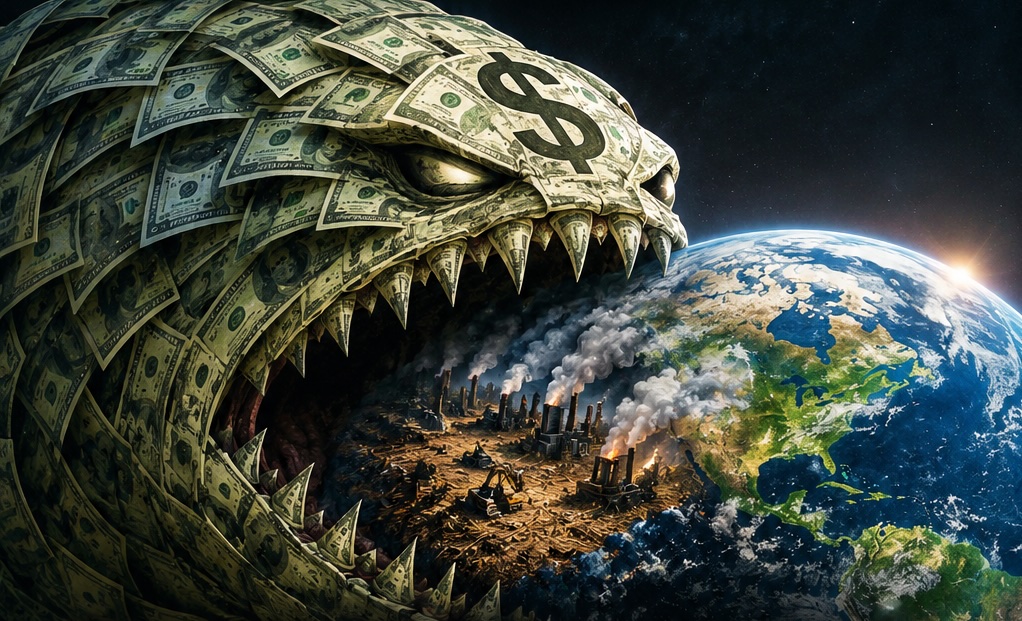
Inspired by David Attenborough’s documentary Our Planet and his vision for restoring biodiversity.
In the documentary Our Planet, David Attenborough delivers a powerful message about the state of our world. Biodiversity is disappearing at an alarming rate, threatening the stability of the ecosystems upon which all life depends.
But it is not too late if we don’t delay too much more.
His message is remarkably simple:
humanity must reduce its impact on the natural world until everything we do can be sustained indefinitely.
He presents four major solutions:
- Phase out fossil fuels and replace them with renewable energy.
- Transform agriculture by producing food more efficiently, reducing meat consumption, and allowing more land to return to nature.
- Restore our oceans through international cooperation, sustainable fishing, and marine protected areas where fish populations can recover.
- Rewild the planet, restoring forests, wetlands, grasslands, and other natural habitats so biodiversity can flourish again.
These are not impossible goals. Humanity already possesses all of the knowledge, technology, and resources needed to accomplish them.
So why haven’t we done it?
The Invisible Obstacle – The Money Monster
It should be obvious what we need to do, but most foundational change is effectively stopped by one entity:
The monetary system.
We know what we need to do as we have done it before, but this time more groundbreaking change is needed than ever before in human history.
The Ozone Layer
When the world discovered that chlorofluorocarbons (CFCs) were destroying the ozone layer, governments came together and agreed to phase them out through the Montreal Protocol in 1987.
It was an extraordinary example of global cooperation, and the ozone layer has been recovering ever since and is still slowly recovering.
Fossil Fuels
But even though fossil fuels are even more crucial as CFCs were, replacing them has proven considerably more difficult.
Why?
Because fossil fuels are deeply embedded in the global monetary economy.
Enormous corporations, investors, governments, and entire industries depend on the continued extraction and sale of oil, coal, and natural gas.
The financial interests involved are staggering. CFCs made up a relatively small part of our economy and was thus no problem to eliminate. Fossil fuels on the other hand risks collapsing our entire economy if they are removed. But maybe that is exactly what we need. To collapse our current economic system and replace it with a sustainable one.
Even though renewable energy technologies have advanced enormously, the fossil fuel industry continues to exert political and economic influence to protect its interests. They even influence the green energy revolution by producing such fuels as hydrogen by using the very fossil fuels we need to phase out. Hydrogen ends up being just as polluting as gasoline.
Industrial Agriculture
The same problem appears in agriculture. For decades, industrial agriculture has expanded vast monocultures, replacing diverse natural ecosystems with enormous fields of single crops. Forests have been cleared, habitats destroyed, and biodiversity diminished.
Meanwhile, an enormous commercial industry has developed around pesticides, herbicides, synthetic fertilizers, patented seeds, and GMOs.
Some of these technologies can serve useful purposes. But in a monetary economy, their development and application are heavily influenced by profitability rather than exclusively by ecological consequences and genuine human needs.
Marine Ecosystems
The oceans face similar pressures. Fishing companies must remain profitable, investors expect returns, and entire coastal economies depend on continued commercial activity. Protecting marine ecosystems can therefore become a financial conflict rather than simply a question of responsible stewardship. All of it resulting in over fishing, trying to extract as much profit as possible from the oceans.
Rewilding Nature
Land is property.
Forests represent timber.
Fields represent agricultural income.
Natural habitats compete with commercial development.
Again and again, the same obstacle appears.
Humanity is trying to save a planet within an economic system that rewards its continuous destruction.
Overconsumption
But the problem goes much further than fossil fuels, agriculture, and fishing.
Consider the extraordinary quantities of resources consumed simply to keep the global monetary economy expanding.
Products are manufactured, marketed, purchased, discarded, and replaced in an endless and increasing cycle.
Advertising encourages people to consume things they may never have wanted otherwise. Products are oftentimes deliberately designed with limited lifespans. Perfectly functional goods become obsolete because newer models promise slightly improved features. Or because the old is out of fashion.
Enormous quantities of food are wasted while millions of people go hungry.
And behind all of this lies a fundamental economic requirement:
businesses must generate revenue, debts must be serviced, investments must produce returns, and economic growth must continue.
The monetary system doesn’t merely distribute the things humanity needs. It also creates an enormous additional demand for production and consumption simply to sustain itself and grow.
Think about that.
The monetary system is literally a self-sustaining entity that stays alive by eating our planet. In effect, a monetary monster.
Every additional product requires materials, energy, transportation, and often packaging. Every unnecessary replacement consumes another portion of Earth’s finite resources.
And every forest cleared, habitat destroyed, and ecosystem disrupted comes at a cost that cannot always be expressed in money.
What an extraordinary contradiction.
Humanity has developed the intelligence to understand the consequences of its activities, yet continues operating an economic system that frequently rewards the very activities threatening its future.
The Solution Was Bigger Than the Problem
Are we doomed?
Not according to this novel: Waking Up – A journey towards a new dawn for humanity.
Eventually, humanity began to understand something remarkable.
The problem wasn’t that people lacked the intelligence to save the planet.
Nor was it that Earth lacked sufficient resources to provide everyone with a fulfilling life.
The problem was the way civilization had organized its relationship with those resources.
Stewardship
For thousands of years, humanity had gradually divided the planet into billions of ownership claims. Land, forests, minerals, water, and virtually everything else had become commodities to be bought, sold, and controlled.
And the monetary system had become so deeply embedded in human civilization that people struggled to imagine any other way of organizing their lives.
But ownership, money and trading were human inventions.
They were not laws of nature.
And what humanity had invented, humanity could also change.
Instead of continuing to fight the financial obstacles to environmental restoration one by one, humanity gradually began replacing the system that created those obstacles in the first place.
A new understanding emerged.
The Earth was not a collection of commodities waiting to be exploited.
It was a living, interconnected system upon which every human being and every other living creature depended.
And humanity’s role was not to own and consume that system, but to become its responsible steward.
We Finally Saved Our Planet
So how did we do it?
We gradually abandoned the outdated monetary system and established a global resource-based economy founded on stewardship, cooperation, and intelligent resource management.
And everything changed.
The financial incentives that had obstructed environmental restoration disappeared along with the monetary system itself.
There were no longer fossil fuel profits to protect, shareholders demanding continuous growth, or agricultural corporations dependent on ever-increasing sales of chemicals and patented products.
There was no longer any economic necessity to manufacture enormous quantities of unnecessary goods or encourage people to consume much more than they needed.
Instead, production was organized around actual needs.
Products were designed to last, to be repaired, upgraded, reused, and eventually recycled. Resources were managed according to their availability, environmental consequences, need and usefulness to society.
Agriculture was transformed. Vast monocultures were gradually replaced where appropriate by more diverse and regenerative systems. Food production became increasingly efficient, while unnecessary chemical use and food waste were dramatically reduced.
Humanity could finally concentrate on feeding everyone while restoring the ecosystems upon which food production itself depended.
The oceans were given the opportunity to recover. Extensive marine protected areas allowed fish populations and entire ecosystems to regenerate. Fishing was coordinated according to ecological knowledge rather than commercial pressure.
Fossil fuels were progressively replaced with renewable energy, supported by improved storage, efficient infrastructure, and intelligent global coordination.
And enormous areas of land were returned to nature.
Forests regenerated. Wetlands were restored. Wildlife corridors reconnected fragmented habitats. Species that had been pushed toward extinction were given the opportunity to recover.
Of course, the physical work still required enormous effort, knowledge, technology, and cooperation. Technology that we had available through AI, automation and robotics.
But humanity was no longer fighting against its own economic incentives at every turn.
The question was no longer whether restoring an ecosystem would be profitable.
The question was simply whether it was beneficial to life on Earth.
And when it was, humanity could organize the resources needed to accomplish it.
A World That Works for All Life
Perhaps the greatest transformation was not technological or environmental.
It was a transformation of understanding.
Humanity finally recognized that its own well-being could never be separated from the well-being of the natural world.
The forests were not merely sources of timber. The oceans were not merely fishing grounds. Animals were not merely commodities. And the Earth was not merely a warehouse of resources waiting to be converted into money.
Everything was connected.
Biodiversity created resilience. Resilience created stability. And stability provided the foundation for a flourishing civilization.
The extraordinary thing was that humanity did not have to sacrifice its own well-being to restore the planet.
Quite the opposite.
By eliminating unnecessary production, waste, competition for profit, and the enormous machinery required to maintain the monetary system, humanity could direct its intelligence and resources toward improving life for everyone.
A world where nobody had to earn the right to exist.
A world where technology served life rather than financial accumulation.
A world where humanity could enjoy the extraordinary abundance of Earth without destroying the natural systems that made that abundance possible.
David Attenborough reminded humanity that it possessed an extraordinary ability to change the world.
And that was precisely what humanity finally did.
But this time, instead of changing the world primarily to serve its own economic ambitions, humanity changed the way it lived so that the entire living planet could flourish.
We stopped trying to make the Earth work for our economy.
Instead, we created a true economy that worked for the Earth, for humanity, and for all life.
And that was how we saved our planet.
The Bewildered Billionaire
In 2015, a billionaire suffering from terminal cancer chose cryogenic preservation after death in the hopes of some day waking up in a future where he would be cured and be able to expand his empire.
Imagine his surprise when he wakes up 100 years later only to find that money, ownership and trading is a thing of the past. And not only that. He encounters both friends and foes on his journey through this strange new world.
If you want to experience that world too, you can. Just click below.
Discover the story of Benjamin Michaels, the bewildered billionaire