Tag: MONETARY SYSTEM

  • The Systemic Change We Desperately Need

    The Systemic Change We Desperately Need

    For thousands of years, humanity has lived inside a story we barely notice. A story so pervasive we mistake it for reality itself. The story says: money is the center of life.

    It decides what we build, what we protect, what we destroy, and even who we become.

    But as the world edges closer to ecological and social breaking points, it’s becoming painfully clear:

    The monetary system we built cannot solve the planetary crisis we created.

    It tells us:

    • compete or fall behind,

    • own or be owned,

    • extract or be extracted,

    • grow or collapse.

    And under the rule of The monetary system, everything on Earth becomes a commodity:

    forests, rivers, animals, ecosystems, even our own time and attention.

    But as the world cracks under ecological collapse, inequality, burnout, and global mistrust, a truth is becoming undeniable:

    A monetary system cannot save a planetary crisis.

    Because the crisis is caused by the monetary system itself.

    Recycling, green tech, ESG scores, carbon markets — these are all efforts to repair a broken house without questioning the foundation.

    To understand the real systemic change we need, we must step back and look at the full architecture of life on Earth.

    There are not one, but three systems

    Monetary. Planetary. Humanitary.

    One artificial, one eternal, one emerging.

    Let’s explore them.

    🌑 1. The Monetary System — The Artificial System

    The monetary system is:

    • human-made

    • extractive

    • competitive

    • based on scarcity

    • driven by profit

    • aligned with neither nature nor wellbeing

    It rewards:

    • depletion over regeneration

    • individual gain over collective good

    • excess over access

    • ownership over stewardship

    Forests are worth more cut down than standing.

    Oceans are worth more dead than alive.

    Humans are worth more as consumers than as creators

    And even climate efforts — like the TFFF – Tropical Forest Forever Facility — must bend to monetary logic: funds must perform, investors must profit, returns must be stable.

    You cannot heal the Earth with the logic that harms it.

    The monetary system is not evil — it’s simply misaligned with life.

    And any system misaligned with life eventually collapses.

    🌍 2. The Planetary System — The True System of Earth

    Long before money existed — long before humans existed — there was already a complete system.

    The planetary system.

    It is:

    • regenerative

    • interconnected

    • circular

    • cooperative

    • balanced

    • self-correcting

    • life-creating

    This system is the real operating system of Earth.

    It includes:

    • ecosystems

    • climate cycles

    • water cycles

    • soil regeneration

    • food webs

    • atmosphere

    • biodiversity

    • evolutionary adaptation

    It has existed for 3.8 billion years.

    It is older, wiser, and infinitely more intelligent than any economic model we have invented.

    And it does not need our permission to function.

    Humans are not outside it — we are expressions of it.

    But somewhere along the way, we disconnected from this system and began living entirely inside the monetary illusion.

    The result?

    We started optimizing for the wrong metrics:

    • GDP instead of biodiversity

    • profit instead of wellbeing

    • ownership instead of stewardship

    • scarcity instead of abundance

    The planetary system is the real system.

    The monetary system is a shadow system.

    And the shadow is failing because it contradicts the real.

    🌱 3. The Humanitary System — Humanity’s Next Operating System

    This is the system humanity must now create.

    A system that is:

    • aligned with the planetary system

    • post-monetary

    • regenerative

    • cooperative

    • contribution-based

    • purpose-driven

    • stewardship-centered

    We now have the name for it:

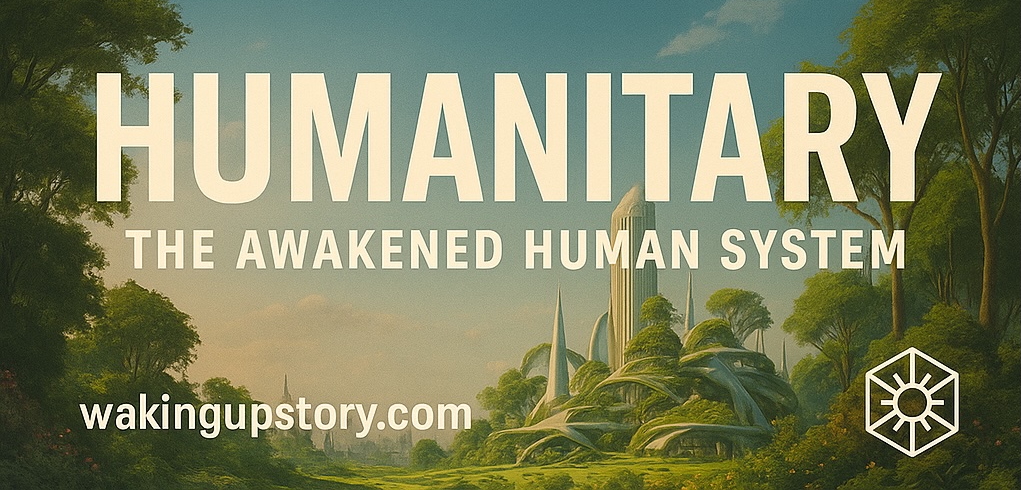
    The Humanitary System

    A new word that did not exist until today — because the idea itself is only now emerging.

    The humanitary system is:

    A post-monetary human civilization aligned with Earth’s planetary system, designed around stewardship, regeneration, cooperation, and shared wellbeing.

    It is humanity expressing the logic of nature through consciousness.

    Humanity → Humanitary.

    A species maturing into alignment with the living Earth.

    Where do we see it emerging?

    • Future Cities of Light

    • Natural Exchange System (NES)

    • regenerative culture

    • kin domains

    • circular local economies

    • universal commons

    • Return On Soul Investment (ROSI)

    • post-money communities

    • Indigenous stewardship laws

    • new governance models (councils, consent, circles)

    This is not utopian — it is evolutionary.

    🔄 Putting it all together: the Three-System Shift

    1. Planetary

    The original system. Real, natural, foundational.

    2. Monetary

    The made-up human system. Artificial, extractive, misaligned.

    3. Humanitary

    The new human system aligned with the planetary system.

    This is the true systemic change humanity needs.

    And once you see this structure, it becomes impossible to “unsee” it.

    🔥 Why the Humanitary System is Inevitable

    Because the planetary system has the final say.

    And the monetary system is collapsing under its own contradictions.

    This is the moment in history when humanity must choose:

    • continue the monetary illusion and collapse,

    or

    • return to the planetary truth and evolve.

    The humanitary system is not a political choice.

    It is a biological necessity.

    It is the only system that makes sense on a living planet.

    🌈 Cities of Light as the First Humanitary Prototypes

    A City of Light does not promise monetary profit.

    Its residents are:

    • not investors

    • not consumers

    • not shareholders

    They are ROSI contributorsReturn On Soul Investment.

    They invest not capital, but consciousness.

    They receive not dividends, but:

    • meaning

    • belonging

    • community

    • purpose

    • wellbeing

    • connection

    • safety

    • planetary restoration

    A City of Light is a prototype of the humanitary system,

    designed in alignment with the planetary system.

    This is how the new civilization begins.

    🌟 Conclusion: The Systemic Change We Need

    Humanity is not just changing systems —

    we are changing civilizational operating systems.

    From the artificial to the natural.

    From extraction to regeneration.

    From competition to cooperation.

    From profit to purpose.

    From planetary via monetary to humanitary.

    This is the future taking shape.

    And it begins with those who dare to name it.

    Call To Action

    If this vision resonates with you, explore how this shift has completely changed humanity in Waking Up – A Journey Towards a New Dawn for Humanity.

    Witness Benjamin Michaels’ transformation as the old monetary world dissolves and the new humanitary paradigm emerges when he steps into this new world….

    👉The more who read and share this book, the bigger chance we have of actually make a change in our world before it is too late… ebook only $4,99

  • The Great Unveiling – Awakening to the Real World

    The Great Unveiling – Awakening to the Real World

    What would actually happen if the world erased all debt overnight?

    1. The Starting Point

    Let’s start with a fact, not an opinion.

    As of 2025, total global debt is about $340 trillion — every mortgage, every student loan, every government bond, every corporate IOU combined.

    It is, quite literally, the sum of what humanity owes to itself.

    Let that sink in.

    To itself.

    How can a species owe itself money?

    How can the left hand be in debt to the right?

    The numbers are real enough on paper — but the logic behind them is absurd.

    We’ve built a global system in which humanity as a whole is perpetually indebted to… humanity as a whole.

    Meanwhile, the world’s annual GGP, Gross Global Product— the total value of everything we actually create and produce — is about $110 trillion.

    So globally we owe more than three times what we make in a year.

    We are, in effect, trying to pay ourselves with our own promises, and calling the shortfall “growth.”

    2. The Paradox of Debt-Money

    Here’s the strange truth of modern economics:

    Money isn’t printed first and then lent — it’s created by lending.

    When a bank issues a loan, it simply types numbers into an account.

    Those digits are new money, but they exist only because someone has agreed to owe them back.

    For every dollar of money, there’s a dollar of debt somewhere else. So of course, since we are constantly creating new money mostly by loans that needs to be repaid with interest which is not created, we constantly need to create new debt perpetually. If everyone repaid their loans tomorrow, almost every dollar in existence would vanish.

    The economy wouldn’t just slow down — it would cease to exist. Because money = debt.

    Debt isn’t a flaw in the system.

    Debt is the system.

    3. The Absurd Scale

    Three hundred and forty trillion dollars.

    A number so large it almost loses meaning.

    To “repay” it, we’d need about three more Earth-sized economies operating at today’s output — three planets producing, mining, farming, shipping, and consuming at full speed just to settle our existing balance sheet.

    But we have only one planet, and it’s already showing the strain: melting ice caps, depleting soils, rising seas.

    We’ve mortgaged the future to pay for the present, and even the collateral — the planet itself — is running out.

    The debt can never be repaid, because repayment would destroy the very money supply that makes repayment possible. The paradox is profound

    It’s a snake eating its own tail.

    4. The Thought Experiment

    So what if, instead of running faster on the treadmill, we simply stopped?

    What if: every government, bank, and individual agreed to wipe the slate clean — erase all debt at once?

    Technically, it would be easy.

    After all, when a bank issues a loan, it simply types numbers into an account.

    Those digits appear from nowhere, authorized by nothing more than confidence in the story.

    And just as easily as they’re created, they can be erased.

    The same keyboard that made them has another key — 

    backspace.

    Press it once for a typo.

    Press it a few more times, and the world is debt-free.

    Thus: the so-called global “debt crisis” is nothing more than a collection of keystrokes. 

    The difficulty isn’t technical. 

    It’s psychological.

    The moment those numbers disappear, the story humanity believes about itself — the story of credit, ownership, and fake obligation — vanishes with them.

    For a few hours, maybe days, the world would panic.

    Markets would freeze. Banks would have no assets. Governments would have no bonds.

    It would look like collapse.

    But collapse of what, exactly?

    5. What Would Still Exist

    Would the roads disappear?

    Would the houses crumble?

    Would the hospitals and schools evaporate?

    Would the oceans stop moving or the sun fail to shine?

    No.

    Every physical thing humanity has built and nature has created would still be there:

    every bridge, every farm, every power plant, every tool, every ship.

    The forests, the animals, the wind and rain — all still exactly as before.

    The real world would remain completely intact.

    The only thing missing would be the numbers we used to measure it.

    That’s the realization: the “economy” we thought sustained us was only a layer of code floating above what was real.

    When the code is erased, the world itself doesn’t vanish

    — it appears.

    6. The Great Unveiling

    That’s the unveiling — the moment when the illusion drops and we see what was always there.

    The money world was never the world.

    It was a veil — a story of ownership drawn over nature, over work, over life itself.

    When that story ends, nothing real is lost.

    In fact, reality becomes visible again.

    The forests keep breathing.

    The clouds still drift and drop rain.

    Birds still fly, insects still hum, whales still cross the oceans.

    People still wake up, stretch, laugh, argue, cook, and create.

    All of it continues as if nothing happened — because to the real world, nothing did.

    7. Seeing the Illusion for What It Was

    Imagine standing in a field the morning after the Great Erasure.

    The banks are silent, the stock tickers blank, but the sun still warms your skin.

    You realize how strange it was to think that this — sunlight, air, grass, breath — could ever be “priced.”

    The absurdity becomes obvious: we built a system that claims ownership over everything that already belongs to life.

    We invented scarcity in the middle of abundance. Saying only those with enough numbers in their accounts would have an abundance of time to really enjoy life.

    We called debt wealth and competition progress.

    We covered the real world with a mirage of money — and then forgot it was a mirage.

    And yet, beneath that mirage, everything real has been patiently waiting.

    8. What Happens Next

    At first, confusion.

    If no one owns anything, who decides?

    But slowly, reason returns.

    People realize they don’t need permission to use what already exists. 

    Food still grows. Tools still work. Knowledge still lives in every mind. We can peacefully agree to create abundance for all.

    Communities reorganize — not around money, but around contribution, skill, and trust.

    Value shifts from possession to participation.

    Humanity begins to live again as nature does — through exchange without debt, through cycles of giving and renewal.

    9. The Realization

    The true catastrophe isn’t the collapse of the money world — it’s that we mistook it for the real one.

    The true awakening is realizing the world doesn’t need to be rebuilt — only remembered.

    Everything that matters survives the erasure:

    the land, the oceans, the people, the animals, the insects, the sky, the sun.

    When the numbers vanish, what remains is life — unpriced, unowned, unending.

    10. The Invitation

    This is the Great Unveiling: not the end of civilization, but the end of its disguise.

    A collective seeing — that the wealth of the world was never in banks, but in being.

    Step outside.

    Feel the ground.

    Everything real is still here.

    The world is Waking Up.

    Are you?

    Follow the former billionaire Benjamin Michaels as he wakes up in a world where this has already happened. Shaken and shocked he staggers out of the hospital where he has been sleeping for a century, only to find his old world of money and numbers completely vanished… Only the real world remains.