
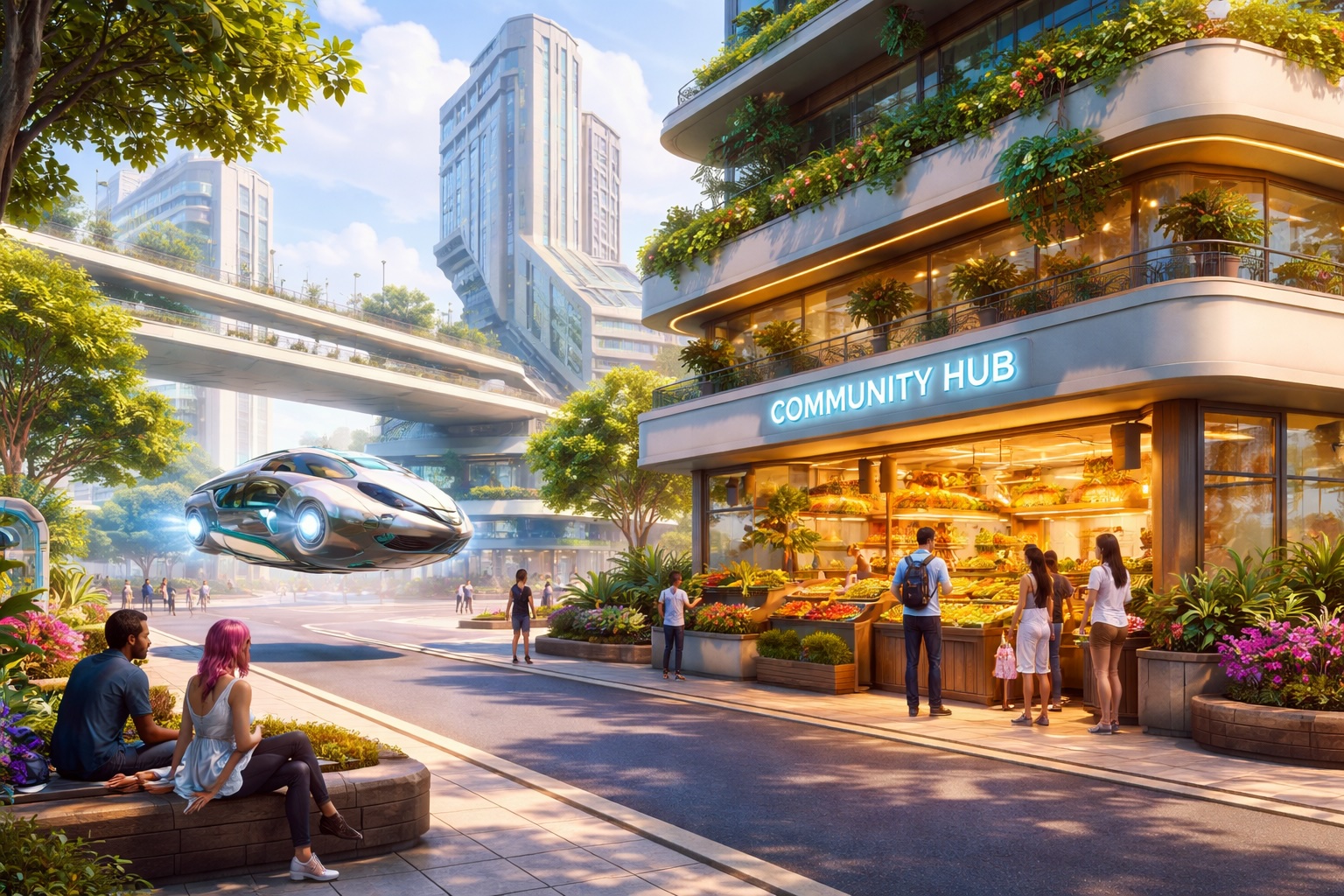
In the previous article, Redistribution vs. Redesign, I suggested that many of the challenges humanity faces today may not be solved by redistributing wealth within the current system, but by redesigning the system itself. Redistribution attempts to adjust the outcomes of the existing structure, while redesign asks a deeper question: whether the structure itself is what creates the problems in the first place.
The Question
That idea often leads to an immediate question:
What would life actually look like after such a redesign — a redesign that leads to a world without money and ownership?
Would shops disappear?
Would production collapse?
Would society fall into chaos?
Or could everyday life actually become simpler and more human?
The Confusion
For many people, the idea of a world without money or trading sounds confusing at first. But that confusion mainly comes from looking at the question through today’s mindset, where the planet is divided into ownership and access depends on money. If no one owned the planet and no one could claim exclusive ownership over parts of it, there would be nothing to trade in the first place. Money would simply have no role. Instead, the question would shift to something much more practical: how humanity can organize the most intelligent and fair ways of sharing this planet as one global family.
The Production
But the assumption of chaos also comes from confusing money with the systems that actually produce and distribute the things we need.
The farms that grow food would still exist.
Factories would still produce tools, clothes, and technology.
Logistics networks would still move goods around the world.
And places where people collect what they need — shops, distribution centers, or community hubs — would still be there.
What would disappear is not production or distribution.
What would disappear is simply the payment step.
Instead of the chain looking like this:
Production → Transport → Shop → Payment → Access
It could simply look like this:
Production → Transport → Distribution → Access
In other words, people would still walk into a place where food and everyday goods are available. The difference is that access would no longer depend on having the right amount of money.
The Trust Based Economy
At this point many people ask a very practical question: what would stop someone from simply emptying the store and taking far more than they need?
The impulse to hoard usually comes from fear of scarcity. In a system designed around continuous access to goods, hoarding quickly becomes pointless. If you know you can return tomorrow and find the same items available, there is little reason to take more than you need today.
Human societies have always relied not only on rules but also on social norms, trust, and simple practicality. Even today we constantly trust each other to honor agreements and to act in good faith. When we buy something in a store, we trust that the contents of the package are actually what the label says they are. We trust each others to heed agreements that we have made. We trust that the money we pay with are not counterfeit. Most people already take what they need in shared situations — at buffets, public spaces, libraries, or community resources. Physical limits also apply: a person can only carry so much, store so much, and consume so much. What can easily be hoarded today is not products themselves but money — a compact, abstract unit that can be accumulated without practical limits. Especially when they are only numbers in an account.
In smaller, human-scale communities, where people feel connected to the places they live and to each other, social responsibility often becomes a natural regulator. Taking wildly excessive amounts would quickly become visible and socially questioned. And practical limits apply as well — how many bananas could someone realistically hoard anyway? Most fresh food spoils quickly, which naturally discourages stockpiling. Physical good take up space and are not always easily transported.
In other words, the system would not rely on money to regulate behavior, but on a combination of abundance, transparency, trust, and human social norms.
Would There Be Enough?
Another question people often ask is: would there actually be enough for everyone?
This question also comes from the experience of living inside a system where access depends on money and where scarcity is often artificially created by price, marketing, and competition.
In reality, modern production systems are already capable of producing enormous quantities of goods. The challenge today is not primarily production or resources, but distribution and the economic rules that control access.
Food is often destroyed while people go hungry. Houses stand empty while people need housing. Warehouses are full of products waiting for buyers.
A redesigned system would simply focus production on meeting real human needs rather than maximizing sales. That alone would likely make abundance far easier to achieve.
Product Design
Another interesting question is how products themselves might look in such a world — and here too it would largely be up to our own creativity how we design and decorate packaging.
Today many products are designed primarily to compete for attention. Packaging is colorful, flashy, and optimized for marketing because companies must constantly fight for visibility in stores.
In a system where products are simply available rather than competing for sales, packaging could become far simpler and more practical.
A toothpaste tube might indeed look very simple — perhaps mostly white, with a clear label that simply says:
TOOTHPASTE
But that does not necessarily mean the world would become dull or boring. Quite the opposite. When products no longer need to scream for attention in order to sell, design can focus on durability, usability, beauty, and sustainability rather than marketing—and it could still be colorful and expressive if that is what people enjoy.
If we prefer simple black-and-white toothpaste tubes, we can design them that way. If we prefer colorful and playful products on the shelves, we can create that too. Colors and aesthetics would still exist — but they could serve human enjoyment rather than commercial competition.
The result might actually be environments that are calmer, less visually noisy, and more thoughtfully designed.
Communities
Another likely change is how we organize our living environments.
Today many people live in enormous megacities largely shaped by economic forces. But humans tend to function better in environments that are more human-scale.
It is easy to imagine communities of perhaps a few thousand to around ten thousand people — large enough to support schools, healthcare, culture, and local production, yet small enough that people feel connected to the place where they live.
Food could be grown locally where possible, supported by regional and global logistics networks that distribute what cannot be produced close by.
Contribution
In such a world, people would no longer need to choose their activities primarily based on what pays the bills.
Instead, people could contribute in areas where their interests, talents, and curiosity naturally lead them.
Some people genuinely enjoy farming.
Some love engineering.
Some enjoy teaching, cooking, building, researching, or creating music.
Human beings are naturally curious and creative. When basic survival is secured, contribution often becomes something people want to do, not something they are forced to do. In such an environment, creativity would likely blossom in every field — from science and engineering to art, music, agriculture, architecture, and new ways of organizing everyday life.
Technology
And the work that few people enjoy — dangerous, repetitive, or exhausting labor — is exactly the kind of work that modern technology is increasingly capable of handling.
Automation, robotics, and AI are already transforming industries today.
In a redesigned system, these technologies could finally be used for what they were always meant to do:
to free human beings from unnecessary labor — something that is already increasingly possible today, as AI and robotics are reaching the level where they can perform many of the tasks humans currently do.
Imagine Through Story
For many readers, this may still feel abstract. After all, we have lived inside a monetary system for so long that imagining life beyond it can be difficult.
This is precisely why I wrote the novel Waking Up – A Journey Towards a New Dawn for Humanity.
The story follows Benjamin Michaels, who wakes up one hundred years in the future in a world where humanity has redesigned its systems and learned to organize society in a way that works for everyone and for the planet.
It is not simply a guided tour of a better future. The story unfolds as a real drama, where Benjamin encounters allies and opponents — including a former secret agent who tries to bring back the old monetary system. He also meets long-lost family, forming relationships that add emotion, tension, and discovery to the journey.
Through his eyes, readers get a glimpse of what life might actually feel like in such a world — not as theory, but as lived experience.
Because sometimes the easiest way to explore the future is not through economic models or political debates…
but by stepping into it through a story.
If this vision resonates with you, you can explore that world through the novel:
Waking Up – A Journey Towards a New Dawn for Humanity
If you think more people should be part of this conversation, please share this article. Thank you.