
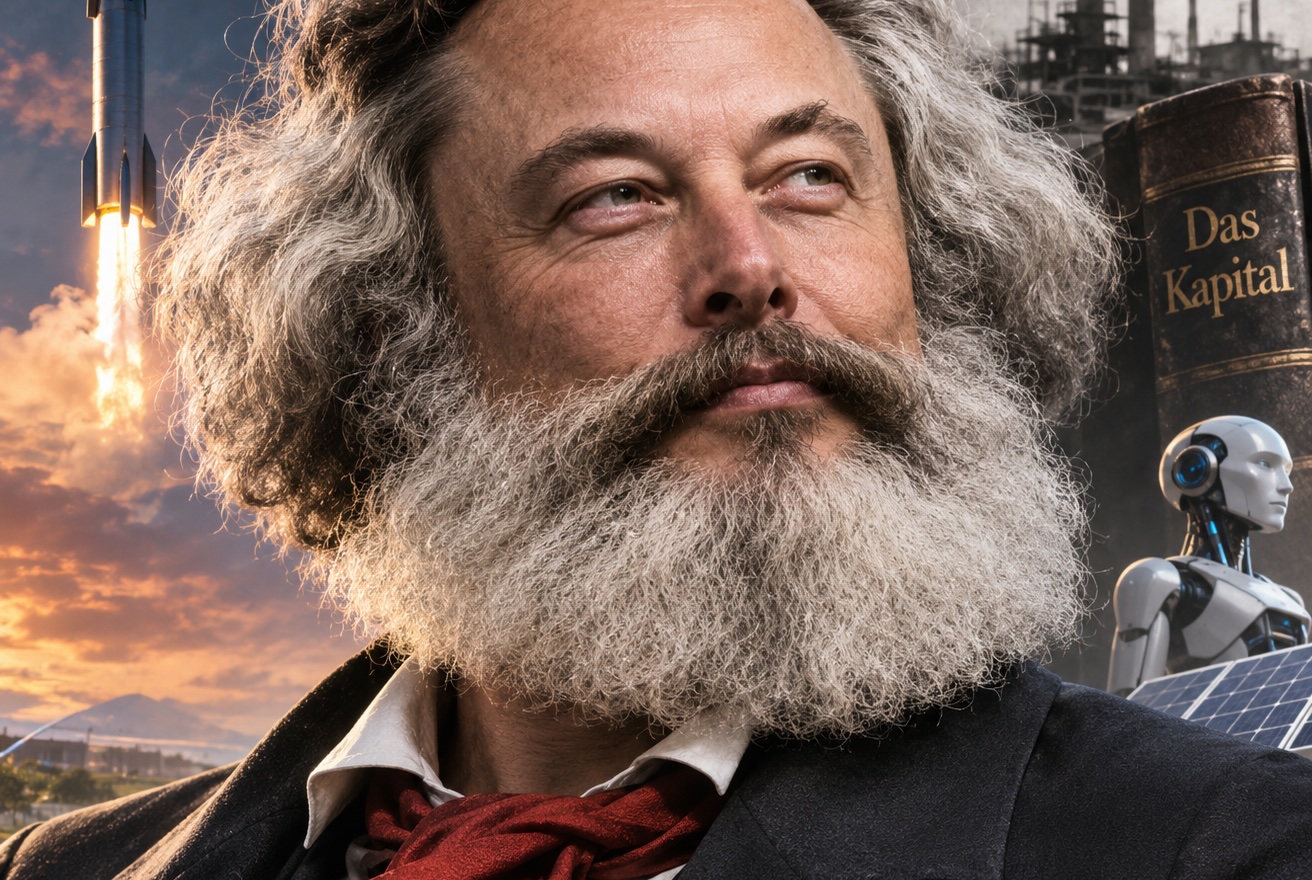
When capitalism creates the technology that could make capitalism obsolete
History has a peculiar sense of humor.
Who would have imagined that one of the world’s wealthiest capitalists today would be predicting something remarkably similar to what Karl Marx envisioned more than 150 years ago?
Yet here we are.
In a July 2026 interview with The Economist, Elon Musk made an extraordinary prediction about the world just ten years into the future:
“Money won’t matter in 2036.”
Not because governments will abolish it. Not because a communist revolution will overthrow capitalism.
But because artificial intelligence and humanoid robots will become so extraordinarily productive that virtually everything humanity needs can be produced with minimal human labor.
Musk envisions a world of technological abundance, where work becomes optional and people enjoy what he calls universal high income.
And here comes the historical irony.
Karl Marx anticipated something remarkably similar.
Capitalism’s Greatest Achievement
Karl Marx is generally remembered as capitalism’s greatest critic. But what is often overlooked is that Marx also recognized capitalism as an extraordinarily powerful engine of technological and industrial development.
In The Communist Manifesto, written with Friedrich Engels in 1848, Marx described how capitalism had unleashed productive forces on a scale unprecedented in human history.
Factories, machinery, transportation, scientific discoveries, and industrial production were transforming the world at breathtaking speed.
Marx understood that this development was not merely an unfortunate consequence of capitalism. It was one of its most important historical achievements.
According to Marx, capitalism was developing the productive capacity that could eventually make an entirely different kind of society possible.
A society where human beings would no longer have to spend most of their lives working simply to survive.
A society where production could serve human needs rather than the accumulation of capital.
And ultimately, a society where money itself would no longer be necessary. Just like Elon Musk envisioned this summer.
In Marx’ Grundrisse, particularly the famous section known as the Fragment on Machines, Marx explored how advancing machinery and scientific knowledge could progressively reduce the importance of direct human labor in production.
As machines became increasingly capable, the amount of human labor required to produce goods would diminish.
And with that development, something fundamental would happen.
The very foundation upon which capitalism measures economic value—human labor—would become increasingly disconnected from humanity’s actual productive capabilities.
Does that sound familiar?
Now, replace the industrial machinery of the nineteenth century with artificial intelligence, autonomous factories, and humanoid robots, and we arrive remarkably close to the technological future Elon Musk is envisioning. And that Marx was anticipating.
The capitalist is building the machines that could make capitalism itself obsolete.
Perhaps history has never delivered a more delicious irony.
The Contradiction Within Abundance
But there is a fundamental problem with Musk’s prediction.
Even if artificial intelligence and robotics eventually make human labor almost unnecessary, that does not automatically make money irrelevant.
Because money is not merely a mechanism for compensating human labor.
It is also a mechanism for controlling access to resources.
And that is where the distinction becomes crucial.
Imagine a world where robots can construct a beautiful house in a few days, manufacture almost anything we need, grow and harvest our food, maintain our infrastructure, and provide countless services without requiring human wages.
The productive capacity of such a civilization would be extraordinary.
But who owns the robots?
Who owns the factories?
Who owns the agricultural land?
Who owns the minerals, energy infrastructure, water resources, and land on which those beautiful houses are built?
And most importantly, who decides who gets access to everything that is produced? Who buys all the products?
If the answers remain determined by private ownership and purchasing power, then money has not become irrelevant at all. And think about this. You can only sell something that you own. So, if money shall become irrelevant like Musk predicts, so will ownership.
We may have eliminated much of the labor required to produce abundance, while preserving an economic system that simultaneously restricts access to that abundance. Creating more money won’t help, as more money only makes money itself more worthless. For money to have value it cannot be too abundant.
We could find ourselves surrounded by extraordinary productive capabilities while millions of people remain unable to access what those capabilities can provide.
Not because the resources or technology are unavailable.
But because the monetary system still stands between human needs and their fulfillment.
We would have solved much of the problem of production without solving the problem of access.
The System That Cannot Afford Its Own Success
There is another contradiction.
Our current economic system depends on a continuous circulation of money. People need to buy all the products.
Businesses need revenue. Workers need wages. Governments need tax income. Banks need borrowers. Investors need returns.
And consumers need purchasing power to keep the entire machinery operating.
Now imagine that artificial intelligence and robotics begin replacing human labor across virtually every sector of the economy.
Manufacturing workers, drivers, cleaners, construction workers, agricultural workers, warehouse employees, accountants, lawyers, programmers, medical professionals, administrators, and countless others could see increasing portions of their work automated and lost to robots.
Production might become dramatically more efficient.
But what happens to the wages?
What happens to the purchasing power of the people whose jobs disappear? And who was supposed to buy all the products and keep the economy going?
And what happens to the companies that depend on those same people buying their products?
The paradox is extraordinary.
The more successful the monetary economy becomes at eliminating the need for human labor, the more it threatens the income structure upon which its own function depends.
Of course, governments might introduce universal basic income or Musk’s proposed universal high income.
They might tax automated production and redistribute purchasing power to the population.
Such measures could help preserve access to goods and services.
But notice what we would actually be doing.
We would continue fueling the rich. The ones behind the machines and the technology taking everyone’s jobs.
We would be creating increasingly sophisticated mechanisms for distributing money so that people could continue purchasing products that the machines of the oligarchs already produce without requiring the labor of any paid worker.
Instead of questioning whether the monetary system is still necessary, we would be desperately trying to keep it going at all cost…
We would be preserving an outdated economic operating system while the technological foundation beneath it have fundamentally changed.
And that brings us to a question far more important than whether money will matter in 2036.
Why should we need money at all if we have developed the capacity to provide abundance directly?
The question we inevitably must ask ourselves is this:
Is the monetary system longer necessary at all? Or could we do without it, and rather create a world without money and trading?
Beyond Ownership
This is where the transition to a genuine post-scarcity civilization becomes much more profound than simply building lots of robots and saying money will be irrelevant.
We would have to reconsider one of the most deeply embedded assumptions in human civilization:
Ownership
Today, virtually everything on Earth is organized through competing claims of ownership.
Land is owned. Buildings are owned. Factories are owned. Natural resources are owned. Even ideas, discoveries, and technological processes can be restricted through intellectual property rights.
Access is determined primarily through ownership, contracts, and monetary transactions. And this ownership is the basis of money. You can’t sell anything you don’t own. But if money becomes irrelevant what happens to ownership?
Ownership is not a law of nature.
It is a human-created institution.
And institutions can change.
Imagine instead a civilization organized around stewardship and usership.
Rather than treating the Earth’s resources as commodities to be owned, traded, and accumulated, humanity could recognize them as a shared inheritance to be managed responsibly for the benefit of everyone, including future generations. Imagine how much less conflict and war this would bring, when we don’t have to fight over competing ownership claims anymore, but rather focus on creating the best possible world for everyone.
This would not mean that people would no longer have homes, personal belongings, privacy, or secure access to the things they use.
Quite the opposite.
A family would have a beautiful home without needing to purchase the land beneath it or carry a mortgage for life.
People would use vehicles, equipment, technology, and facilities without needing to own every resource individually.
Communities could coordinate land use according to actual needs, environmental conditions, and the availability of resources.
And instead of producing goods primarily because someone can pay for them, we could organize production according to what people actually need and want.
The distinction is fundamental.
Ownership asks: Who has the right to control this resource?
Stewardship asks: How can this resource best serve life?
Abundance Still Requires Coordination
Of course, even a civilization equipped with extraordinarily advanced AI and robotics would not have unlimited physical resources.
There is only so much land on Earth.
There are finite quantities of minerals, freshwater, fertile soil, and other natural resources.
Certain locations will always be more desirable than others.
And the planet’s ecosystems have limits that no amount of automation can simply ignore.
But none of this means that we must continue using money to coordinate access. Quite the contrary.
What we need is information.
How many people need housing in a particular region?
How much food is required?
What materials are available?
How much energy can be generated sustainably?
Which resources can be reused, recycled, or shared?
What are the ecological consequences of different choices?
And how can we organize production and distribution to meet human needs while preserving the natural systems upon which all life depends?
These are questions that advanced computing, artificial intelligence, and globally connected information systems could help humanity answer with extraordinary precision.
Instead of coordinating production through competing financial interests, we could coordinate it through real-time information about needs, resources, productive capabilities, and ecological constraints.
Scarce resources would still require priorities, transparent decisions, and fair methods of allocation.
But those priorities would no longer have to be determined by who possesses the most money.
They could be determined by human needs, practical considerations, and the common good.
In such a civilization, technological abundance would not mean that everyone could consume without limits.
It would mean that everyone could enjoy an extraordinary standard of living while humanity collectively used far fewer resources than our wasteful, competitive, consumption-driven economy requires today.
And perhaps that is the most important distinction of all.
True abundance is not the ability to consume endlessly. It is the ability to live extraordinarily well without needing to.
Where Marx and Musk Meet
So what do Karl Marx and Elon Musk actually have in common?
Both recognize, in different ways, that technological development can transform the economic foundations of civilization.
Marx saw capitalism as a historical system that developed productive capabilities while simultaneously creating contradictions within its own economic structure.
Musk sees artificial intelligence and robotics as technologies capable of generating such enormous productive capacity that money may eventually lose its importance.
Their perspectives are different, but the historical trajectory they describe has a remarkable resemblance.
Yet neither technological development nor economic criticism alone gives us a complete blueprint for the civilization that could follow.
Marx envisioned a higher stage of communist society organized around the principle:
From each according to his ability, to each according to his needs.
But he did not provide a detailed technological model for coordinating a global civilization without money. Naturally, the technology back then was far from such global coordination.
Musk, meanwhile, describes the extraordinary capabilities that AI and robotics might deliver, but his prediction leaves fundamental questions about ownership, access, land use, and resource management unresolved.
And those questions are not secondary.
They are central to the transition itself.
Because a world in which robots produce everything but where a small minority still controls access to the Earth’s resources are not necessarily a world of universal abundance.
It could simply be a world of unprecedented productive power combined with unprecedented concentrations of ownership.
To move beyond that possibility, humanity must do more than automate production.
We must rethink the economic foundations of civilization.
The Revolution of Understanding
Perhaps the most extraordinary aspect of this potential transformation is that it does not necessarily require a violent revolution.
It requires a revolution in understanding.
For generations, humanity has been conditioned to believe that money, ownership, competition, and financial incentives are indispensable foundations of civilization.
We have built our institutions, governments, businesses, and personal lives around those assumptions.
But if the technologies we are developing can increasingly provide for humanity without requiring human labor, we have an unprecedented opportunity to question the assumptions themselves.
The Purpose of Production
What if the purpose of production were simply to provide what people need?
What if the Earth’s resources were managed as a shared inheritance rather than divided into competing financial assets?
What if we declared the whole of Earth, just like we have done with the moon; as a celestial body that cannot be owned, but must rather be shared?
What if technological progress were measured by improvements in human well-being and ecological health rather than profitability?
What if we could organize a global civilization around cooperation, stewardship, and the intelligent coordination of abundance?
And what if doing so could provide everyone with a far higher quality of life while dramatically reducing humanity’s ecological footprint?
None of this requires us to reject the technological achievements of capitalism.
On the contrary.
We can recognize those achievements as an extraordinary chapter in human development.
But we do not have to assume that the economic system responsible for developing those technologies must remain in place forever.
Just as earlier economic systems eventually gave way to new forms of social organization, the monetary system itself may one day become a chapter in human history.
And perhaps the technologies being developed by Elon Musk and others will help make that transition possible.
But the machines cannot make the fundamental decision for us.
We must decide what kind of civilization we want those machines to serve.
The Final Irony
Elon Musk predicts that money won’t matter in 2036.
Perhaps he will be right.
Perhaps artificial intelligence and robotics will develop so rapidly that humanity’s productive capabilities will exceed anything we can presently imagine.
But making money irrelevant requires more than eliminating the cost of human labor.
It requires rethinking the very institutions that determine how people access the Earth’s resources.
Ownership. Land use. Distribution. Production. Consumption. Stewardship.
All of them must be reconsidered if we genuinely want to move beyond a monetary civilization.
And that is where the historical irony reaches its conclusion.
Karl Marx recognized that capitalism could develop the productive forces that would eventually challenge its own existence.
Elon Musk is helping to develop those forces while publicly predicting that money itself will lose its importance.
Perhaps the ultimate achievement of capitalism will indeed be to create the technological conditions for a civilization that no longer needs capitalism.
But technology alone will not complete that transformation.
The machines may make a post-monetary civilization possible. But only humanity can make it real.
And perhaps that is the most important lesson Elon Marx has to teach us.
⸻
The New Dawn for Humanity
Since you have read this far I assume you like to read! If so I would like to tip you about the novel: Waking Up: A Journey Towards a New Dawn for Humanity.
The story follows Benjamin Michaels, a wealthy businessman diagnosed with terminal cancer who chooses cryonic preservation in the hope of escaping his fate. When he awakens a hundred years later, he discovers a radically different world.
Humanity has abandoned money, ownership, and economic competition in favor of cooperation, stewardship, and a civilization organized around the well-being of everyone.
But how does such a civilization actually function? And what happens when the values of the old world threaten the new?
Waking Up explores these questions through a story of discovery, conflict, transformation, and hope.
Because perhaps the future we are waiting for is a future we could choose to create.