
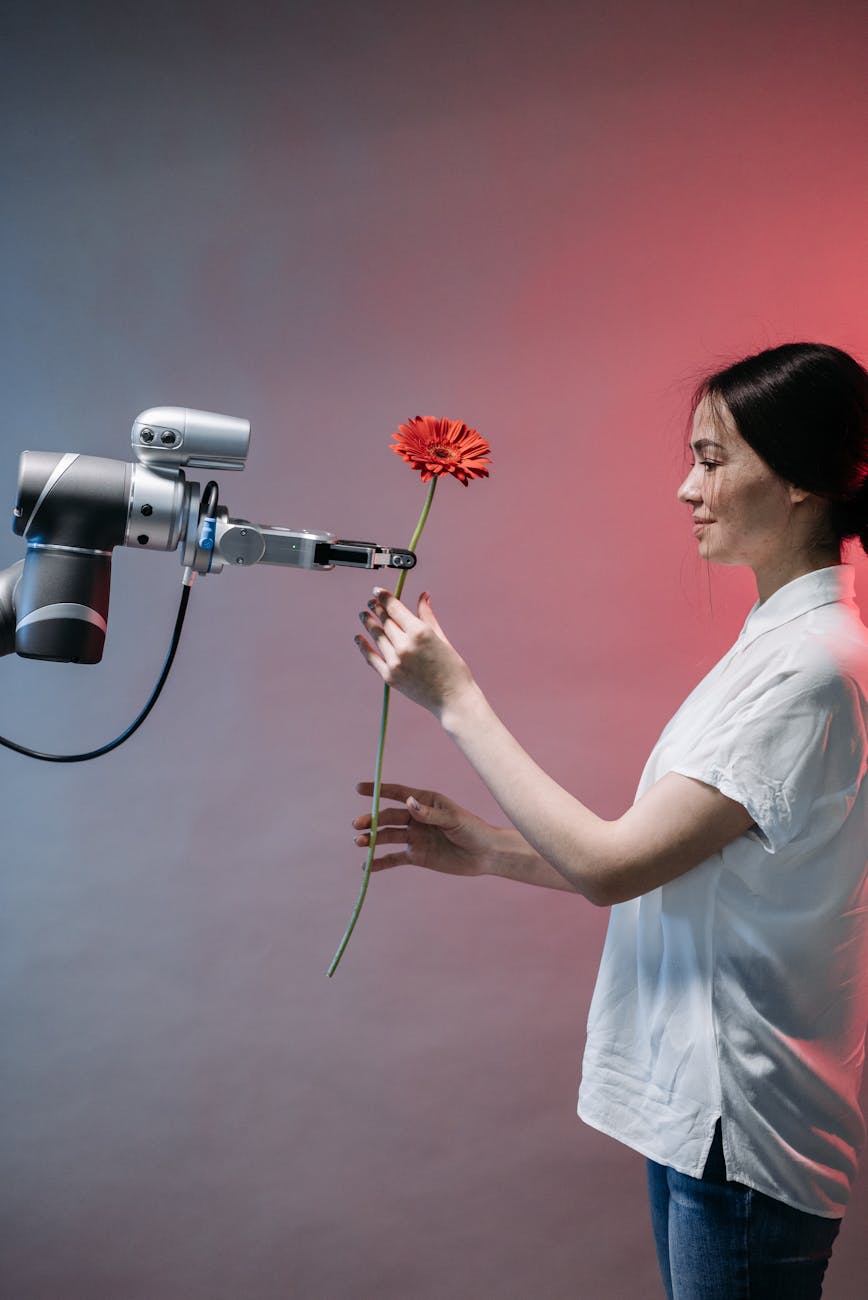
We are often told that humanity has entered something called The Fourth Industrial Revolution. The concept was popularized by Klaus Schwab, founder of the World Economic Forum in 1971.
The Transformation
According to the popular narrative, new technologies—artificial intelligence, robotics, biotechnology, sensors, and global data networks—are transforming the world faster than any previous technological wave in history. Factories are becoming autonomous. Cars are beginning to drive themselves. Algorithms now perform tasks that once required trained professionals.
His argument is that governments, corporations, and global institutions must cooperate to guide the transformation responsibly.
Schwab warns about risks such as:
• massive job displacement
• technological inequality
• social instability
⸻
The transformation is real. But the real question is not technological.
The real question is what kind of society these technologies will create.
The Three First Industrial Revolutions
The first industrial revolution mechanized human labor with steam power.

The second industrial revolution introduced electricity and mass production.

The third industrial revolution digitized information through computers and the internet.

Increased Productivity
Each industrial revolution dramatically increased productivity and reshaped society. At the same time, because the economic system remained based on money, ownership, and capital accumulation, each wave also tended to concentrate power and wealth into fewer hands. The owners of the new technologies—factories, energy systems, and later digital platforms—captured disproportionate gains, allowing influence and economic power to accumulate around a relatively small number of individuals and institutions.
Now the fourth Industrial revolution promises something even more profound:
automation of both physical and intellectual work.

Machines no longer just replace muscles.
They increasingly replace thinking.
The solution?
The most discussed solution is the possibility of policies such as Universal Basic Income, where people receive a basic payment from the state even if they are not employed.
But this approach raises a deeper question.
How would an economic system built on wages and taxes survive at all in a world where human labor is increasingly unnecessary?
The Likely Outcome
If the fourth industrial revolution unfolds while the underlying economic architecture remains unchanged, the most plausible result is what could be called extreme techno‑capitalism.
In such a world:
• automated factories produce most goods
• artificial intelligence performs much intellectual work
• autonomous systems run logistics, finance, and infrastructure
But ownership of these systems remains private and highly concentrated.
The result is simple.
Machines produce the wealth.
Owners accumulate the wealth.
Everyone else must somehow survive within the system. Jobs will be scarce, pay will be little and goods barely affordable.
Governments may attempt to stabilize society through subsidies or basic income programs. But this merely keeps the old system functioning artificially.
Instead of workers earning income through meaningful contribution, large parts of the population could become economically redundant.
The social consequences of such a structure are difficult to imagine as desirable.
surveillance
In order to maintain stability in a society with extreme inequality and large populations that the economic system no longer needs, governments and corporations would likely rely heavily on technological monitoring and control. Massive AI-driven surveillance systems could become normal: cameras and sensors everywhere, automated facial recognition, predictive algorithms monitoring behavior, and robotic security systems patrolling streets to ensure that no one steps out of line. The world could begin to resemble the dystopian futures long imagined in science-fiction films.
Extreme inequality, social tension, and heavy technological monitoring would likely become permanent features of the system.
The Hidden Contradiction
The deeper contradiction is rarely discussed.
Industrial revolutions increase productivity by reducing the need for human labor.
But the modern economic system distributes purchasing power primarily through wages from labor.
When machines increasingly perform the work, the foundation of the system begins to erode.
Trying to preserve this system through subsidies or basic income is like attempting to maintain a horse‑based transportation system after the invention of the automobile.
The technology has already moved beyond the structure.
A Different Possibility
There may be another way to think about this transformation.
If automation can produce most goods and services, society could begin organizing itself around direct management of resources and production, rather than around prices, wages, and ownership.
Instead of distributing money, societies could ensure access to what people actually need.
The technologies of the Fourth Industrial Revolution—AI, global data networks, and automated production—make it possible to monitor resources, coordinate production, and distribute goods far more efficiently than any price system ever could. It would literally be a priceless world.
The real challenge, therefore, may not be technological at all.
It may be institutional imagination.
Imagine This
Imagine waking up in a world where humanity has finally solved the problem it struggled with for centuries.
Not by redistributing money.
Not by building bigger governments.
But by redesigning the system itself.
In this world, the extraordinary productivity of automation, robotics, and artificial intelligence is no longer used to create unemployment, inequality, surveillance and competition for survival.
Instead, it is used to provide what humanity has always wanted:
Security.
Freedom.
Time to live.
Cities that are clean, quiet, and filled with greenery.
Transportation that moves silently through the streets and through the air.
Production that is largely automated, coordinated locally and globally, and optimized to minimize waste and environmental damage.
Food, goods, and services are available through distribution centers — places that look like stores, but without prices.
People simply take what they need.
Because when abundance is organized intelligently, the fear of scarcity disappears.
Trust becomes the operating principle of society — just as it already quietly is in countless parts of our lives already.
People create, research, build, explore, teach, design, and invent — not because they must earn a salary to survive, but because human curiosity and creativity finally have room to flourish.
This is the world Benjamin Michaels wakes up to after one hundred years of cryonic sleep in the novel Waking Up – A Journey Towards a New Dawn for Humanity.
But the story is far from a simple tour through a perfect world.
Because even in a better world, the debate about how society should function never completely disappears.
Especially when humanity begins waking people from the past — former billionaires and secret agents whose minds were shaped by the old monetary system.
Some of them are not convinced the new world should exist at all…
And that is exactly where the story begins.
If this perspective resonates with you, I urge you to share this article. Thank you.
The question now is whether we will simply automate the old system…
or whether we are willing to design something better.