Tag: hopeful future

  • How Can Ending the Monetary System Save the Planet?

    How Can Ending the Monetary System Save the Planet?

    At first glance, the question sounds absurd.

    Money feels neutral — just a tool for exchange. Environmental destruction is usually framed as a technological problem, a political failure, or a lack of individual responsibility.

    But what if it’s none of those?

    What if the primary driver of ecological collapse is a system that requires endless growth on a finite planet?

    And what if, by following that logic honestly, we discover something even more unsettling:

    That the same system destroying Earth is also quietly destroying our lives and our dignity.

    Growth is not a flaw — it is a requirement

    In a monetary system, growth is not optional.

    • Companies must grow to survive.

    • Nations must grow GDP to remain stable.

    • Debt requires interest, which requires expansion.

    But Earth does not grow.

    Forests regenerate slowly.

    Soils take centuries to rebuild.

    Oceans absorb damage silently — until they don’t.

    The collision is inevitable:

    Infinite economic growth meets finite ecological limits.

    This is not a moral failure.

    It is a design conflict.

    Money turns living systems into profit

    In a monetary framework, nature has value only when it can be priced.

    A living forest is “unused land.”

    A cut forest is “economic activity.”

    Clean air, biodiversity, climate stability, and future generations do not appear on balance sheets — so they are systematically ignored.

    What cannot be monetized is treated as expendable.

    The result is not stewardship, but liquidation.

    Profit rewards destruction faster than care

    Today, it is often cheaper to pollute than to protect.

    It is more profitable to extract than to regenerate.

    It is easier to destroy than to repair.

    Environmental damage is labeled an “externality” — a cost pushed onto nature, communities, or the future.

    This doesn’t happen because people are evil.

    It happens because the system reward the wrong behavior.

    As long as money is the scoreboard, the fastest destroyers tend to win.

    The planet is indebted to itself — and it is still not enough

    Here is the absurdity, stated plainly:

    The entire planet is in debt to itself. It’s basically bankrupt.

    Total global debt now equals more than three years of the planet’s entire yearly output — everything humanity produces in one year, multiplied by three, already promised away.

    And even that is still not enough.

    Because if we stop borrowing — the system breaks.

    If we stop growing — the system collapses.

    If we stop expanding — debt becomes unpayable, which it is already, as the money we use ARE debt. “Paying it back” will mean we don’t have any money anymore.Still, governments think debt can actually be paid back. But even trying means creating more debt and more environmental destruction.

    So even while drowning in debt, we are told we must take on more.

    More loans.

    More growth.

    More extraction.

    More pressure on land, oceans, climate, and people.

    Debt is not just money owed. It is a demand placed on the future and the planet itself.

    It is a claim that tomorrow must produce more than today — forever.

    But the planet does not know debt.

    The planet does not grow GDP.

    The planet does not compound interest.

    Forests do not grow faster because markets demand it.

    Oceans do not replenish on quarterly schedules.

    Soils do not regenerate on balance-sheet timelines.

    This is the core insanity:

    We have built a system that treats Earth as an infinite credit card —

    and even after maxing it out, demands a higher limit.

    That is why this is not a problem that can be fixed with better regulation, greener growth, or smarter finance.

    A system that requires endless expansion on a finite planet is not malfunctioning.

    It is doing exactly what it was designed to do. 

    Artificial scarcity fuels overconsumption

    Money-based systems depend on scarcity.

    Not natural scarcity — manufactured scarcity.

    There is enough food, yet people starve.

    More than enough homes, yet people sleep outside.

    An abundance of energy from the sun, yet we burn the planet for fuel.

    Scarcity is no longer a condition of nature.

    It is a condition of design.

    And scarcity doesn’t just damage ecosystems — it damages people.

    A wounded humanity consumes to compensate

    Much of modern overconsumption is not driven by greed.

    It is driven by emptiness.

    When work is disconnected from meaning,

    when time is stolen from life,

    when worth is measured numerically,

    people compensate.

    With status.

    With possessions.

    With distraction.

    The planet pays the price for a wound we rarely name.

    The same system erodes human dignity

    In a monetary world, your value becomes conditional.

    You are valued when you are:

    • productive,

    • efficient,

    • competitive,

    • profitable.

    Rest must be earned.

    Care must be justified.

    Illness becomes a liability.

    Aging becomes a problem.

    Your right to exist quietly shifts from being human to being useful.

    That shift happens slowly — until exhaustion feels normal.

    Ending money changes the question

    Without money, society stops asking:

    “Is this profitable?”

    And begins asking:

    “Is this necessary?”

    “Is this sustainable?”

    “Does this improve life — for people and the planet?”

    Production becomes needs-based.

    Technology serves life, not return on investment.

    Durability replaces planned obsolescence.

    This is not idealism.

    It is systems logic.

    Why saving the planet without ending the monetary system is almost impossible

    It is not that people aren’t trying to save the planet within the monetary system today — they are. 

    But every serious environmental effort is forced to operate against the system’s underlying logic. Renewable energy must compete with fossil fuels on price. Ecosystem protection must justify itself in economic terms. Climate action must promise growth, jobs, and returns to be considered “realistic.” 

    In other words, nature is allowed to survive only if it can be made profitable. 

    This creates a constant contradiction: we try to heal the planet while preserving the very engine that requires its continued destruction. As long as money, debt, and growth remain the organizing principles of society, ecological protection will always be partial, fragile, and reversible — tolerated only until it threatens profits. That is why saving the planet without ending the monetary system is not just difficult; it may be structurally impossible.

    But what can we have instead? This is the only system we’ve got. Or is it…?

    Stewardship replaces ownership

    When land, water, and ecosystems are no longer owned for profit:

    • extraction loses its incentive,

    • care becomes collective,

    • long-term thinking becomes natural.

    The guiding question shifts from:

    “How can we extract as much as possible?”

    to:

    “How do we keep this system healthy for generations?”

    That shift alone rewrites humanity’s relationship with Earth.

    Saving the planet is not only about the planet

    A humanity stripped of dignity will compete, consume, and destroy.

    Not because it is evil — but because it is wounded.

    A humanity that feels safe, valued, and meaningful does not need to dominate its environment.

    Healed people make good ancestors.

    The deeper truth

    Money is not neutral.

    It is a behavioral engine.

    And as long as that engine requires scarcity, competition, and endless growth, ecological collapse is not a failure.

    It is the expected outcome.

    Ending the monetary system does not magically save the planet.

    But it removes the root incentive that is currently destroying it —

    and gives both Earth and humanity a chance to recover.

    Call to action

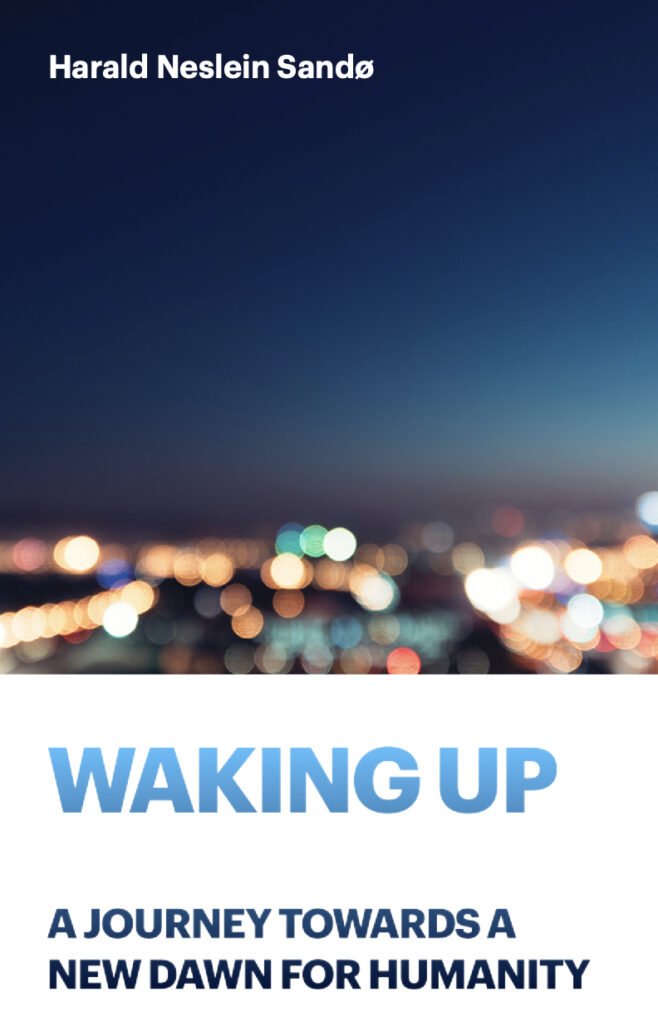
    This is the core vision explored in Waking Up – A Journey Towards a New Dawn for Humanity — a story that doesn’t ask whether such a world is perfect, but whether it becomes possible once the old rules are removed.

    The question is no longer whether we can afford to imagine a world beyond money.

    The question is whether we can afford not to. If you want to be inspired, dive into this new world with Benjamin Michaels:

  • The Declaration of Human Rights

    The Declaration of Human Rights

    How much is it actually lived up to?

    In 1948, in the aftermath of the Second World War, humanity made a remarkable statement.

    The Universal Declaration of Human Rights proclaimed that every human being is born free and equal in dignity and rights. It affirmed rights to life, liberty, security, food, housing, healthcare, education, work, rest, and participation in society.

    After the atrocities of WW2 it was meant as a collective “never again.”

    And yet, more than seventy-five years later, a quiet question lingers beneath the surface:

    How much of this declaration is actually lived — not in words, but in reality?

    A moral milestone — not an operating system

    The Declaration of Human Rights is one of the most beautiful documents humanity has ever produced. It has inspired constitutions, civil rights movements, and international law. It has given language and legitimacy to struggles for dignity across the world.

    But there is an important detail we rarely confront honestly:

    The declaration is not legally binding.

    It is a moral compass, not an operating system.

    And more importantly — it was never accompanied by a redesign of the systems meant to support it.

    Rights on paper — conditions in reality

    On paper, every human has the right to adequate food, housing, healthcare, and security.

    In reality:

    • Millions work full time and still cannot afford to live well

    • Access to healthcare depends on income or nationality

    • Poverty itself is often punished rather than addressed

    • Refugees and migrants live in permanent legal limbo

    • Starvation can often be rampant in parts of the world

    A right that depends on purchasing power is not truly a right.

    It is limited access — granted conditionally.

    The declaration speaks in universal terms.

    The system delivers selectively.

    Equality before the law — in theory

    The Declaration states that all are equal before the law.

    Yet in practice:

    • Money buys better legal outcomes

    • Corporations enjoy protections individuals do not

    • Environmental destruction is rarely prosecuted proportionally

    • Indigenous land rights are overridden in the name of “development”

    Justice, like so many rights, bends quietly toward power.

    Freedom — with invisible boundaries

    Most people are technically free to speak, move, and express themselves.

    But:

    • Whistleblowers are punished

    • Journalists are imprisoned or killed

    • Economic pressure silences dissent

    • Algorithms amplify some voices while burying others

    Freedom exists — but often only within boundaries that remain unspoken.

    The right to life — selectively defended

    Nearly every nation that signed the Declaration participates in war, arms trade, or policies that knowingly harm civilians.

    • Civilian deaths become statistics.

    • Environmental collapse is treated as collateral damage.

    • Future generations have no legal standing at all.

    Human rights are defended loudly — until they conflict with power, profit, or geopolitics.

    The uncomfortable truth

    The Declaration of Human Rights assumes a world where systems serve humans.

    But we live in a world where humans serve systems:

    • Money precedes rights

    • Markets outrank morality

    • Survival must be earned

    • Systems are defended even when they harm people

    So the declaration floats above reality as an ideal —

    while the underlying system quietly undermines it every day.

    This is not primarily a failure of human values.

    It is a failure of design.

    The question the Declaration quietly leads to

    Once this contradiction is seen, an unavoidable question emerges:

    What kind of system would actually make the Declaration of Human Rights real?

    If human rights are to be lived rather than merely declared, they cannot be conditional. A right that depends on income, status, employment, or luck is not a right — it is a privilege.

    A system that fully honors human rights would therefore have to guarantee access to life’s essentials — food, water, shelter, healthcare, education, and basic security — by default, not as rewards for success in a competitive market.

    These essentials would not be commodities.

    They would be infrastructure — part of the shared foundation of society, like roads, clean air, or gravity.

    This also implies a different relationship to the planet itself. Earth was not created by anyone alive today. Its resources are a shared inheritance, not private trophies. We must declare them as what they really are: a shared inheritance. In the book Waking Up, the protagonist wakes up in a future world where humanity has already been waking up and created a new world where the human rights are actually heeded and built into the system. Stewardship replaces ownership. Access replaces accumulation.

    Contribution, then, becomes something people choose — guided by interest, ability, creativity, and care — rather than something coerced by survival pressure. Only under such conditions does “freedom of work” become real rather than theoretical.

    This is not about charity, redistribution, or ideology.

    It is about coherence and an awakened humanity.

    As long as money remains the gatekeeper of life, human rights will remain something we defend after they are violated — rather than something we design never to be violated in the first place.

    Where the question continues

    This line of thought does not end with theory.

    It is explored through story rather than argument in this  book:

    Waking Up – A Journey Towards a New Dawn for Humanity.
    The book does not try to convince the reader of a new system.

    Instead, it invites them to step inside a world where the old rulebook has quietly dissolved — and to experience what happens to people, relationships, responsibility, and meaning when human rights stop being conditional.

    Not as a blueprint.

    Not as ideology.

    But as inspiration.

    👉 If this article resonated, the story continues in Waking Up.

  • A 1200-Page Warning: Nothing Is Going in the Right Direction — But What If We Acted in Time?

    A 1200-Page Warning: Nothing Is Going in the Right Direction — But What If We Acted in Time?

    UN’s new GEO-7 report calls for a complete economic transformation — and invites us to imagine the world we could still create.

    Read the report here if you like:

    https://www.unep.org/geo/global-environment-outlook-7

    When the United Nations releases a Global Environment Outlook, the world is meant to take notice. The latest one — GEO-7, more than 1,200 pages long and created by hundreds of scientists across disciplines — is not a gentle document. It does not soothe, and it does not flatter. It delivers a single, unsettling truth:

    Nothing in the global environment is moving in the right direction.

    GEO-7 is the most comprehensive environmental “health check” humanity has ever received. It examines climate, biodiversity, pollution, land degradation, freshwater decline, and material use — not separately, but as one interconnected crisis. And when you see the whole picture at once, the conclusion becomes unavoidable:

    Humanity has destabilized the very systems that make life possible.

    Yet the report does something even more important than document the damage.

    It points directly at the cause.

    And it says the quiet part out loud.

    The System Itself Is the Problem

    For the first time in a UN environmental assessment of this scale, the authors state clearly:

    Humanity cannot solve these crises within the current economic system.

    A systemic transformation is required.

    This is not activist rhetoric.

    It is the institutional voice of global science.

    GEO-7 lays it out plainly: We are trying to preserve a living planet using an economic logic designed for extraction, competition, short-term survival and endless material expansion. It worked while the world was large and humanity was small. But now we realize the world is finite and humanity is enormous — consuming at a level the Earth cannot regenerate. We have already entered deep ecological overshoot: using the equivalent of multiple planets’ worth of resources every year, drawing down forests, soils, oceans and biodiversity faster than they can rebuild themselves. In other words, we are living on borrowed time from ecosystems that can no longer keep up with the demands of an outdated economic system.

    Our system rewards destruction because destruction is profitable.

    It treats nature as “free” until it collapses.

    It externalizes costs until they come back as disaster.

    The report is diplomatic, but the meaning is blunt:

    The global economy is structurally misaligned with the continuation of life.

    Robert Watson: “It Costs More to Be Passive Than to Act.”

    One of GEO-7’s leading contributors, world-renowned scientist Robert Watson, summarized the situation with sharp clarity:

    “It costs more to be passive than to act.”

    GEO-7 estimates that deep global transitions — energy, food, materials, waste, transport — would save humanity thousands of billions of dollars, eventually rising to tens of trillions in avoided damages.

    Think about that:

    The greatest financial savings in human history are found in not destroying our home.

    And Watson goes further: only a new economic system — one that values planetary stability, regeneration and long-term wellbeing — can prevent collapse. Incremental fixes won’t work. Price adjustments won’t work. Technological substitution won’t work without systemic redesign.

    This is the part of the report that should be printed in bold, underlined, and taped to every parliament door:

    We are not choosing between “expensive action” and “cheap inaction.”

    We are choosing between investment and ruin —

    and ultimately, between the life and death of our planet.

    Because if we fail to act, the costs won’t just be financial.

    They will be existential.

    But Here Is the Real Question:

    What Does Acting in Time Actually Look Like for our future?

    Reports diagnose.

    Policies prescribe.

    Economists calculate.

    But humanity also needs something else:

    A vision.

    Because we are not only facing an environmental crisis.

    We are facing an imagination crisis.

    We know what failure looks like.

    But what does global success feel like?

    What does a world look like where we truly acted in time?

    A world where:

    • collaboration replaced competition,

    • regeneration replaced extraction,

    • shared inheritance replaced private hoarding,

    • and value was measured in life, not currency?

    This is where science reaches its limit — and story begins.

    A Glimpse Into a World Where Humanity Chose Another Path

    In the novel Waking Up – A Journey Towards a New Dawn for Humanity, I explore a future set about one hundred years after we finally did what the GEO-7 scientists are begging us to do today.

    It is a world where humanity ultimately realized:

    If the economic system is killing us, the only logical solution is to create a new one.

    But the world of Waking Up goes one step further — the step no scientific report dares to make:

    Humanity discovered that the most efficient, regenerative, fair and intelligent economic system was… no money at all.

    Because when all resources are declared the shared inheritance of all people,

    when technology handles abundance and distribution,

    when wellbeing replaces profit as the guiding principle…

    then the greatest savings of all become obvious:

    We saved not thousands of billions.

    Not trillions.

    But an infinite amount of money — by abolishing money itself.

    You cannot spend money that no longer exists.

    You cannot misallocate resources when everything is shared.

    You cannot bankrupt a planet when its systems are aligned with nature instead of against it.

    In the world of Waking Up, humanity didn’t just cut costs.

    Humanity ended the concept of cost itself.

    Why This Vision Matters Now

    GEO-7 gives us the clearest scientific warning ever issued.

    It tells us what will happen if we continue down this path.

    It tells us what we could save if we change course.

    But reports alone do not inspire transformation.

    They cannot show us how it feels to live in a world healed from fear and scarcity.

    For that, we need imagination.

    We need courage.

    We need stories that reveal the contours of a future worth fighting for.

    Because between the data and the dream, a new world waits.

    And every transformation in human history began first as an idea.

    If you want to experience a world where humanity acted in time —

    and saved the greatest amount of money by making money obsolete —

    you can step into that world HERE.

  • Why Waking Up Is Not a Blueprint — And Why the Future Should Never Have One

    Why Waking Up Is Not a Blueprint — And Why the Future Should Never Have One

    From time to time, Waking Up – A Journey Towards a New Dawn for Humanity is described as a “blueprint” for a new society.

    The word is meant with admiration — a recognition that the world portrayed in the story feels coherent, compelling, and deeply humane.

    But the truth is simple:

    It is not a blueprint.

    And a future worth living in should never be based on one.

    A blueprint belongs to a different era of human consciousness. —

    a time when the world believed it needed strict plans, rigid structures, and predefined systems to shape the unknown.

    In contrast, the future hinted at in Waking Up emerges from something much deeper than planning:

    a shift in how humanity sees itself.

    This article explores why the book is not a blueprint,

    why the future must remain fluid,

    and how a new consciousness is already transforming what humanity expects from its systems.

    Blueprints Come From an Old Consciousness

    A blueprint is a product of fear-driven thinking.

    It reflects an assumption that people need to be controlled, guided, and managed from above — that order must be imposed rather than allowed.

    Blueprints emerge from:

    • distrust of human nature

    • fear of mistakes

    • anxiety about uncertainty

    • attempts to design behavior

    • systems that see people as objects to be moved through procedures

    They belong to a mindset shaped by historical trauma:

    a world where competition, scarcity, and survival anxiety made rigid systems feel necessary.

    Much of classic dystopian fiction — 1984, Brave New World, Fahrenheit 451 — reflects this worldview.

    They depicted horrifying futures engineered by fear, where humanity was controlled through rigid structure, technology, and force.

    Those visions came from a consciousness that believed enforced control was the only alternative to chaos.

    The world of Waking Up arises from the opposite.

    A New Consciousness Is Already Emerging

    Humanity is beginning to experience itself differently.

    Not as isolated individuals, but as interconnected expressions of the same living whole.

    This new awareness is spreading quietly, globally, and without central leadership.

    People increasingly recognize that:

    • humanity is one species sharing one planet

    • separation is an illusion created by fear

    • collaboration is natural

    • harming another being ultimately harms oneself

    • life thrives when approached with respect

    • consciousness shapes systems, not the other way around

    This shift is not theoretical.

    It is already here.

    And it is the soil from which a new kind of world can grow —

    a world built not on fear, but on recognition.

    A world where systems arise from understanding rather than enforcement.

    The World of Waking Up Emerges — It Is Not Engineered

    The society depicted in the novel is not designed in advance.

    It is not the result of committees, diagrams, or bureaucratic planning.

    It is what naturally appears when humanity awakens into unity.

    Such a world emerges because:

    • fear no longer governs behaviour

    • empathy becomes instinctive

    • trust replaces suspicion

    • survival is no longer the driving force

    • technology serves life instead of profit

    • people feel responsible for each other

    • collaboration is easier than conflict

    When consciousness changes, systems reorganize themselves.

    Not through command, but through coherence.

    Not through rules, but through shared life supporting values.

    Not through rigid structures, but through naturally evolving patterns.

    A blueprint cannot produce such a world.

    Awakening can.

    Systems Exist — But They Are Living Systems, Not Bureaucracies

    A humane future is not system-less.

    Systems remain necessary for coordination, communication, and daily life.

    But the nature of those systems changes profoundly.

    Instead of controlling people, they support people.

    Instead of restricting action, they facilitate action.

    Instead of imposing order, they reflect organic order.

    Instead of treating individuals like cases, files, or packages to be processed,

    they treat every person as a human being — with dignity, creativity, and inherent worth.

    This shift alone dismantles half of what is traditionally called “bureaucracy.”

    Bureaucracy is what happens when systems lose sight of humanity.

    Awakened systems never forget it.

    In the old consciousness, systems protect themselves from the population.

    In the new consciousness, systems help the population express its highest potential.

    Why a Blueprint Would Undermine Everything

    A blueprint requires:

    • rigid definitions

    • fixed roles

    • predetermined structures

    • rules enforced from above

    • a central authority to uphold it

    • compliance from everyone

    • a future frozen on paper before it is lived

    Such rigidity recreates the very consciousness the world is growing beyond.

    A blueprint for an awakened world is a contradiction.

    It would instantly pull humanity back into:

    • hierarchy

    • control

    • dogma

    • ideology

    • conflict over interpretation

    • power struggles over “the right version”

    Blueprints create gatekeepers.

    Awakening removes the gates.

    Any attempt to “design” the awakened world would recreate the egoic mindset the story transcends.

    The future cannot be diagrammed.

    It must be discovered.

    The Future Will Be Co-Created, Not Pre-Designed

    The new world will not emerge from manuals, manifestos, or static visions.

    It will emerge from consciousness.

    From people who act from unity rather than fear.

    From cultures that treat life as sacred rather than expendable.

    From communities that choose cooperation over coercion.

    From technologies that amplify awareness rather than dominate behavior.

    From shared agreements that evolve as humanity evolves.

    Such a world is not built —

    it grows.

    It is not engineered —

    it unfolds.

    It is not enforced —

    it is emergent.

    And because it is alive, it can never be captured in a blueprint.

    Why Waking Up Must Remain a Vision, Not a Plan

    The power of the novel lies in what it reflects, not what it prescribes.

    It shows what becomes possible when humanity awakens.

    It portrays a world shaped by consciousness rather than fear.

    It invites readers to imagine life beyond survival and separation.

    Its purpose is not to explain systems, but to illuminate the state of mind that gives rise to them.

    Not to dictate, but to inspire.

    Not to design, but to remind.

    Not to construct the future, but to reveal what emerges when humanity becomes ready.

    A blueprint belongs to the past.

    Awakening belongs to the future.

    And the world that follows awakening can only be lived —

    never engineered.

    Call To Action

    To explore the vision behind this article, visit the world of Waking Up – A Journey Towards a New Dawn for Humanity and discover a future shaped by consciousness rather than control.

    👉 Available HERE.

  • I am right! How Opinion Destroys Our World…

    I am right! How Opinion Destroys Our World…

    Why a civilization built on mostly personal opinion cannot solve global challenges.

    Humanity has of now more potential than any generation before us. We have the science and knowledge to restore ecosystems, the technology to eliminate scarcity, and the global capacity to meet every human need.

    Yet progress stalls — not for lack of solutions, but because too many decisions that shape our world are driven by opinion, not facts.

    When opinion overrides reality

    In modern political and economic systems, personal preferences frequently override evidence. Leaders shape national policies based on what they “feel,” “believe,” or “prefer,” even when the data suggests the opposite.

    And the consequences are visible everywhere.

    Concrete examples of opinion-based damage

    1. Food waste: belief vs. biology

    Governments continue subsidizing overproduction because “it’s good for the economy,” even though biology shows soil degradation intensifies with monoculture and chemical inputs.

    Result:

    • More than 40% of global food is thrown away.

    • Farmers are incentivized to grow more, not better.

    • Soil becomes depleted and requires more fertilizer to compensate.

    This is not rational. It is ideological.

    2. Climate policy shaped by party preference

    Scientific consensus on climate change is overwhelming. Yet entire nations still delay action because certain parties “don’t believe” it’s urgent or “disagree” with the methods.

    Opinions block:

    • renewable energy grids

    • electric transport transitions

    • coastal protection plans

    • long-term climate resilience investments

    Meanwhile, the laws of physics continue unaffected by political opinion.

    3. Public health decisions made by sentiment

    During health crises, evidence-based strategies can be ignored because a segment of leadership prefers alternative narratives. This leads to:

    • delayed responses

    • avoidable deaths

    • mistrust in institutions

    • overwhelmed healthcare systems

    Once again, opinions overpower objective medical knowledge — with measurable consequences.

    4. Urban planning based on tradition, not function

    Cities still prioritize cars over people because “that’s how it has always been,” ignoring data showing:

    • walkable cities increase health

    • green spaces reduce heat

    • public transit improves efficiency

    • compact design reduces emissions

    Opinion keeps cities locked in the past.

    5. Education shaped by ideology instead of evidence

    Some nations cut arts programs because certain parties claim they “aren’t useful,” despite research showing arts improve cognitive development, emotional resilience, and innovation capacity.

    Opinion wins. Students lose.

    The world we get when opinion rules

    When decisions depend on belief rather than reality:

    • resources are misused

    • progress becomes unstable

    • innovation is blocked

    • global problems worsen

    • the future is shaped by personal taste, not planetary needs

    Civilisation becomes a ship drifting at the mercy of whoever holds the wheel this season.

    What becomes possible when decisions follow facts and knowledge

    Now imagine the opposite.

    Imagine a world where we make choices based on what actually works, not what someone prefers.

    1. Food systems that nourish the planet

    With regenerative agriculture, vertical farming, and precision logistics:

    • food waste drops dramatically

    • soil regenerates

    • biodiversity returns

    • everyone gets fresh food daily

    Not a dream — the technology already exists.

    2. Energy abundance through clean infrastructure

    Using evidence-driven planning:

    • renewable grids provide stable energy

    • cities become energy-positive

    • storage systems smooth out supply

    • emissions fall without economic loss

    Physics is on our side — if we let it be.

    3. Health guided by science, not sentiment

    Fact-based policies create:

    • resilient healthcare systems

    • rapid response capabilities

    • preventative public health

    • dramatically reduced mortality

    Data saves lives.

    4. Cities redesigned for wellbeing

    Urban design centered on evidence produces:

    • cleaner air

    • cooler streets

    • less noise

    • more social interaction

    • higher productivity

    • lower cost of living – completely free in the new world.

    Every major study supports this.

    5. Education that prepares children for the real world

    When curricula follow neuroscience and developmental research:

    • creativity increases

    • critical thinking strengthens

    • emotional wellbeing improves

    • innovation thrives

    Evidence builds thriving minds.

    Opinion is loud — but knowledge is powerful

    The gap between the world we have and the world we could create is not technology.

    It is not money.

    It is not capability.

    It is simply this:

    We run civilisation on personal opinion instead of collective intelligence.

    If we change that, humanity enters a new era — one defined not by fear, bias, and ideological preference, but by what is real, what is true, and what actually works.

    Call To Action — For readers who want to explore a world beyond opinion-driven chaos

    Follow the former billionaire Benjamin Michaels into this new world and discover the vision of a civilization guided by knowledge, cooperation, and shared human values. Waking Up – A journey towards a new dawn for humanity is a book that reimagines a future where facts and knowledge overrides opinion..

  • But Who Will Make the Roads in a Moneyless World?

    But Who Will Make the Roads in a Moneyless World?

    Why this question reveals the deepest wound of our civilization

    People often ask me the same question my friend Henny asked recently:

    “But who will make the roads in a moneyless world?”

    On the surface, it sounds practical.

    Underneath, it carries something much deeper: the belief that without coercion, nothing essential will get done.

    To understand why this fear appears, we have to look honestly at the system we’ve lived under for millennia.

    The Old System Was Coercion With Extra Steps

    Our entire economy has been built on one unspoken rule:

    Work… or you don’t survive.

    It is a softer, modernized form of slavery —

    not chains, but contracts.

    Not whips, but bills.

    Not owners, but employers.

    Not physical force, but financial fear.

    It’s the same mechanism:

    Do this, or you lose your life’s stability.

    When someone asks, “But who will do the necessary jobs if nobody is forced?”, they are really saying:

    “I don’t trust human nature.”

    And how could they?

    We live in a money world where people are exhausted, underpaid, disconnected from meaning, and pressured every day to “earn their right” to exist.

    No wonder it’s hard to imagine anything else.

    Humans Resist Meaninglessness — Not Work

    The belief that people won’t contribute unless they’re coerced is disproven every day:

    • people volunteer

    • they build open-source software

    • they help neighbors

    • they raise children

    • they care for elders

    • they rescue strangers in disasters

    • they create gardens, art, solutions, communities.

    Not because someone threatens them.

    But because contribution is a natural human impulse.

    Humans thrive when they can see:

    • meaning

    • impact

    • purpose

    • connection

    • respect

    The problem isn’t work.

    The problem is the system around it.

    So Who Makes the Roads in a Moneyless World?

    1. Those who feel drawn to it

    Every area of life attracts different kinds of people:

    • some love machines

    • some love construction

    • some love planning and designing

    • some love engineering

    • some love logistics

    • some love earthwork and outdoor labor

    The world already works like this —

    except today people are often forced into jobs they don’t like because they need a paycheck.

    Remove the coercion, and people naturally gravitate toward what they enjoy and what they’re good at.

    2. The needs of society direct the contributions

    This is the part most people have never experienced:

    In a moneyless world, needs shape contribution, not markets.

    • If a road is needed, the community requests it.

    • If a hospital needs staff, people trained in care step forward.

    • If infrastructure needs upgrading, teams form naturally around that task.

    The organizing principle is simple:

    Need → Resonance → Contribution.

    Instead of “What job will pay me enough?”, the question becomes:

    “What does the community need, and where do I fit naturally?”

    3. AI, robotics, and machinery do the heavy lifting

    We already have road-printing robots today.

    We already have self-driving construction machines.

    We already have AI that plans infrastructure more efficiently than any human could.

    Project this 100 years forward — the world of Waking Up:

    • dangerous work is automated

    • repetitive work is automated

    • heavy work is automated

    • humans guide, design, and coordinate

    • machines handle the rest

    Road-building becomes a creative, collaborative, mostly automated process.

    The “labor shortage” fear belongs to an era that is ending.

    The Real Fear Hidden in the Question

    Henny wasn’t asking about roads.

    She was asking:

    “If no one is forced to work, will society fall apart?”

    The answer becomes obvious when you look at the world we have today:

    Crime, Wars, and Prisons Are Products of Coercion — Not Freedom

    People often point to violence and crime as “proof” that humans can’t be trusted.

    But:

    Crime is a symptom of unmet needs.

    Most crime comes from:

    • poverty

    • desperation

    • exclusion

    • trauma

    • lack of belonging

    • lack of opportunity

    These are system-created conditions, not human nature.

    War is institutionalized coercion.

    Wars are driven by:

    • resource control

    • profit

    • power

    • fear

    • strategic dominance

    A world without ownership and scarcity has nothing to fight over.

    Prisons are evidence of system failure.

    People don’t end up in prison because they are “bad.”

    They end up there because:

    • their needs weren’t met

    • their communities broke

    • their lives lacked support, meaning, and belonging.

    Prisons don’t fix people.

    They reflect the collapse of a coercive society.

    A coercive system creates coercive behavior.

    When life is structured around:

    • fear

    • competition

    • scarcity

    • punishment

    • hierarchy

    • economic pressure

    then society must produce crime, war, and prisons.

    Not because humans are broken.

    But because the system is.

    A trust-based system produces trust-based behaviour.

    When:

    • needs are met

    • belonging is real

    • contribution is voluntary

    • coercion disappears

    • technology carries the burden

    • community is the foundation

    violence evaporates the way darkness disappears when you switch on a light.

    Call To Action

    Benjamin Michaels went into cryonic sleep believing — exactly like Henny — that without money, nothing essential would ever get done.

    When he wakes 100 years later, he discovers a world where contribution follows need, where technology removes the drudgery, and where humans give because it is natural, not forced.

    If you want to explore that world, my novel Waking Up – A Journey Towards a New Dawn for Humanity is for you.

    Discover it here:

  • The Systemic Change We Desperately Need

    The Systemic Change We Desperately Need

    For thousands of years, humanity has lived inside a story we barely notice. A story so pervasive we mistake it for reality itself. The story says: money is the center of life.

    It decides what we build, what we protect, what we destroy, and even who we become.

    But as the world edges closer to ecological and social breaking points, it’s becoming painfully clear:

    The monetary system we built cannot solve the planetary crisis we created.

    It tells us:

    • compete or fall behind,

    • own or be owned,

    • extract or be extracted,

    • grow or collapse.

    And under the rule of The monetary system, everything on Earth becomes a commodity:

    forests, rivers, animals, ecosystems, even our own time and attention.

    But as the world cracks under ecological collapse, inequality, burnout, and global mistrust, a truth is becoming undeniable:

    A monetary system cannot save a planetary crisis.

    Because the crisis is caused by the monetary system itself.

    Recycling, green tech, ESG scores, carbon markets — these are all efforts to repair a broken house without questioning the foundation.

    To understand the real systemic change we need, we must step back and look at the full architecture of life on Earth.

    There are not one, but three systems

    Monetary. Planetary. Humanitary.

    One artificial, one eternal, one emerging.

    Let’s explore them.

    🌑 1. The Monetary System — The Artificial System

    The monetary system is:

    • human-made

    • extractive

    • competitive

    • based on scarcity

    • driven by profit

    • aligned with neither nature nor wellbeing

    It rewards:

    • depletion over regeneration

    • individual gain over collective good

    • excess over access

    • ownership over stewardship

    Forests are worth more cut down than standing.

    Oceans are worth more dead than alive.

    Humans are worth more as consumers than as creators

    And even climate efforts — like the TFFF – Tropical Forest Forever Facility — must bend to monetary logic: funds must perform, investors must profit, returns must be stable.

    You cannot heal the Earth with the logic that harms it.

    The monetary system is not evil — it’s simply misaligned with life.

    And any system misaligned with life eventually collapses.

    🌍 2. The Planetary System — The True System of Earth

    Long before money existed — long before humans existed — there was already a complete system.

    The planetary system.

    It is:

    • regenerative

    • interconnected

    • circular

    • cooperative

    • balanced

    • self-correcting

    • life-creating

    This system is the real operating system of Earth.

    It includes:

    • ecosystems

    • climate cycles

    • water cycles

    • soil regeneration

    • food webs

    • atmosphere

    • biodiversity

    • evolutionary adaptation

    It has existed for 3.8 billion years.

    It is older, wiser, and infinitely more intelligent than any economic model we have invented.

    And it does not need our permission to function.

    Humans are not outside it — we are expressions of it.

    But somewhere along the way, we disconnected from this system and began living entirely inside the monetary illusion.

    The result?

    We started optimizing for the wrong metrics:

    • GDP instead of biodiversity

    • profit instead of wellbeing

    • ownership instead of stewardship

    • scarcity instead of abundance

    The planetary system is the real system.

    The monetary system is a shadow system.

    And the shadow is failing because it contradicts the real.

    🌱 3. The Humanitary System — Humanity’s Next Operating System

    This is the system humanity must now create.

    A system that is:

    • aligned with the planetary system

    • post-monetary

    • regenerative

    • cooperative

    • contribution-based

    • purpose-driven

    • stewardship-centered

    We now have the name for it:

    The Humanitary System

    A new word that did not exist until today — because the idea itself is only now emerging.

    The humanitary system is:

    A post-monetary human civilization aligned with Earth’s planetary system, designed around stewardship, regeneration, cooperation, and shared wellbeing.

    It is humanity expressing the logic of nature through consciousness.

    Humanity → Humanitary.

    A species maturing into alignment with the living Earth.

    Where do we see it emerging?

    • Future Cities of Light

    • Natural Exchange System (NES)

    • regenerative culture

    • kin domains

    • circular local economies

    • universal commons

    • Return On Soul Investment (ROSI)

    • post-money communities

    • Indigenous stewardship laws

    • new governance models (councils, consent, circles)

    This is not utopian — it is evolutionary.

    🔄 Putting it all together: the Three-System Shift

    1. Planetary

    The original system. Real, natural, foundational.

    2. Monetary

    The made-up human system. Artificial, extractive, misaligned.

    3. Humanitary

    The new human system aligned with the planetary system.

    This is the true systemic change humanity needs.

    And once you see this structure, it becomes impossible to “unsee” it.

    🔥 Why the Humanitary System is Inevitable

    Because the planetary system has the final say.

    And the monetary system is collapsing under its own contradictions.

    This is the moment in history when humanity must choose:

    • continue the monetary illusion and collapse,

    or

    • return to the planetary truth and evolve.

    The humanitary system is not a political choice.

    It is a biological necessity.

    It is the only system that makes sense on a living planet.

    🌈 Cities of Light as the First Humanitary Prototypes

    A City of Light does not promise monetary profit.

    Its residents are:

    • not investors

    • not consumers

    • not shareholders

    They are ROSI contributorsReturn On Soul Investment.

    They invest not capital, but consciousness.

    They receive not dividends, but:

    • meaning

    • belonging

    • community

    • purpose

    • wellbeing

    • connection

    • safety

    • planetary restoration

    A City of Light is a prototype of the humanitary system,

    designed in alignment with the planetary system.

    This is how the new civilization begins.

    🌟 Conclusion: The Systemic Change We Need

    Humanity is not just changing systems —

    we are changing civilizational operating systems.

    From the artificial to the natural.

    From extraction to regeneration.

    From competition to cooperation.

    From profit to purpose.

    From planetary via monetary to humanitary.

    This is the future taking shape.

    And it begins with those who dare to name it.

    Call To Action

    If this vision resonates with you, explore how this shift has completely changed humanity in Waking Up – A Journey Towards a New Dawn for Humanity.

    Witness Benjamin Michaels’ transformation as the old monetary world dissolves and the new humanitary paradigm emerges when he steps into this new world….

    👉The more who read and share this book, the bigger chance we have of actually make a change in our world before it is too late… ebook only $4,99

  • The moneyless past of humanity 

    The moneyless past of humanity 

    How Humanity Lived Without Money — And What That Means for Our Future

    When we talk about money today, people often say:

    “That’s just how humans are. There has always been money, trade, taxes, property, and hierarchy.”

    But that is not true.

    For roughly 300,000 years, Homo sapiens has walked the Earth.

    And for 290,000 of those yearsmore than 95% — humans lived with:

    no money

    no taxes

    no landlords

    no kings or nobles

    no feudal lords

    no organized wars

    no rigid hierarchy

    no debt

    no price tags

    no “jobs” in the modern sense

    And yet we lived.

    We thrived.

    We created art, songs, rituals, and complex cultures.

    We raised children collectively.

    We developed deep spiritual practices and sophisticated social systems.

    Not through buying and selling.

    Not through ownership and competition.

    But through sharing without expectation, because collaboration was the foundation of survival.

    This is the part of human history almost no one is ever taught.

    Let’s walk through the story.

    1. The Natural Human Baseline: Moneyless, Peaceful, Cooperative

    For most of our history, humans lived as hunter-gatherers in small interconnected groups, typically 20–150 people.

    Their world was built on simple but profound principles:

    No rulers

    Leaders existed, yes — but they led with respect, not power.

    If someone became aggressive or tried to dominate others, the group simply ignored them or walked away.

    No land ownership

    The idea that “this land is mine” would have seemed absurd.

    Land was home.

    A living being.

    Not property.

    No money or trading system

    Economies were based on:

    • sharing

    • gifting

    • natural exchange

    • kinship

    • responsibility to the community

    Anthropologists call this generalized reciprocity:

    you give today because someone gave yesterday, and because tomorrow you may be the one who needs help. I call this natural exchange: giving to anyone and getting back from anyone.

    Low violence, no organized war

    Conflicts happened, of course — humans are humans.

    But there were:

    • no armies

    • no permanent warfare

    • no conquest

    • no mass coercion

    • no militarized elites

    When conflict grew, groups simply moved.

    Mobility was the safety valve.

    Equality and mutual care

    Without private property or inheritance, society stayed egalitarian.

    Women and men both held influence.

    Children belonged to the whole group.

    Elders were respected, not abandoned.

    Deep spiritual life

    Early societies maintained:

    • rituals

    • meditative practices

    • shamanic traditions

    • nature-based spirituality

    • trance, visioning, healing

    Spirituality wasn’t an institution — it was woven into daily life.

    This is how humans lived for almost all of our existence.

    This is our species’ baseline.

    2. Everything Changed With Agriculture

    About 10,000 years ago, after the last Ice Age, some groups settled and began farming.

    At first it seemed simple:

    “Instead of moving with the food, we grow the food.”

    But agriculture created something new in human life:

    surplus

    storage

    fixed locations

    higher populations

    resource concentration

    the concept of property

    Suddenly, it mattered:

    • who controlled the land

    • who guarded the stored grain

    • who distributed resources

    • who decided disputes

    • who inherited what

    Hierarchy appeared.

    Inequality appeared.

    Power appeared.

    And the ever present ego grew stronger.

    And with that, the long, complex story of civilization began.

    3. The First Taxes, the First Accounting, the First Currencies

    Early city-states like Mesopotamia and Egypt quickly realized:

    • stored grain must be managed

    • irrigation systems must be maintained

    • armies must be fed

    • temples must be supplied

    So rulers created taxation.

    People owed a portion of their harvest — or labor — to the state or temple.

    To track this, they developed:

    • clay tablets

    • tally marks

    • early bookkeeping

    • measures

    • ration systems

    Money didn’t begin with coins in a marketplace.

    It began as recorded obligation — who owes what to whom.

    Coins came much later and were used mostly by:

    • elites

    • merchants

    • temples

    • palace economies

    Ordinary people still lived in a world of sharing and reciprocal obligations.

    4. A Brief Note on Slavery (and Why It’s Relevant)

    It’s worth mentioning simply and truthfully:

    Slavery did not exist in our deep hunter-gatherer past.

    It emerged only after:

    • surplus

    • hierarchy

    • property

    • early states

    Because now elites had something to defend and something to build.

    Later, in places like Egypt, rulers realized:

    Feeding, housing, and maintaining slaves is expensive.

    So they experimented with an idea:

    Pay workers a small amount of money instead, “freeing” them — and let them feed and house themselves.

    This wasn’t true liberation.

    It was an early form of wage labour.

    A person wasn’t owned anymore —

    but they were still dependent on whoever controlled the money.

    This shift foreshadows everything that comes after.

    5. Feudalism and the Full Pyramid

    Fast-forward a few thousand years.

    Rome collapses.

    Europe reorganizes.

    Out of the ruins, feudalism emerges.

    Now we see:

    • kings who claim ownership of all land

    • nobles who receive land in exchange for loyalty

    • peasants (serfs) tied to estates

    • taxes paid to lords and kings

    • tithes paid to the Church

    • inherited hierarchy

    • punishment for disobedience

    • work obligations

    • no real mobility

    Your birth determined your destiny.

    This is the world most people vaguely imagine when they think “the past.”

    But remember: this is the last 0.5–1% of human history. Not the beginning.

    6. Modern Money: A Recent Invention That Feels Ancient

    Capitalism, banknotes, interest, global markets, debt-based currencies — all of that is incredibly new.

    • Modern banking: 1600s

    • Paper money: 1700s–1800s

    • Global capitalism: 1800s–1900s

    • Digital money: last 40 years

    In the grand scale of our 300,000-year journey, our current system is just a blink.

    And yet people now believe it is natural, eternal, “just the way it is.”

    But it isn’t.

    It’s simply the latest version of a long experiment.

    7. So What Does This Really Mean?

    It means the biggest story we are never told is this:

    *Humanity lived peacefully, cooperatively, and moneyless for 95% of its existence.

    We are not naturally greedy.

    We are not naturally competitive.

    We are not naturally hierarchical.

    We are not naturally violent.

    We are naturally cooperative, egalitarian, connected, and abundant.

    We didn’t lose this because human nature changed.

    We lost it because systems changed.

    Agriculture created surplus.

    Surplus created hierarchy.

    Hierarchy created taxation and states.

    States created money and control.

    The pyramid replaced the circle.

    And the ego grew out of hand.

    But the deep truth remains:

    Human nature is still the same as it was 300,000 years ago.

    We are built for cooperation, not competition.

    8. The Future: Returning to Our Nature With Modern Tools

    The question is no longer:

    “Could humans ever live without money?”

    We already did.

    For nearly 300,000 years.

    The real question is:

    Can we rediscover the best of our ancient cooperative nature

    —but this time on a global scale, using modern technology, data, AI, and abundance?

    This is where new ideas emerge:

    • resource-based economies

    • Cities of Light

    • Natural Exchange Systems

    • contribution instead of coercion

    • shared access instead of ownership

    • abundance instead of scarcity

    Not a return to the Stone Age.

    A return to the human spirit, supported by technology.

    A future that feels familiar — because it resonates with who we truly are.

    If this resonates with you…

    If something in you relaxes at the thought that:

    • humans lived peacefully without money for 95% of our history

    • money and hierarchy are inventions, not destiny

    • cooperation is our natural baseline

    • and the next step for humanity may simply be a conscious return to what we actually are

    …then you are already part of the awakening that is silently happening.

    This is exactly the vision behind my novel Waking Up – A Journey Towards a New Dawn for Humanity, set 100 years into the future in a world beyond money, hierarchy, and fear — a world that feels like home to the human soul.

    Let’s remember who we truly are — and build the future that reflects it.

    Follow Benjamin Michaels when he wakes up in such a future…

  • The Great Unveiling – Awakening to the Real World

    The Great Unveiling – Awakening to the Real World

    What would actually happen if the world erased all debt overnight?

    1. The Starting Point

    Let’s start with a fact, not an opinion.

    As of 2025, total global debt is about $340 trillion — every mortgage, every student loan, every government bond, every corporate IOU combined.

    It is, quite literally, the sum of what humanity owes to itself.

    Let that sink in.

    To itself.

    How can a species owe itself money?

    How can the left hand be in debt to the right?

    The numbers are real enough on paper — but the logic behind them is absurd.

    We’ve built a global system in which humanity as a whole is perpetually indebted to… humanity as a whole.

    Meanwhile, the world’s annual GGP, Gross Global Product— the total value of everything we actually create and produce — is about $110 trillion.

    So globally we owe more than three times what we make in a year.

    We are, in effect, trying to pay ourselves with our own promises, and calling the shortfall “growth.”

    2. The Paradox of Debt-Money

    Here’s the strange truth of modern economics:

    Money isn’t printed first and then lent — it’s created by lending.

    When a bank issues a loan, it simply types numbers into an account.

    Those digits are new money, but they exist only because someone has agreed to owe them back.

    For every dollar of money, there’s a dollar of debt somewhere else. So of course, since we are constantly creating new money mostly by loans that needs to be repaid with interest which is not created, we constantly need to create new debt perpetually. If everyone repaid their loans tomorrow, almost every dollar in existence would vanish.

    The economy wouldn’t just slow down — it would cease to exist. Because money = debt.

    Debt isn’t a flaw in the system.

    Debt is the system.

    3. The Absurd Scale

    Three hundred and forty trillion dollars.

    A number so large it almost loses meaning.

    To “repay” it, we’d need about three more Earth-sized economies operating at today’s output — three planets producing, mining, farming, shipping, and consuming at full speed just to settle our existing balance sheet.

    But we have only one planet, and it’s already showing the strain: melting ice caps, depleting soils, rising seas.

    We’ve mortgaged the future to pay for the present, and even the collateral — the planet itself — is running out.

    The debt can never be repaid, because repayment would destroy the very money supply that makes repayment possible. The paradox is profound

    It’s a snake eating its own tail.

    4. The Thought Experiment

    So what if, instead of running faster on the treadmill, we simply stopped?

    What if: every government, bank, and individual agreed to wipe the slate clean — erase all debt at once?

    Technically, it would be easy.

    After all, when a bank issues a loan, it simply types numbers into an account.

    Those digits appear from nowhere, authorized by nothing more than confidence in the story.

    And just as easily as they’re created, they can be erased.

    The same keyboard that made them has another key — 

    backspace.

    Press it once for a typo.

    Press it a few more times, and the world is debt-free.

    Thus: the so-called global “debt crisis” is nothing more than a collection of keystrokes. 

    The difficulty isn’t technical. 

    It’s psychological.

    The moment those numbers disappear, the story humanity believes about itself — the story of credit, ownership, and fake obligation — vanishes with them.

    For a few hours, maybe days, the world would panic.

    Markets would freeze. Banks would have no assets. Governments would have no bonds.

    It would look like collapse.

    But collapse of what, exactly?

    5. What Would Still Exist

    Would the roads disappear?

    Would the houses crumble?

    Would the hospitals and schools evaporate?

    Would the oceans stop moving or the sun fail to shine?

    No.

    Every physical thing humanity has built and nature has created would still be there:

    every bridge, every farm, every power plant, every tool, every ship.

    The forests, the animals, the wind and rain — all still exactly as before.

    The real world would remain completely intact.

    The only thing missing would be the numbers we used to measure it.

    That’s the realization: the “economy” we thought sustained us was only a layer of code floating above what was real.

    When the code is erased, the world itself doesn’t vanish

    — it appears.

    6. The Great Unveiling

    That’s the unveiling — the moment when the illusion drops and we see what was always there.

    The money world was never the world.

    It was a veil — a story of ownership drawn over nature, over work, over life itself.

    When that story ends, nothing real is lost.

    In fact, reality becomes visible again.

    The forests keep breathing.

    The clouds still drift and drop rain.

    Birds still fly, insects still hum, whales still cross the oceans.

    People still wake up, stretch, laugh, argue, cook, and create.

    All of it continues as if nothing happened — because to the real world, nothing did.

    7. Seeing the Illusion for What It Was

    Imagine standing in a field the morning after the Great Erasure.

    The banks are silent, the stock tickers blank, but the sun still warms your skin.

    You realize how strange it was to think that this — sunlight, air, grass, breath — could ever be “priced.”

    The absurdity becomes obvious: we built a system that claims ownership over everything that already belongs to life.

    We invented scarcity in the middle of abundance. Saying only those with enough numbers in their accounts would have an abundance of time to really enjoy life.

    We called debt wealth and competition progress.

    We covered the real world with a mirage of money — and then forgot it was a mirage.

    And yet, beneath that mirage, everything real has been patiently waiting.

    8. What Happens Next

    At first, confusion.

    If no one owns anything, who decides?

    But slowly, reason returns.

    People realize they don’t need permission to use what already exists. 

    Food still grows. Tools still work. Knowledge still lives in every mind. We can peacefully agree to create abundance for all.

    Communities reorganize — not around money, but around contribution, skill, and trust.

    Value shifts from possession to participation.

    Humanity begins to live again as nature does — through exchange without debt, through cycles of giving and renewal.

    9. The Realization

    The true catastrophe isn’t the collapse of the money world — it’s that we mistook it for the real one.

    The true awakening is realizing the world doesn’t need to be rebuilt — only remembered.

    Everything that matters survives the erasure:

    the land, the oceans, the people, the animals, the insects, the sky, the sun.

    When the numbers vanish, what remains is life — unpriced, unowned, unending.

    10. The Invitation

    This is the Great Unveiling: not the end of civilization, but the end of its disguise.

    A collective seeing — that the wealth of the world was never in banks, but in being.

    Step outside.

    Feel the ground.

    Everything real is still here.

    The world is Waking Up.

    Are you?

    Follow the former billionaire Benjamin Michaels as he wakes up in a world where this has already happened. Shaken and shocked he staggers out of the hospital where he has been sleeping for a century, only to find his old world of money and numbers completely vanished… Only the real world remains.

  • The Tipping-Point Generation(who this book is for)

    The Tipping-Point Generation(who this book is for)

    We are living in the most paradoxical time in human history.

    Never before have we been so connected, yet so divided.

    So informed, yet so confused.

    So powerful, yet so close to the edge.

    Everywhere we look, something is collapsing — and something else is quietly being born.

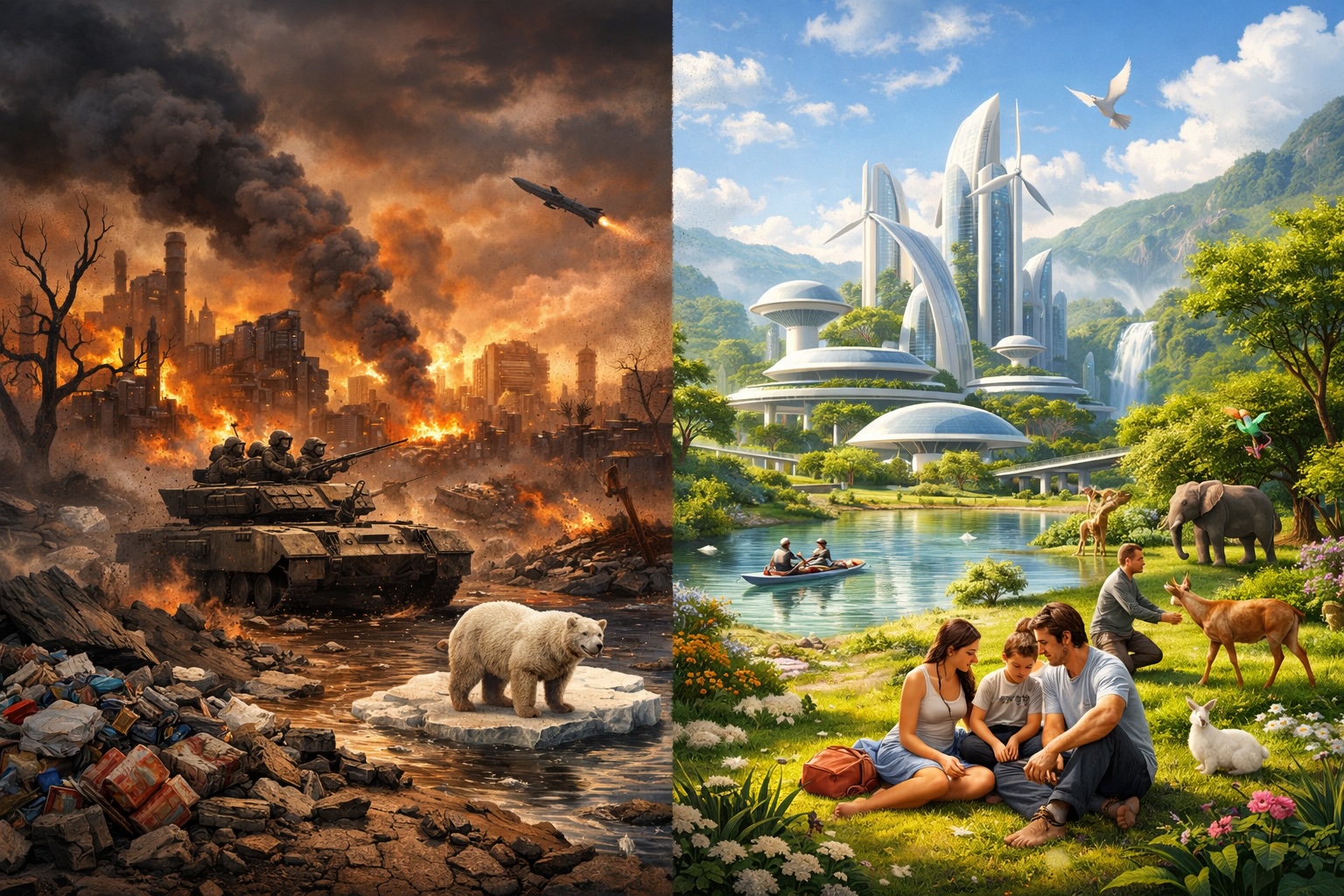
    We stand between two possible futures: the abyss and the dawn.

    The Abyss — What’s Breaking Down

    The signs of exhaustion are everywhere.

    A planet fevered with heat and pollution.

    A suicidal economy that thrives on debt, fear, conflict and competition.

    A species so busy surviving that it has forgotten how to live.

    We scroll past wars, famine and wildfires in the same feed.

    We work harder while feeling emptier.

    We chase “growth” that devours its own foundation.

    This is the shadow side of our brilliance —

    a civilization built on separation, now facing the consequences of its illusion.

    The Dawn — What’s Emerging

    And yet — beyond the noise, something luminous is stirring.

    All over the world, people are beginning to wake up.

    To question, to reconnect, to imagine again.

    Open-source creators are sharing freely.

    Communities are forming outside the logic of money and profit.

    Technology is turning from exploitation to regeneration.

    Young people are marching not for ideology, but for life itself.

    Science, spirituality, and empathy are converging.

    Even AI — once feared as our rival — is revealing itself as a tool for healing, learning, and collaboration.

    This is the first light of the Generation of Awakening

    the ones who remember that the Earth was never ours to own, only to care for together.

    Who This Book Is For

    Waking Up was written for this generation — the Tipping-Point Generation.

    Not defined by age, but by awareness.

    It’s for those who sense that the old story of humanity has run its course,

    and that a new one is waiting to be told.

    For those who feel both the grief of what’s ending and the quiet certainty of what’s possible.

    This is not a book of escape.

    It’s an invitation — to remember, to imagine, to be inspired, and to help birth the world that lies just beyond our fear.

    From Impossible to Inevitable

    Many will say that such a world — without money, greed, or ownership — is impossible.

    But every transformation begins that way. With the impossible.

    Flying was impossible.

    Electricity was impossible.

    The moon was impossible.

    Talking to someone across the planet in real time was impossible.

    Healing the body with light and sound was impossible.

    Even believing that humanity could live in peace was impossible —

    until it wasn’t.

    What we call “impossible” is often just unimagined.

    The moment enough people see it, it begins to take shape.

    The future isn’t waiting for permission.

    It’s waiting for participation.

    If you’ve ever felt that subtle call — that there must be another way —

    this story is for you.

    👉 Read Waking Up – A Journey Towards a New Dawn for Humanity.

    Visit an online bookstore and be part of the generation that tips the balance.