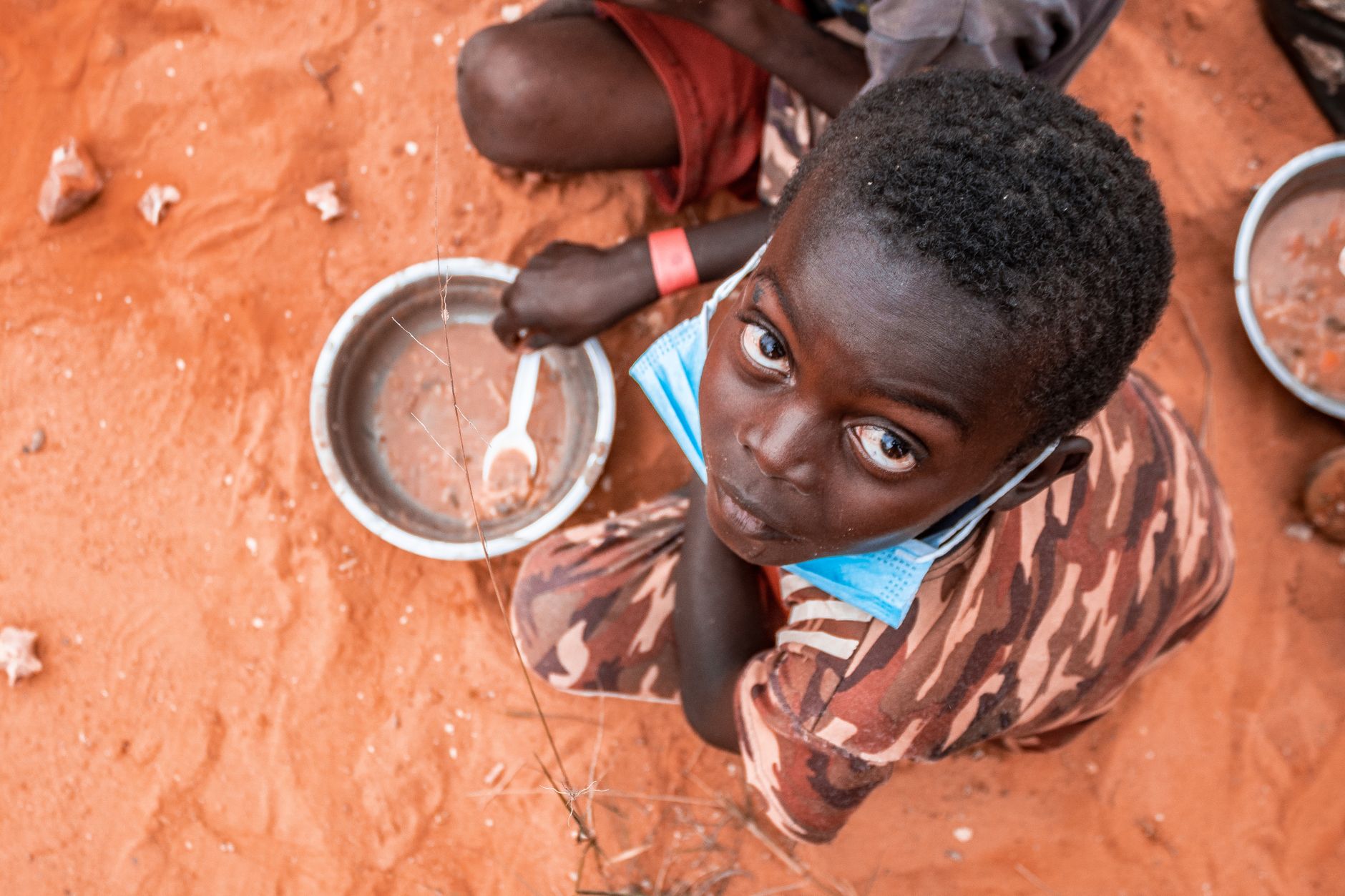
Why are people dying from hunger in a world capable of feeding everyone?
The Starvation Death
Starvation is not a quick death. It is a slow process in which the body gradually consumes itself in a desperate attempt to survive.
At first, hunger can be overwhelming. The stomach aches, the mind becomes obsessed with food, and weakness begins to set in. But as starvation continues, something strange happens. The sensation of hunger may actually diminish, even as the body deteriorates.
Muscles waste away. The immune system weakens. Walking becomes difficult, then impossible. Eventually, vital organs begin to fail. You may become confused, apathetic, and increasingly unconscious until death finally arrives.
Imagine experiencing this yourself.
Or worse, watching your own child slowly starve, knowing there is nothing you can do.
And now consider the most horrifying part:
This is actually happening in a world that already produces more than enough food to feed everyone.
People are not necessarily starving because there is no food. They are starving because they cannot access it.
What kind of civilization allows human beings to die from hunger when we have an abundance of food?
Too Much Food
Every year, approximately 2 billion tonnes of food are lost or wasted globally. This includes food deliberately destroyed, left unharvested, or withheld from sale for economic reasons, including market mechanisms that make surplus production unprofitable. We simply have too much food. According to the United Nations Environment Programme (UNEP), approximately 1.05 billion tonnes are wasted annually by households, restaurants, and retailers alone, while another 931 million tonnes are lost earlier in the supply chain. Together, that’s more than 5 million tonnes of food every single day. In a world where people are dying from hunger, we are not only producing enough food to feed everyone, but losing and throwing away staggering amounts of it because of how our money based food system operates.
5 million tonnes of food.
Every single day.
Wasted.
The Food We Actually Produce
Humanity produces an extraordinary amount of food every year, whereof much is wasted as we see.
According to the United Nations Food and Agriculture Organization (FAO), global agricultural production amounts to approximately 10 billion tonnes of crops annually, in addition to hundreds of millions of tonnes of meat, milk, eggs, and seafood.
Divided among the world’s roughly 8.3 billion people, the crop production alone represents approximately 3.3 kilograms per person every single day, or around 1,200 kilograms per person annually.
Of course, not all these crops are destined for human consumption. Some are used as animal feed, biofuels, and industrial materials. But even after accounting for these uses, FAO’s latest comprehensive food-balance statistics show that the global food supply provides more than 3,000 calories per person per day.
We Have Enough
In other words, we already produce more than enough dietary energy to nourish every human being on Earth, if everyone had adequate access to the food we actually produce.
We are producing food on an enormous scale, yet we have created a system in which millions of people cannot obtain enough to survive.
Surely, humanity can do better than that.
As I was reading the book Why Money is killing us and what we can do about it by Richard Arthur I came across this number:
9 million people die every year because of hunger. I had to check this and Google confirmed it:
An estimated nearly 25,000 people die from hunger and malnutrition-related causes each day globally. This calculation is based on mainstream humanitarian figures—such as those from Concern Worldwide and international food monitors—stating that approximately 9 million people lose their lives to hunger-related complications every year. [1, 2]
Read that again.
On average almost 25000 people. 25000. Die. Every day. From hunger. In 2026.
I felt physically ill reading these numbers. Honestly, I didn’t know it was that bad.
That’s approximately 1,000 people every hour.
About 17 people every minute.
One human being every four seconds.
And among them are children.
Children who will never grow up, never discover their potential, never experience all the wonderful things life could have offered them.
Every single day.
Not because humanity has forgotten how to grow food.
Not because we lack the technology to transport it.
Not because we lack the knowledge to nourish every human being on Earth.
But because we have created a civilization in which access to the necessities of life depends on money.
And if you don’t have money, you might die.
The World We Have Learned to Ignore
The precise number is uncertain, and it isn’t a verified annual death count, but the scale of the tragedy is horrifying no matter what.
Here I am, sitting comfortably in my home, with a roof over my head and enough nutritious food to eat until I am satisfied.
I can choose what I want for dinner. I can prepare a delicious dinner with fresh vegetables, herbs, and a variety of ingredients. I can enjoy my meals without worrying about whether I will have anything to eat tomorrow.
And millions upon millions of people enjoy the same security.
Meanwhile, elsewhere on this very same planet, people are struggling to find enough food to survive.
Children are going to bed hungry. Parents are watching their children become weaker, knowing they cannot provide what they desperately need.
And some of them will die.
Not because they have done anything wrong.
Not because they are less deserving of life.
But because they were born into circumstances that deny them access to the necessities of survival.
Perhaps the most disturbing thing is that we have learned to live with knowing this.
Disaster Headlines
When a disaster kills a thousand people, the world is shocked. Headlines appear everywhere. Governments respond. Aid organizations mobilize.
But the ongoing tragedy of hunger has become part of the background noise of civilization.
We cannot bear to think about it for too long.
So we push it out of our minds.
And life goes on.
Abundance with (Artificial) Scarcity
What makes this tragedy so extraordinary is that humanity already possesses enormous capabilities to produce, preserve, and distribute food.
We have sophisticated agricultural technology, global transportation networks, refrigeration, automated production, and an extraordinary understanding of nutrition.
Yet hundreds of millions of people still experience hunger.
According to the United Nations, approximately 673 million people experienced hunger in 2024.
How can this be?
The answer is not simply that humanity lacks food. We don’t.
Hunger results from poverty, conflict, displacement, failing infrastructure, environmental disasters, and unequal access to resources.
But there is a fundamental contradiction at the heart of our civilization.
We have made access to the necessities of life dependent on purchasing power.
A supermarket can be filled with nutritious food while someone right outside is starving.
The food exists.
The hungry person exists.
The need is undeniable.
But the person has not enough money.
And therefore, the food remains inaccessible.
We have somehow come to accept financial scarcity as though it were the same thing as physical scarcity.
It isn’t.
A lack of money does not necessarily mean a lack of resources.
It means a lack of permission, within our economic arrangements, to access those resources.
And when that distinction determines whether someone eats or starves, surely something is fundamentally wrong.
The Other Hunger
But humanity also suffers from another kind of hunger.
A hunger for money. For property. For power. For more more more.
And unlike the hunger for food, this hunger often seems impossible to satisfy.
A hungry person needs enough nutritious food to live a healthy life.
But how much money does a billionaire need?
How many houses? How much land? How much power?
There seems to be no natural point at which the hunger for accumulation is satisfied.
And while some people accumulate far more than they could ever personally use, others struggle to obtain the most basic necessities of life.
One kind of hunger can be satisfied with a good meal. The other can consume an entire planet without ever being satisfied.
Human Conscience
Of course, humanity does have a conscience.
We send emergency food supplies to famine-stricken regions. Governments contribute aid. Charitable organizations raise funds. Volunteers dedicate their lives to helping those in need.
And thank goodness they do.
These efforts save lives.
But consider what we are actually doing.
We send bags of fortified flour, emergency porridge, and therapeutic food to people who are starving.
And while such food can be essential for survival, why should survival be the limit of our ambitions?
Why should some human beings enjoy fresh, varied, delicious meals every day, while others must depend on emergency rations?
Why shouldn’t everyone have access to nutritious food that is also enjoyable?
Food is not merely fuel.
It is pleasure. Culture. Community. Celebration. Life.
There are wonderful initiatives, including those led by chefs who prepare freshly cooked meals for people in crisis.
But even these initiatives face the same fundamental obstacle.
They need money.
Money to purchase ingredients. Money to pay for transportation. Money to operate kitchens. Money to maintain their organizations.
And when the funding runs out, their ability to help is threatened.
Think about the absurdity.
We have created a civilization in which people must beg for money to feed the hungry.
Not necessarily beg for food.
Beg for money.
The fertile land is there.
The farmers may be ready to grow it. The chefs may be ready to prepare it. The volunteers may be willing to help. The trucks may be available to transport it.
But somewhere between the food and the hungry person stands an invisible barrier.
A price tag.
And until someone pays it, the hungry person may remain hungry.
Conditional Compassion
I don’t believe that most human beings are indifferent to the suffering of others.
Quite the opposite.
Whenever a catastrophe occurs, people demonstrate extraordinary generosity. They donate money, volunteer their time, open their homes, and share what they have.
Humanity is capable of tremendous compassion.
But we have organized our civilization around an economic system in which survival, security, and prosperity are tied to financial resources.
Businesses must remain profitable.
Governments must balance competing financial demands.
Organizations must secure funding.
Individuals must earn enough money to survive.
And those who accumulate wealth gain greater control over resources and opportunities.
Even people who desperately want to help others must operate within these financial constraints.
This is what I have repeatedly described as the invisible logic of the monetary system.
It doesn’t require everyone to be selfish.
It simply makes financial considerations central to almost everything we do.
And oftentimes, those considerations stand directly between a human being and the necessities of life.
What If We Changed the Question?
Imagine, for a moment, that humanity decided to organize civilization around a completely different principle.
Need.
Instead of money.
Instead of asking:
Can people afford the food they need?
We ask:
Do we have the resources and capabilities to feed everyone?
And if the answer is yes, we organize those resources accordingly.
No prices. No purchasing power requirements.
No need to earn the right to eat.
Food would be produced, transported, and distributed according to human needs and ecological possibilities.
Of course, we would still need farmers, scientists, engineers, transportation networks, distribution systems, and people willing to contribute.
We would still need to deal with droughts, crop failures, damaged infrastructure, and other genuine physical challenges.
But these would be problems of resources, organization, and technology.
Not problems of money.
Imagine what humanity could accomplish if the goal of our food system were simply to provide the best possible nutrition and food experiences for everyone, while protecting the ecosystems that sustain us.
Not maximizing profit.
Not increasing market share.
Not generating financial returns.
Feeding Humanity
Surely that should be the primary purpose of a food system.
Survival Is Not Enough
And I want to emphasize something important.
The goal should not merely be to eliminate starvation.
That is the absolute minimum.
We should aim much higher.
Every human being should have the opportunity to enjoy healthy, delicious, varied food.
Every child should have the nourishment needed to develop fully.
Every family should be able to sit down together and enjoy a meal without worrying about how to pay for the next one.
Nobody should have to choose between food, housing, medicine, or other necessities.
We should not be trying merely to keep people alive.
We should be creating the conditions for everyone to enjoy being alive.
That is what true prosperity means.
Not the accumulation of money and property.
But the abundance of life itself.
A Different Future Is Possible
The novel Waking Up: A Journey Towards a New Dawn for Humanity describes a future civilization that has managed to create a world where everyone are fed and live healthy happy lives.
It is not a manifesto. Nor is it a detailed blueprint explaining every step of how to get there or precisely how everything would work.
It is a story meant to inspire humanity to imagine something fundamentally different.
People no longer have to purchase the right to survive.
They are free to contribute according to their abilities, interests, and willingness, while advanced technology helps provide the necessities of life.
It is a vision of a world where nobody needs to be poor for somebody else to be rich.
Where prosperity is measured by well-being rather than monetary wealth.
And where sharing is not considered charity, but a natural part of belonging to one human family.
I am not suggesting that such a transformation would be effortless.
But I believe it is something humanity can choose to work toward.
Because the obstacles are not merely technological.
They are also embedded in how we think about resources, property, entitlement, and our responsibilities toward one another.
And those are things we can change.
The Hunger of Humanity
We are more than eight billion human beings sharing one extraordinary planet.
We have developed technologies that would have seemed miraculous only a century ago.
We can communicate instantly across continents. We can explore other planets. We can automate increasingly complex tasks.
Yet we have still not ensured that every human being has enough nutritious food to eat.
What does that say about our priorities?
Perhaps the greatest tragedy isn’t only that people are dying from hunger.
It’s that the rest of us have learned to live with knowing it.
But we don’t have to accept this as inevitable.
We can imagine a different civilization.
We can begin to build it.
And we can recognize that nobody should have to earn the right to eat, drink clean water, or have a safe place to sleep.
These should be unconditional foundations of human life.
Because ultimately, the purpose of civilization should not be to maximize financial wealth.
It should be to maximize life.
A world without money that is not only possible to live in, but genuinely wonderful to live in. A world we might discover is the one we have wanted all along.
And I don’t mean a moneyless society for a privileged few, while the rest of humanity continues struggling with poverty and financial insecurity.
I mean a world without money for absolutely everyone.
Because if we create abundance for some while leaving others behind, we have merely recreated the inequality we were trying to escape.
The goal is not to build a paradise for a few.
It is to make the whole Earth a paradise for everyone.