
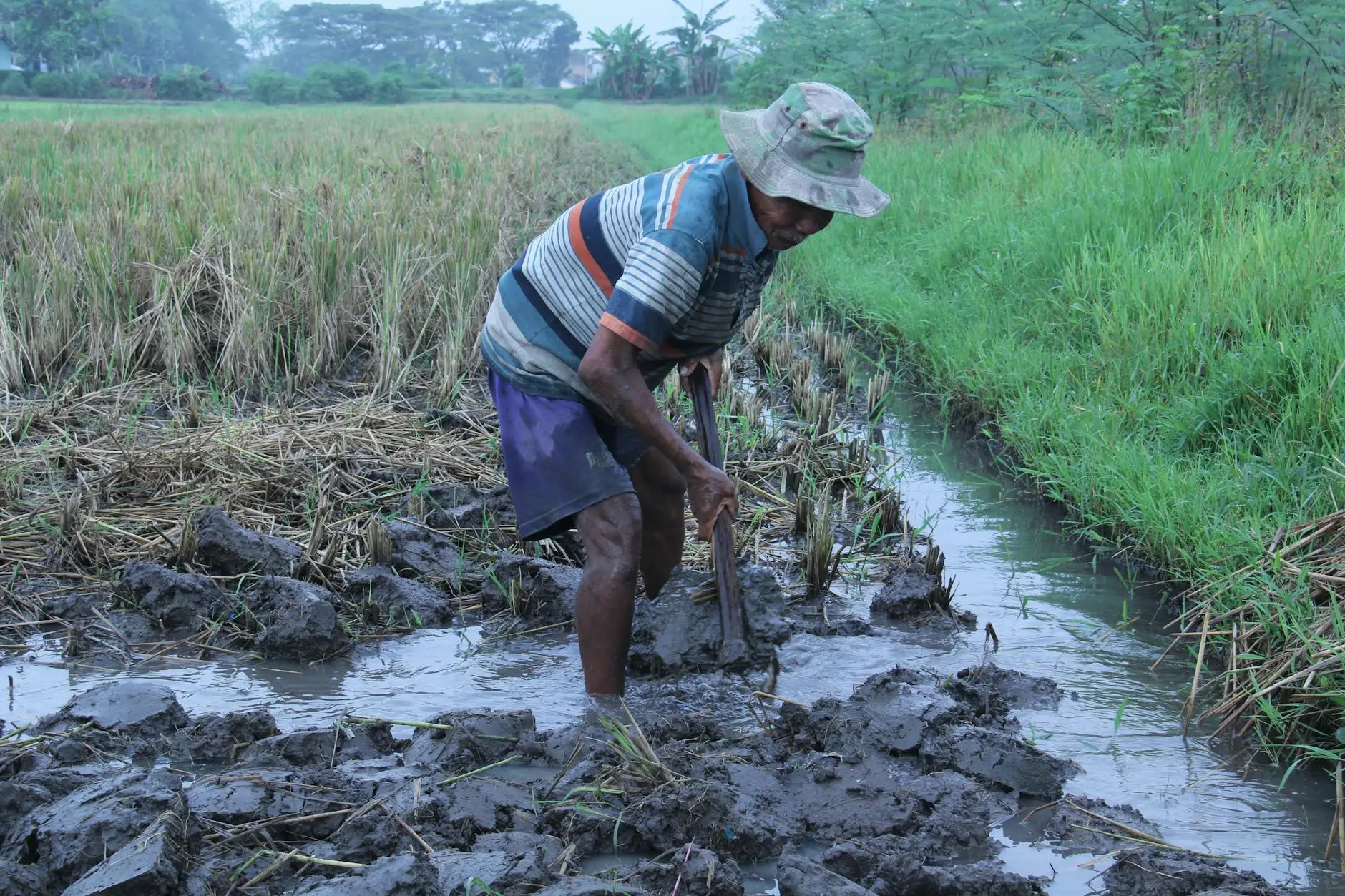
When we think about feudalism, most of us picture castles, kings, nobles, and exhausted peasants toiling in muddy fields on land they themselves did not own.
A brutal world of rigid hierarchy.
The lord owned the land.
The king owned the kingdom.
And the ordinary people worked to survive within a system they had very little control over.
Most people did not own the fields they worked on. They paid taxes, gave labor, or handed over parts of the harvest in exchange for protection and permission to live on the land.
Power flowed downward through ownership. If you controlled the land, you controlled food. If you controlled food, you controlled survival and people.
For the ordinary peasant, life was often about obligation, dependency, and survival within a hierarchy they themselves did not shape.
Ownership and Survival
Most people today look back at that world and think:
“Thank God we don’t live like that anymore. Now we are civilized.”
But are we really as civilized as we think?
Modern capitalism created freedoms, technologies, opportunities, and living standards that medieval people could never even dream of.
Did it Really End?
But perhaps the more uncomfortable question is this:
Did humanity fully leave feudalism behind?
Or did we simply transform it into something far more sophisticated?
Because beneath the modern world of smartphones, supermarkets, global brands, online shopping, and endless convenience, there still exists a system where access to life itself is heavily mediated through ownership, money, labor, and dependency on the rich. The owners.
The forms changed. The packaging changed. But several of the deeper structures may still remain.
That is the question this article explores.
The Rise of Capitalism
Trade expanded.
Cities grew.
Markets developed.
Money became more widespread.
And humanity slowly began moving away from the old feudal structures.
A New Kind of Freedom
At first, this was liberating.
Instead of being tied directly to a lord or a piece of land, people could increasingly sell their labor, start businesses, move to cities, trade goods, and participate in a growing economy.
Ownership became more structured.
Contracts became formalized.
Banking systems expanded.
Industrialization exploded.
And eventually, modern capitalism emerged.
The Explosion
Compared to feudalism, capitalism felt like freedom.
And in many ways, it was.
The modern world that emerged from capitalism created enormous technological progress.
Science advanced.
Medicine improved.
Transportation connected the planet.
Hundreds of millions escaped extreme poverty.
The global distribution system became astonishingly efficient.
Products suddenly appeared from all over the world.
Food in winter.
Cheap electronics.
Fast transportation.
Endless consumer choice.
Humanity had built an economic machine unlike anything in history.
The New Global Hierarchy
But beneath all this progress, something else quietly happened.
The Old Structures Evolved
The old dependency structures did not completely disappear.
They evolved.
Instead of local lords and kings controlling access to survival directly, access increasingly became mediated through money, wages, debt, corporations, contracts, and global ownership structures.
The hierarchy became more abstract.
More distant.
More sophisticated.
The Hidden Costs
And perhaps most importantly:
The harshest parts of the system became externalized.
Factories moved far away.
Mining operations moved far away.
Pollution moved far away.
Cheap labor moved far away.
The suffering became geographically distant from the consumers benefiting from the products.
In wealthy countries, products simply appeared on shelves.
Cheap clothes.
Cheap electronics.
Cheap furniture.
Cheap food.
We rarely saw the exhausted workers.
The polluted rivers.
The dangerous mines.
The children sewing clothes.
The forests being destroyed.
Because money masked most of it.
The monetary system had permeated nearly every country and institution.
People needed money to survive, and when survival depends on money, people are often willing to take almost any job they can get.
The system normalized it.
Not because ordinary people are evil.
But because the system itself creates distance.
A distance not only in geography, but in consciousness.
And because the products were cheap, convenient, beautiful, and endlessly available, we gladly consumed more and more.
Consumption as Escape
Consumption itself became part of the emotional escape.
Buy more.
Upgrade more.
Consume more.
Keep the machine running.
The Monetary System
Meanwhile, the underlying engine remained largely unquestioned.
The monetary system.
The system that now coordinates all global trade.
The system that determines access to resources.
The system that forces endless competition, endless growth, endless extraction.
Of course, money itself once solved many problems.
It allowed trade between strangers.
It simplified exchange.
It helped organize increasingly complex societies.
When Money Became the System
But over time, money also became something else.
Not merely a tool for exchange.
But the central operating system of civilization itself.
And once an entire civilization depends on monetary growth to survive, stopping becomes almost impossible.
Corporations must grow.
Economies must grow.
Markets must grow.
Consumption must grow.
Even when the planet itself clearly cannot sustain infinite material expansion.
This is why so many modern crises feel impossible to solve.
Because even well-meaning governments, corporations, and individuals remain trapped inside the same underlying logic.
Compete or fall behind.
Reduce costs.
Increase profits.
Expand markets.
The system rewards what generates monetary value, not necessarily what creates long-term balance for humanity or the Earth.
And so we arrive at a difficult but important question:
What if humanity did not fully transcend feudalism?
What if we transformed it?
Scaled it?
Globalized it?
Wrapped it in technology, finance, convenience, and beautiful packaging?
Not in the sense that modern life is identical to medieval life.
Clearly it is not.
Modern capitalism brought enormous freedoms and advancements.
But perhaps the deeper structure of dependency never fully disappeared.
It simply evolved into a far more sophisticated global system.
Another Turning Point
And now, for the first time in history, humanity may be approaching another turning point.
Artificial intelligence.
Automation.
Robotics.
Renewable energy.
Global communication.
Technologies that increasingly make it possible to imagine a world where survival no longer has to be tied to endless labor, scarcity, debt, or competition.
A world where the purpose of technology is not merely to maximize profit, but to optimize life itself.
Perhaps capitalism was not the final stage of civilization.
Because if humanity has truly transcended feudalism, then perhaps the peasants toiling on muddy fields are no longer needed at all. Machines can increasingly do that labor.
But if capitalism was considered more fair than feudalism because people became “free” to sell their labor wherever they wanted, then a new question suddenly emerges:
Who will own the machines?
And if a tiny part of humanity owns the automated systems that produce most of the world’s wealth, resources, food, transportation, and infrastructure, is that truly the fair and just world we ultimately want?
If not, then perhaps ownership itself must eventually be reconsidered.
Maybe the next step after capitalism is not state ownership or centralized control, but no ownership at all.
Instead, humanity itself becomes the collective steward of the Earth and its resources.
Not peasants.
Not masters.
But caretakers.
Each person contributing to, maintaining, and caring for the parts of the world they resonate with most.
All increasingly supported by AI, automation, robotics, and intelligent systems.
Perhaps it was a transition.
A necessary step between feudalism and something humanity has not yet fully imagined.
A future where ownership slowly evolves into stewardship.
Where intelligent coordination replaces artificial scarcity.
Where technology serves life instead of forcing life to serve the system.
Reinventing Civilization
Perhaps the next great leap for humanity is not merely technological.
Perhaps it is psychological.
A realization that the systems we created are not laws of nature.
They are human inventions.
And what humanity invents, humanity can also reinvent.
Call To Action
If these ideas resonate with you, then I highly recommend reading and sharing my novel Waking Up – A Journey Towards a New Dawn for Humanity.
The book was written to help people imagine what kind of world could emerge beyond the systems we currently take for granted.
Not through violence.
Not through collapse.
But through imagination, cooperation, technology, and a gradual awakening to new possibilities.
Follow Benjamin Michaels as he wakes up one hundred years into the future and discovers a world where humanity has moved beyond money, ownership, and artificial scarcity.
Because before humanity can build a new world, humanity must first be able to imagine one.
Please share this article if it resonates. I thank you.