
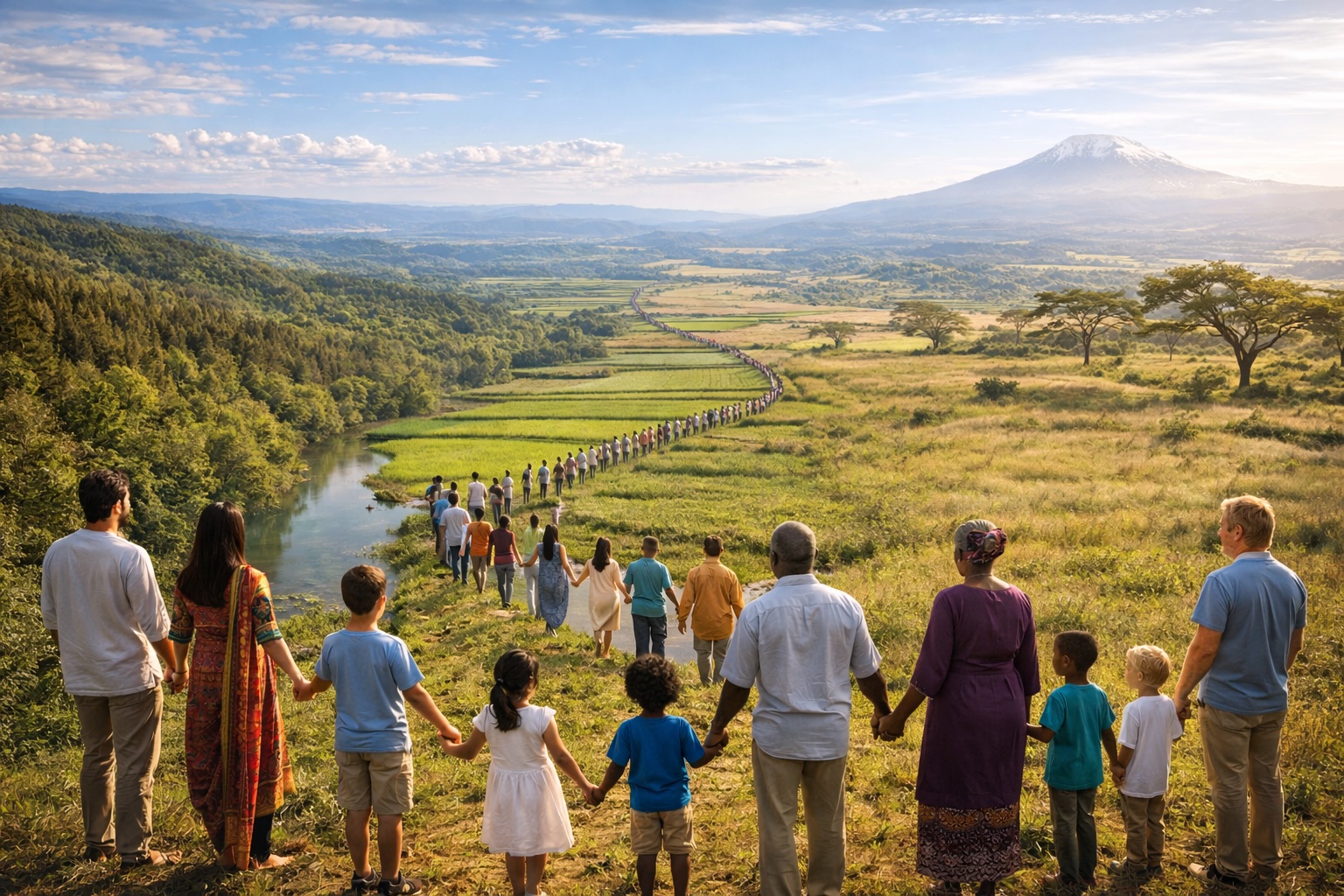
We are all brothers, sisters, fathers, mothers, daughters, and sons.
Not metaphorically. Not only spiritually. But literally.
Modern science confirms what intuition has always whispered: all human beings descend from the same small ancestral family. Long before nations, borders, currencies, religions, or ideologies, there was simply family. Humanity did not begin as competing tribes or opposing camps. It began as people caring for one another in order to survive.
What we call division today came much much later.
For most of our history, cooperation was not a moral ideal — it was a practical necessity. Family bonds expanded into clans, villages, and cultures. Over time, as populations grew and resources were unevenly distributed, systems emerged to manage complexity. Some of those systems brought stability. Others slowly replaced trust with control, kinship with contracts, and belonging with alienation.
Somewhere along the way, we forgot something fundamental.
The idea of a global family is not a new invention. It is a remembrance.
In today’s world, we often speak about humanity as if it were an abstraction — billions of strangers divided by borders, interests, and identities, trading time and resources with money, and not seeing any other possibility. Yet at the smallest scale, humanity already functions without money, ownership, or coercion: within families. Families share. Families care. Families contribute according to ability and receive according to need, not because a system enforces it, but because relationship makes it natural.
This is the seed
When families expand their circle of trust beyond blood alone — into communities built on cooperation, contribution, and shared stewardship — something remarkable happens. The logic of family begins to scale. These are what I call Cities of Light: communities that function like extended families rather than competing units.
And when such families and communities spread across regions, cultures, and continents — not through force, but through resonance — a quiet transformation occurs.
The global family emerges.
Not as a centralized authority.
Not as a uniform culture.
Not as a political project.
But as a living network of families across Earth recognizing one another as kin.
This is the complete realization of the brotherhood of man — not as a slogan, but as a lived reality. A world where diversity is preserved, individuality flourishes, and cooperation replaces fear as the organizing principle of society.
The global family does not erase differences. It contextualizes them. Just as siblings can be different yet belong to the same family, humanity can remain diverse while acting in shared care for one another and for the planet that sustains us.
Seen this way, the future does not require humanity to become something new.
It requires us to remember what we already are.
If this perspective resonates with you, please share this article, as the more people can imagine a better world, the bigger chance we have of actually getting there.
And since you’ve read this far, you clearly enjoy reading, and I hope you enjoy this as well. And if you’d like to experience a full story from a future world like this, you can find the book Waking Up – A Journey Towards a New Dawn for Humanity HERE.