
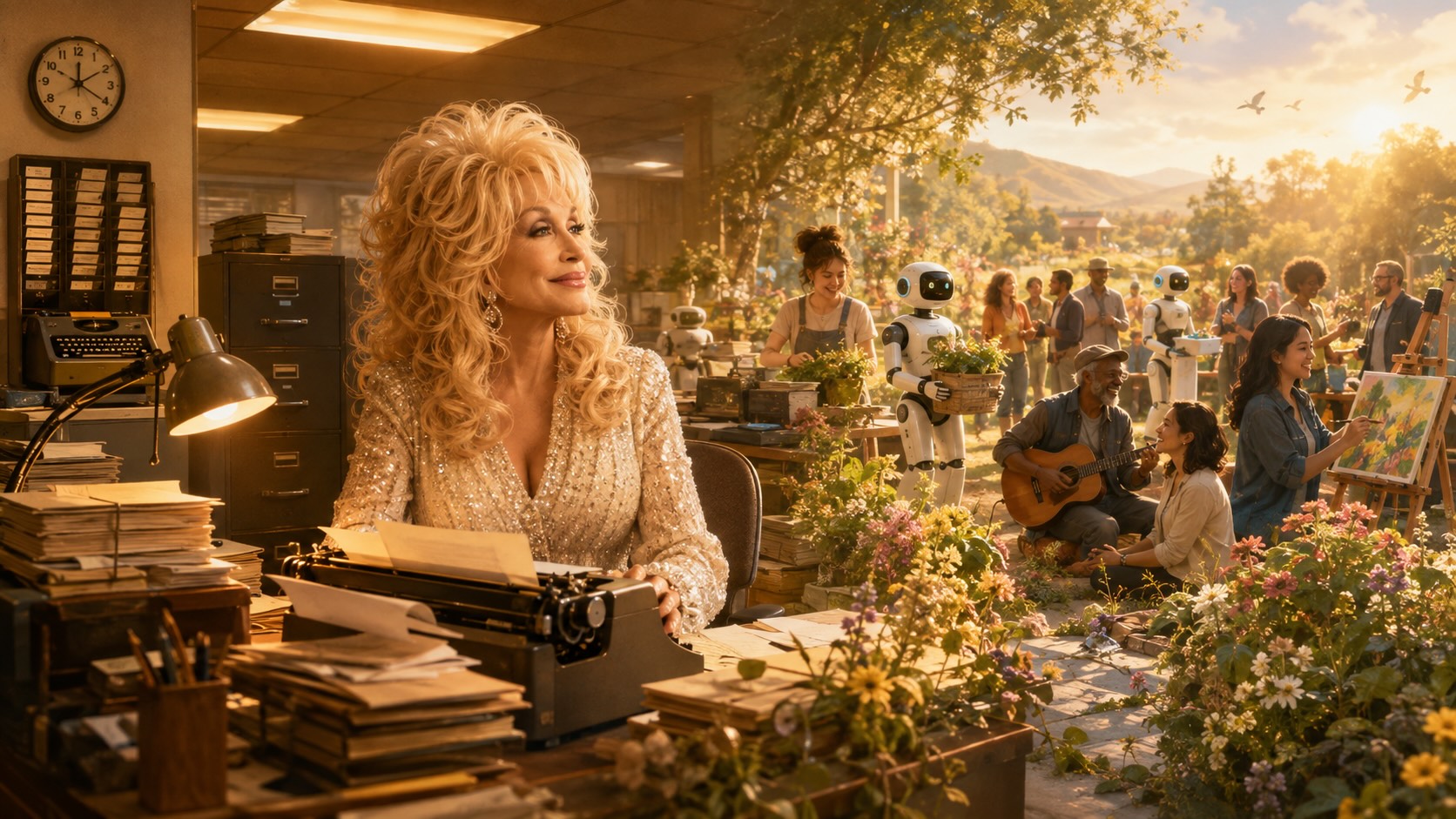
I was never a huge Dolly Parton fan. But I had—and still have—immense respect for her. This is a little tribute to her, may she rest in peace.
Larger Than Life
Behind the deliberately larger-than-life exterior, the extravagant hair, the glittering clothes, the infectious laughter and the wonderfully disarming humor was a songwriter with something serious to say.
Dolly Parton came from poverty.
She understood hardship, work, inequality and the dignity of people who keep going despite receiving far less than they give.
Her joy did not conceal the depth of her work so much as carry it.
She could sing about poverty without asking for pity. She could expose exploitation without sounding like a political lecturer. She could deliver a remarkably sharp criticism of the economic system through one of the most joyful and infectious songs ever recorded.
She made millions of people dance to a song about spending their lives making somebody else rich.
A Rich Man’s Game
“9 to 5” was released in 1980, written for the film of the same name. It became a huge global hit and remains instantly recognizable more than four decades later.
But beneath its irresistible rhythm is a devastating description of working life.
You get out of bed and pour yourself a cup of ambition. You struggle through the morning traffic. You arrive at work and surrender your time, your energy and your intelligence to someone who controls what you do and whether you advance. You are promised that your efforts will eventually be recognized, yet somebody else takes the credit. You work hard enough to build another person’s dream while barely finding the time or resources to pursue your own.
“It’s all takin’ and no givin’.”
That is not merely a complaint about one unpleasant employer. It is a description of the structure itself.
Millions of people exchange the largest and most active part of their lives for the money they need to survive. Their work generates wealth, but much of that wealth flows upward. The worker receives enough to return the following morning and do it again. Meanwhile, those who own the company, the land, the machinery or the financial assets accumulate the rewards created by everybody else’s effort.
Dolly Parton compressed this entire arrangement into a cheerful country-pop song that people could sing in the car on their way to work.
That was its brilliance.
The Dream of Escape
The song recognizes the injustice clearly. It also expresses the familiar hope that one day circumstances will change. The worker’s ship will finally come in. The tide will turn. A better life is waiting somewhere beyond the present struggle.
That dream keeps many people moving.
The Purchase of Freedom
We hope for a promotion, a better-paying job, a successful business, a lucky investment, an inheritance or a lottery win. We imagine reaching the point where we will finally possess enough money to control our own time. Then we will be able to rest, travel, create, spend time with the people we love and decide for ourselves how our days should be lived.
But notice what this means.
We have created a civilization in which freedom is treated as something we must purchase.
Those without enough money must sell their time. Those with sufficient money can buy the time and labour of others. The ultimate dream is to accumulate enough wealth that we are no longer compelled to participate from the vulnerable side of that exchange.
The End of The Game
The song exposes the rich man’s game, but like most social criticism of our time, it stops short of imagining the end of the game itself. It dreams of a better life within the system. It hopes that the worker might finally succeed, escape or receive a fairer portion of what they produce.
That would certainly be an improvement. But it leaves the machinery intact.
For every person who escapes the 9-to-5 struggle, millions remain inside it. And those who do escape are still dependent on those who remain to do the actual work.
The Rich Man
Do most people really dream of becoming the rich man?
Some undoubtedly do. Our culture teaches us to admire those who accumulate fortunes, own enormous properties and rise above everyone else. Wealth is presented as evidence of intelligence, discipline and success, regardless of how it was acquired or how many other people’s labour made it possible.
But I do not believe most people truly want power over others.
Freedom
They do not dream of exploiting workers or hoarding resources. They do not need ten private islands, servants, fleets of cars or billions sitting in financial accounts. What they want are the things that wealth appears to provide: freedom, security, dignity, time, comfort, and the ability to pursue their interests without constantly worrying about survival.
They want to know that they will have a home. They want nutritious food, healthcare and education. They want time with their children. They want to create, explore, learn, travel, rest and contribute according to their abilities. They want to wake up in the morning knowing that their lives belong to them.
They do not necessarily want to become the rich man.
They want a world in which nobody has to be poor.
The Fear of Freedom
There is a strange and revealing paradox in listening to “9 to 5” today.
The work people resented and dreamed of escaping in 1980 is precisely the work many are now terrified of losing.
Artificial intelligence and robotics are becoming capable of performing more of the repetitive, exhausting and monotonous tasks that generations of workers longed to escape. This should be wonderful news. Humanity has spent centuries inventing tools so that human beings would not have to carry every burden with their own bodies and minds.
Yet every new advance now arrives as both a promise and a threat.
People are not necessarily frightened that a machine will answer emails, drive a truck, operate a warehouse, process paperwork or perform some mind-numbing task. They are frightened that when the machine takes the work, the monetary system will also take their income, their home, their security and their place in society.
They do not fear losing the work itself.
They fear losing everything attached to it. The relative freedom and life it gives.
We have therefore reached an absurd position. We are defending the work that exhausts us because our right to live remains attached to performing it. We demand that companies preserve unnecessary jobs because no job still means no money, and no money still means no access to the necessities of life.
Technology offers liberation, but the economic system translates liberation into unemployment.
That is not a technological failure. It is a systemic failure.
The sensible response to automation would be to shorten the working day, share the remaining necessary responsibilities and give everyone access to the abundance that machines help create. Instead, we preserve a system in which people must compete against technology for the right to earn enough money to survive.
The original dream was to be released from compulsory labour. Now that release is becoming technically possible, we experience it as a nightmare.
The problem is not that machines can do our work.
The problem is that we have built a civilization in which human beings lose their livelihood when their work is no longer needed.
The New World
What if the dream was never to win the rich man’s game? What if it instead was to end the game—and create a new world in which everyone possesses the freedom that money currently reserves for the fortunate?
Technology is rapidly changing the conditions under which we live. Machines can perform an increasing share of the repetitive, exhausting and dangerous work once imposed upon human beings. Artificial intelligence can help us understand needs, resources, production and distribution on a scale no earlier civilization could manage.
We now have the ability to ask a question that would have sounded impossible when “9 to 5” was written:
Why should human survival remain dependent upon selling human time?
If food can be cultivated with a fraction of the labour, homes can be constructed efficiently, energy can be produced abundantly and goods can be distributed intelligently, why should access to these things continue to depend upon wages?
Why automate the work while preserving a system that requires everyone to have a job?
Why continue placing all the necessities of life behind prices when our productive capacity can provide those necessities for free for everyone?
A truly advanced civilization would not merely promise workers better treatment. It would make compulsory labour unnecessary. It would use technology to liberate people rather than make them economically redundant. Resources would be held in stewardship rather than ownership, production would respond to actual needs, and access would replace ownership.
Human beings would still contribute. They would still create, solve problems, care for others, conduct research, grow food, make music and build extraordinary things. But contribution would no longer be coerced by the threat of poverty.
We would not abolish human purpose.
We would finally separate purpose from survival.
More Than Hardship
Dolly Parton understood more than hardship. She understood how to speak about it without surrendering her spirit to it.
That may be one reason she reached so many people. She did not appear burdened by the seriousness of her message. She remained playful, glamorous, warm and unapologetically herself. Her humor invited people closer, and once they were listening, her lyrics could say something much deeper than the presentation initially suggested.
Her joy was not evidence that she failed to understand suffering. It was evidence that suffering had not defeated her.
There is something profoundly hopeful in that.
The Beautiful Life
It is easy to describe exploitation with anger. It is harder to expose it while reminding people that life can still contain beauty, laughter and possibility. Dolly Parton managed to do both. She did not simply sing about working people. She preserved their humor, dreams and humanity.
“9 to 5” gave voice to something millions already knew: the modern working arrangement takes too much of our lives and gives too little in return.
Corporate Wealth
More than forty years later, the song remains relevant because the underlying system remains largely unchanged. We may have laptops instead of typewriters, video meetings instead of office memos and digital platforms instead of factory floors, but human time is still being converted into corporate wealth. People are still waiting for their ship to come in. They are still dreaming about the life they might begin once they finally have enough money to live it.
And now, just as technology is becoming capable of releasing us from much of this labour, we cling to it in fear because we have not yet changed the system surrounding it.
We can honour Dolly Parton by celebrating her music, her humour, her generosity and the joy she brought into the world.
But we can also listen to what she was telling us.
Then we can carry the thought one step further.
The Future
The future does not have to be a world in which everyone struggles for the chance to become rich. It can be a world in which the security, freedom and opportunity associated with wealth are available to everyone—without anyone needing to be rich at all.
That is the world Benjamin Michaels discovers when he awakens in 2115 in the novel Waking Up – A Journey Towards a New Dawn for Humanity. The rich man’s game has finally ended. Humanity no longer spends its life putting money into somebody else’s wallet.
Life itself has become the common wealth.
And it is shared by everyone.
You can discover this story here.