
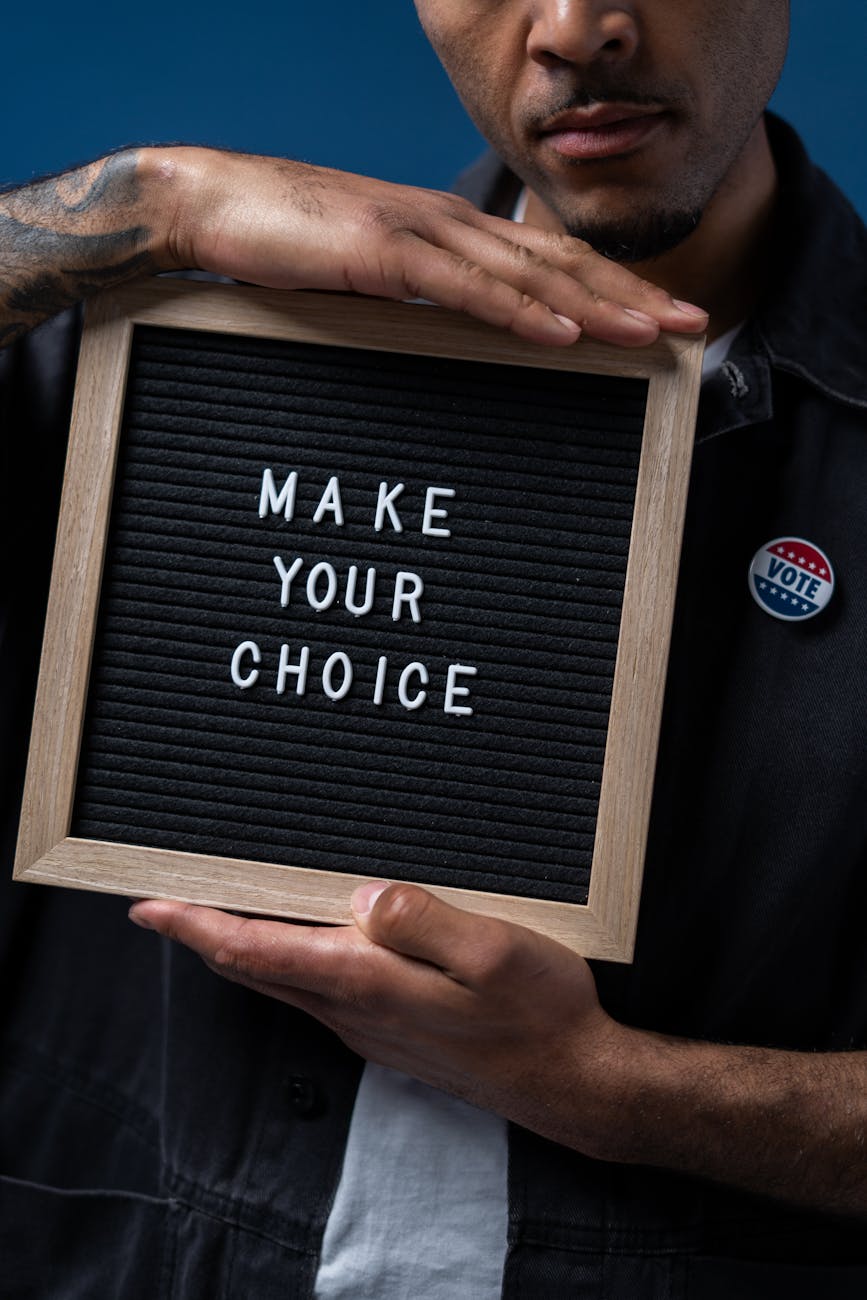
We hear it everywhere.
“Make better choices.”
“Vote with your wallet.”
Vote for this president!
No, for this president!
“It’s up to you.”
Choose organic or conventional.
Choose vegan or omnivore.
Choose electric or gasoline.
On the surface, it sounds empowering. Almost liberating. A billion choices.
But is it really?
The Illusion of Choice
Because when we look closer, something doesn’t quite add up.
Most of our “choices” are made within a system we did not choose.
We don’t choose:
- how food is produced
- how cities are designed
- how energy systems are structured
- how access to basic needs is controlled
- the political system
- the monetary system
We simply choose between the options that are made available to us.
And those options are shaped by a system that mostly prioritizes profit, financial growth, and competition over human well-being and planetary health.
So when we are told to “vote with our wallet,” what we are really being told is:
“Try to fix a systemic problem through your personal consumption”.
The Limits of Individual Responsibility
Individual choices matter. Of course they do.
They signal values. They shape culture. They can spark change.
But they cannot carry the weight of a system that is fundamentally flawed.
The Impossible Choice
Because in many cases:
- the most sustainable option is the most expensive
- the most convenient option is the least healthy
- the most profitable option is the most destructive
So the individual is placed in an impossible position:
Do what is best for you in the short term… or what is best for the world in the long term.
That is not real freedom. That is an impossible choice by design.
So obviously, when our choices are limited by our wallets, the result will almost always be that we choose what we can afford. And since most people can’t afford the most sustainable and highest-quality products, much of what gets produced ends up being lower-quality—often less sustainable, and in many cases harmful to both people and the planet.
A Systemic Problem
The real issue is not that people are making bad choices.
The real issue is that the system often makes the wrong choices easy… and the right choices impossible.
And no amount of personal optimization can fully overcome that.
So the question shifts.
Not:
Are we making the right choices?
But:
Why is the system producing the wrong outcomes in the first place?
Can We Choose a Better System?
This leads to a deeper and more important question:
Can we, collectively, choose a system that works better for everyone?
At first, that might sound unrealistic.
But think about it.
Everything around us is already the result of more or less collective choices:
- laws
- rules
- infrastructure
- currencies
- ownership structures
- markets
None of these are natural laws. They are agreements.
So if we can collectively – although unconsciously – agree on a system that produces stress, inequality, scarcity, pollution, war and insecurity…
Why couldn’t we agree on one that produces health, stability, peace, abundance and well-being?
Not Collectivism but Alignment
For those who are wary of collectivism, this is not about forcing people into a shared system against their will.
It is about discovering a way of organizing society where:
What is good for the individual… is also good for everyone.
We already see this alignment in everyday life:
- hygiene protects both you and others
- traffic rules keep everyone safe
- public infrastructure benefits all who use it
These are not experienced as loss of freedom.
They are experienced as common sense.
The Freedom to Not Trade
Today, we are not just choosing—we are forced to participate.
We must trade:
- our time
- our skills
- our energy
- our property
In order to access:
- food
- housing
- mobility
- healthcare
Opting out of this system is not really possible.
Because opting out means losing access to survival and life itself.
In that sense, participation is not a choice.
It is a condition.
Now imagine a different foundation.
A system where access to basic needs is not dependent on money or trade.
Where resources are organized and distributed based on need and availability.
In such a system, something interesting happens:
Trade is no longer required for survival.
And when something is no longer required… it becomes optional.
You could still trade if you really wanted to.
Create your own system. Trade goods or services.
But then the question naturally arises:
Why would you need to or want to?
When Choice Becomes Real
In today’s system:
- Freedom means choosing how you participate in trade
In a resource-based system:
- Freedom means choosing whether you participate in trade at all
That is a profound shift.
Because for the first time, choice becomes real.
Not a constrained selection between predefined options…
But the ability to step outside the necessity altogether.
A System That Works for All
This is not about perfection.
It is about alignment.
A system works when it removes the conflict between:
- individual well-being
- and collective well-being
When people don’t have to choose between themselves and the world.
When thriving is not a privilege, but a natural outcome of how society is organized.
The Real Power of Choice
So perhaps the real power of choice is not found in what we buy.
But in what we are willing to imagine.
And eventually… what we are willing to build together.
Because the systems we live in are not fixed.
They are chosen collectively, whether consciously or not.
And if they are chosen…
They can be changed.
Discover the story
👉 Discover the story of Benjamin Michaels who wakes up 100 years in the future and experience a world where humanity has made a conscious choice and created a world that works for all. If this sounds interesting, then the novel Waking Up – A journey towards a new dawn for humanity is for you.
If this perspective resonates, please share this article.