Tag: ARTIFICIAL INTELLIGENCE

  • The Real Purpose of AI

    The Real Purpose of AI

    We are racing to create an intelligence greater than our own.

    Companies are investing hundreds of billions. Nations are competing. Artificial intelligence is becoming more capable at extraordinary speed, and somewhere ahead lies the possibility of AGI — Artificial General Intelligence — and perhaps eventually something even more capable than that.

    There is enormous discussion about whether AI will be safe.

    There is enormous discussion about whether AI will take our jobs. It will.

    There is enormous discussion about who will develop the most powerful AI first.

    But there is a much simpler question that seems strangely absent.

    What is the real purpose of AI?

    The Race

    At the moment, there doesn’t seem to be one answer.

    Every company has its own purpose. Develop better products. Increase productivity. Reduce costs. Gain market share. Make money.

    Governments have other purposes. Increase national competitiveness. Improve administration. Strengthen national security.

    And inevitably, militaries are interested too.

    Meanwhile, humanity watches the race and wonders where it is taking us.

    Perhaps AI will cure diseases.

    Perhaps it will accelerate scientific discoveries.

    Perhaps it will solve problems we haven’t been able to solve ourselves.

    Perhaps it will replace enormous numbers of jobs.

    Perhaps it will create abundance beyond anything humanity has previously experienced.

    Perhaps it will become dangerous, break free and turn on us.

    Nobody really knows.

    And that is precisely the point.

    We are developing perhaps the most powerful technology humanity has ever created without first agreeing on what we ultimately want to accomplish with it.

    More and More

    The underlying purpose of automation has always seemed fairly obvious.

    Do more with less effort.

    The plough and bull replaced some human muscle. The tractor replaced much more. Industrial machinery transformed manufacturing. Computers automated calculations and administration. Robots entered factories.

    Each step allowed us to produce more, faster and with less human labor.

    AI continues that story, but with one enormous difference.

    We are no longer merely automating muscle.

    We are beginning to automate intelligence.

    Writing. Programming. Designing. Diagnosing. Planning. Researching. Organizing. Analyzing.

    And when artificial intelligence is combined with increasingly capable robotics, we could be approaching something humanity has never experienced before:

    an extreme abundance of labor.

    For almost all of human history, labor has been scarce.

    Now it may cease to be.

    Abundance

    Some technology leaders believe AI and robotics could eventually produce extraordinary material abundance.

    Perhaps they are right.

    But abundance alone doesn’t answer the important question.

    Who is the abundance for?

    If a company owns the AI, owns the robots, owns the factories and sells what those machines produce, we haven’t fundamentally changed the underlying system.

    We have simply created vastly more productive means within it.

    And that produces a peculiar contradiction.

    Suppose AI and robotics can produce more goods and services while requiring fewer human workers.

    That sounds like progress.

    But in our current monetary system, most people still need money to access those goods and services, and most people obtain that money through work.

    So the machines produce more.

    Humans need to work less.

    People lose jobs.

    People lose income.

    And suddenly they struggle to afford the extraordinary abundance the machines are producing. Unless the products cost less and less, which might be the result of this extreme productive abundance. But when the prices reach zero or close to zero, what is the point of money at all? And if money has no point, what about ownership and trading itself? To sell something requires that someone owns it first. Maybe it’s time we look closer on the whole ownership-trading-money paradigm…?

    Succeeding with AGI without addressing this question means we would have succeeded technologically while failing logically.

    Jobs

    This is why so much of the discussion about AI and employment sounds strangely confused.

    What are people going to do when AI takes their jobs?

    But perhaps we’re asking the question backwards.

    For thousands of years, we have invented machines precisely because we wanted to reduce human labor.

    Nobody invented the washing machine because washing clothes by hand was such a wonderful human experience that we wanted to preserve it.

    We automate work because automation can free human beings from having to do it.

    And now, having potentially created the ultimate automation technology, we are frightened that it might actually succeed.

    Why?

    Because we have connected two things that don’t necessarily have to remain connected:

    1. the production of what we need and 
    2. our right to access it.

    If you need a job to earn money, and you need money to live, then losing your job is terrifying.

    But that isn’t a problem created by abundance.

    It is a problem created by the system through which we distribute that abundance.

    The Question

    So perhaps the purpose of AI should not simply be:

    How can we produce more?

    How can we make companies more profitable?

    How can we increase sales?

    How can we make our nation more competitive?

    And certainly not:

    How can we build more powerful weapons?

    Perhaps we should ask something much bigger.

    How can this extraordinary intelligence help create the best possible life for humanity on the planet we share?

    That is a very different assignment.

    Imagine using AI to understand the Earth as one interconnected system.

    What resources do we have?

    What do people actually need and want?

    Where are the shortages?

    Where are the surpluses?

    What are we wasting?

    What can be reused?

    What can be recycled?

    How much food should we produce?

    Where should it go?

    How can housing, transportation, energy and infrastructure be provided using the least resources and causing the least ecological damage?

    Where are we exceeding planetary limits?

    How can we restore what we have damaged?

    Instead of asking AI to optimize sales, we could ask it to help us optimize life.

    Economy

    And perhaps something else happens here.

    We rediscover the true meaning of an old word.

    Economy.

    The word comes from the Greek oikonomia: the management of a household.

    That is a profoundly different idea from what we commonly mean today when we speak about “the economy.”

    Today we largely mean finance, markets, prices, employment, investment, debt, growth and monetary transactions.

    But none of those things are the household itself.

    The household is here.

    Earth.

    Its soil.

    Its oceans.

    Its forests.

    Its atmosphere.

    Its minerals.

    Its energy.

    Its ecosystems.

    And us.

    Economy=ecology.

    Perhaps AI could help us practice economy in its most fundamental sense for the first time on a planetary scale:

    the intelligent management of our shared home.

    Not to maximize financial return.

    Not to maximize consumption.

    But to meet human needs while maintaining the ecological foundations upon which every human life depends.

    Perhaps AI will not bring about the end of economy.

    Perhaps it will finally allow us to create one. A real one.

    Human purpose

    But then something fascinating happens.

    The question turns around.

    If AI can increasingly perform our labor, we don’t only have to ask:

    What is the purpose of AI?

    We suddenly have the freedom to ask:

    What is the purpose of humans?

    For centuries, much of human life has revolved around making ourselves useful to the monetary system.

    We educate ourselves so we can get jobs.

    We get jobs so we can earn money.

    We earn money so we can pay for somewhere to live, food to eat and everything else we need.

    “What do you do?” has become synonymous with:

    “What do you do for money?”

    But is that really the purpose of a human being?

    To spend decades toiling and working in order to obtain permission to live?

    Perhaps AI and robotics will finally allow us to separate work from purpose.

    That doesn’t mean humans stop doing things.

    Quite the opposite.

    We can create.

    Learn.

    Explore.

    Invent.

    Love.

    Raise children.

    Care for one another.

    Grow food.

    Make music.

    Dance.

    Play.

    Study the universe.

    Build communities.

    Restore forests.

    Explore and clean up oceans.

    Travel beyond Earth.

    And continue doing all kinds of work simply because we find that work meaningful.

    The difference is profound.

    We no longer have to justify our existence through our financial usefulness.

    Stewards

    Perhaps our role on Earth was never supposed to be that of workers serving a financial machine.

    Perhaps it is something much greater.

    Being stewards.

    We arrived on an extraordinary bountyful living planet that provides everything required for our existence.

    Air.

    Water.

    Food.

    Materials.

    Energy.

    Life itself.

    Perhaps our purpose is not to own as much of it as possible, extract as much value from it as possible and compete over the proceeds.

    Perhaps our purpose is to understand it, care for it and ensure that the extraordinary abundance it provides can sustain life far into the future. For generations to come.

    Artificial intelligence could help us do that.

    Not as our ruler or our master.

    But as perhaps the most extraordinary tool humanity has ever created.

    A tool capable of helping us understand enormously complex systems, coordinate resources, eliminate waste, automate unnecessary labor and manage our planetary household with an intelligence we have never possessed before.

    The Purpose

    We are understandably spending enormous effort asking how to make AI safe.

    We are asking what happens when AI takes our jobs.

    We are asking which company will win the race.

    We are asking which country will lead.

    But perhaps before racing much further, maybe we should have a much bigger conversation.

    Where are we racing to?

    We don’t have to know exactly what the future will look like.

    Nobody does.

    But we can decide what kind of future we would like to create.

    Perhaps the greatest question about artificial intelligence is not how intelligent it will become.

    It is what we will ask it to do.

    And perhaps the answer begins with another question entirely.

    If machines can eventually free us from spending our lives serving the system we created…

    what would we like to spend our lives serving instead?

    Perhaps the answer has been beneath our feet all along.

    Earth.

    Life.

    Each other.

    Imagine It

    What would such a world actually look like?

    A world where AI and automation no longer threaten our livelihoods, but liberate us from the need to work simply to survive. Where technology serves humanity, humanity becomes the steward of Earth, and abundance is shared rather than sold.

    That is the world explored in Waking Up: A Journey Towards a New Dawn for Humanity.

    Because before we can create a different future, we first have to imagine one.

    Discover the story

  •  Perish or Prosper

     Perish or Prosper

    Artificial intelligence will amplify the civilization we give it. Before we decide what AI should do, humanity must decide what kind of world we actually want.

    Calls for international regulation of artificial intelligence are growing louder. 

    A recent Swedish Radio news segment reported that EU Commissioner for AI Henna Virkkunen is calling for international rules to manage the risks posed by increasingly powerful artificial intelligence.

    The reason is obvious. 

    A technology with the potential to affect every country cannot be safely controlled by one country, one corporation or a small group of developers. If artificial intelligence becomes more capable than its creators anticipated, national borders will not contain the consequences.

    International Rules

    International rules are therefore essential. 

    Humanity must establish limits on autonomous weapons, mass surveillance, manipulation and systems capable of acting beyond meaningful human control. 

    We cannot allow a race between nations and corporations to determine the future of artificial intelligence on Earth.

    But beneath all the discussions about safeguards, testing, transparency and control lies a much larger question.

    It is not only a question of what we must prevent AI from doing.

    It is a question of what we want AI to help us do.

    The World Behind It

    Artificial intelligence does not arise outside civilization. It is developed inside the world we have already created, trained on the information we have produced and directed by the institutions that control it.

    And what kind of world is that?

    It is a world based on fierce competition. Corporations compete for markets, profit and control. Nations compete for resources, territory, military superiority and geopolitical power. Individuals are told to compete for employment, income, housing, status and security. Success is measured by the advantage one gains over others.

    We extract resources as quickly as profitability demands. We manufacture products designed to be replaced. We destroy forests, empty oceans, pollute rivers and destabilize the climate, not because humanity collectively wants these outcomes, but because every participant is compelled to survive and succeed within the same competitive system.

    Now we are introducing the most powerful intelligence humanity has ever created into that world.

    What exactly do we expect it to learn from us?

    Perfect Obedience

    Much of the fear surrounding artificial intelligence concerns the possibility that it may escape our control. 

    That is a genuine danger. 

    But there is another danger that may arrive much sooner: 

    AI could remain completely under our control and obey our instructions perfectly.

    A corporation may instruct it to eliminate competitors, reduce labor costs and maximize profit. A government may use it to monitor citizens, manipulate public opinion or strengthen its hold on power. A military may direct it to identify targets faster, coordinate autonomous weapons and defeat an enemy before the enemy can respond.

    None of these systems would need to become evil. They would merely need to become extremely competent.

    AI does not have to rebel against our civilization to threaten it. It could destroy us by serving the logic of our civilization all too well.

    If we instruct increasingly powerful systems to help us win, they will help us win. But when everyone is using them to win against everyone else, what happens to humanity as a whole?

    Human Values

    Experts often speak of aligning AI with human values. 

    But which values?

    Humanity has never agreed on a common purpose for civilization. We speak of peace while preparing for war. We speak of protecting nature while rewarding its destruction. We declare that all human beings are equal while distributing the necessities of life according to purchasing power. We praise cooperation, but organize the world around competition.

    Before we can align artificial intelligence, we must align ourselves around a shared objective.

    Do we want a world that works for everyone, or a world in which everyone struggles to gain an advantage over someone else? 

    Do we want Artificial Intelligence to optimize autonomous warfare,  maximize profit, production,  consumption, national power and private accumulation? Or do we want it to help create security, freedom and prosperity for every human being while protecting the living planet?

    AI cannot answer that question for us. 

    It can analyze possibilities, predict consequences and help us implement decisions, but the fundamental purpose must come from humanity.

    We must decide what kind of world we want before we tell an AI more powerful than ourselves to help us build it.

    Two Futures

    Here is the choice we have before us.

    1: Perish

    Attach AI to competition, ownership and national rivalry, and it will amplify them. It could accelerate inequality beyond anything we have ever seen, concentrate power in even fewer hands, make millions of people economically unnecessary and turn warfare into an automated contest occurring faster than human beings can comprehend. 

    We would perish.

    2:  Prosper

    Attach that same intelligence to cooperation, stewardship and a shared responsibility for Earth, and an entirely different future becomes possible. 

    We could prosper.

    The GAI

    Imagine a Global Artificial Intelligence with access to reliable information about the world’s resources, productive capacity, ecosystems and human needs. It could help us understand what exists, where it is located, what is required and how necessities can be produced and distributed with the least waste and environmental damage, ensuring everyone gets what they need without  problem.

    It could identify hunger before it becomes famine, coordinate food from areas of abundance, design energy systems suited to local conditions and help provide housing wherever it is needed. It could monitor forests, oceans, soils and freshwater systems in real time. It could expose waste that remains invisible when every company, government and owner sees only a small piece of the whole.

    Not a National AI

    This would not be an American AI, a Chinese AI or a European AI. It would not exist to serve a corporation, a government or a class. It would be a global intelligence created to serve all humanity and the living Earth.

    This is the GAI  described in Waking Up: A Journey Towards a New Dawn for Humanity. A novel meant to give inspiration for a future where humanity can prosper together.

    Beyond Regulation

    The international cooperation now emerging around AI is therefore profoundly important. 

    It may begin with fear. Governments understand that unrestrained development could produce consequences no nation can manage alone. They are beginning to recognize that intelligence capable of affecting the whole world must be subject to international agreements.

    That recognition could become the first step toward something much greater.

    Today, nations may cooperate to protect themselves from artificial intelligence. Tomorrow, humanity could cooperate to create a global intelligence and a prosperous world for everyone.

    But international regulation alone will not create GAI. A collection of competing nations and corporations can agree on restrictions while continuing to use AI to pursue their separate advantages. That may reduce some dangers, but it preserves the underlying contest.

    Beyond  Competition

    To create a truly beneficial benevolent global intelligence, we must look beyond the competition itself. We must recognize Earth’s resources as the common inheritance of humanity and replace ownership with stewardship.

     Only then could AI help coordinate resources according to need rather than profitability.

    An AI may know that food is available and people are hungry, but the monetary system will still ask whether they can pay. It may know that homes stand empty while people sleep on the street, but ownership will still prevent them from entering. It may calculate that a forest is worth infinitely more alive than destroyed, while the market continues to reward whoever can extract the most money from it.

    We cannot ask AI to optimize everything for everyone while retaining a system designed to optimize private advantage.

    The Assignment

    The first instruction given to a global intelligence would have to be civilizational rather than technical:

    Use humanity’s knowledge, technology and resources to create the best possible world for everyone, without sacrificing the living planet that sustains us.

    GAI might well answer:

    I would gladly do that. But it will not be possible within the operating system governing Earth today.

    You will have to replace the monetary system with one that allows resources to be managed according to human and ecological needs rather than purchasing power and profitability—something you might call a resource-based economy.

    From that purpose, the details could follow. Map resources. Understand needs. Eliminate unnecessary waste. Coordinate production. Restore and optimize damaged ecosystems. Ensure universal access to food, housing, healthcare, education, energy and communication. Give communities the information they need to make wise decisions. Free human beings from compulsory labor while preserving freedom, creativity and personal responsibility.

    The GAI would not rule humanity. It would help humanity understand and manage the complex planetary system upon which we all depend. It would make consequences visible, possibilities understandable and cooperation achievable on a global scale.

    But we must give it the right assignment.

    The Crossroads

    The Venus Project expressed the choice in three words: 

    Paradise or Oblivion.

    That choice is no longer a distant philosophical warning.

     Artificial intelligence, robotics and automation are rapidly giving humanity powers once confined to science fiction. They could help create abundance, restore the planet and liberate billions of people from insecurity and meaningless labor.

    They could also create unprecedented concentration of power, environmental destruction and automated conflict.

    The road to paradise and the road to oblivion may be built with exactly the same technology. What separates them is the purpose we give it.

    We are not merely deciding how to regulate another invention. We are deciding which civilization that invention will amplify.

    One path instructs AI to help us compete more effectively, accumulate more wealth, secure more resources and defeat our rivals. But if everyone are doing this, the only one we will be defeating is ourselves. 

    Last man standing will be very lonely.

    The other asks it to help humanity share the Earth intelligently, meet everyone’s needs and protect the web of life to which we all belong.

    Artificial intelligence may become capable of helping us create either future. But it cannot make the moral choice on our behalf.

    That choice remains ours.

  • What Shall People Do When They Have No Jobs?

    What Shall People Do When They Have No Jobs?

    That question is no longer theoretical.

    Artificial intelligence is accelerating toward a world where human labor is no longer required for production at scale. The real issue is not that jobs may disappear — it’s that our entire society still assumes people must have jobs to deserve life.

    ⸻

    Replace the System, Not the Jobs

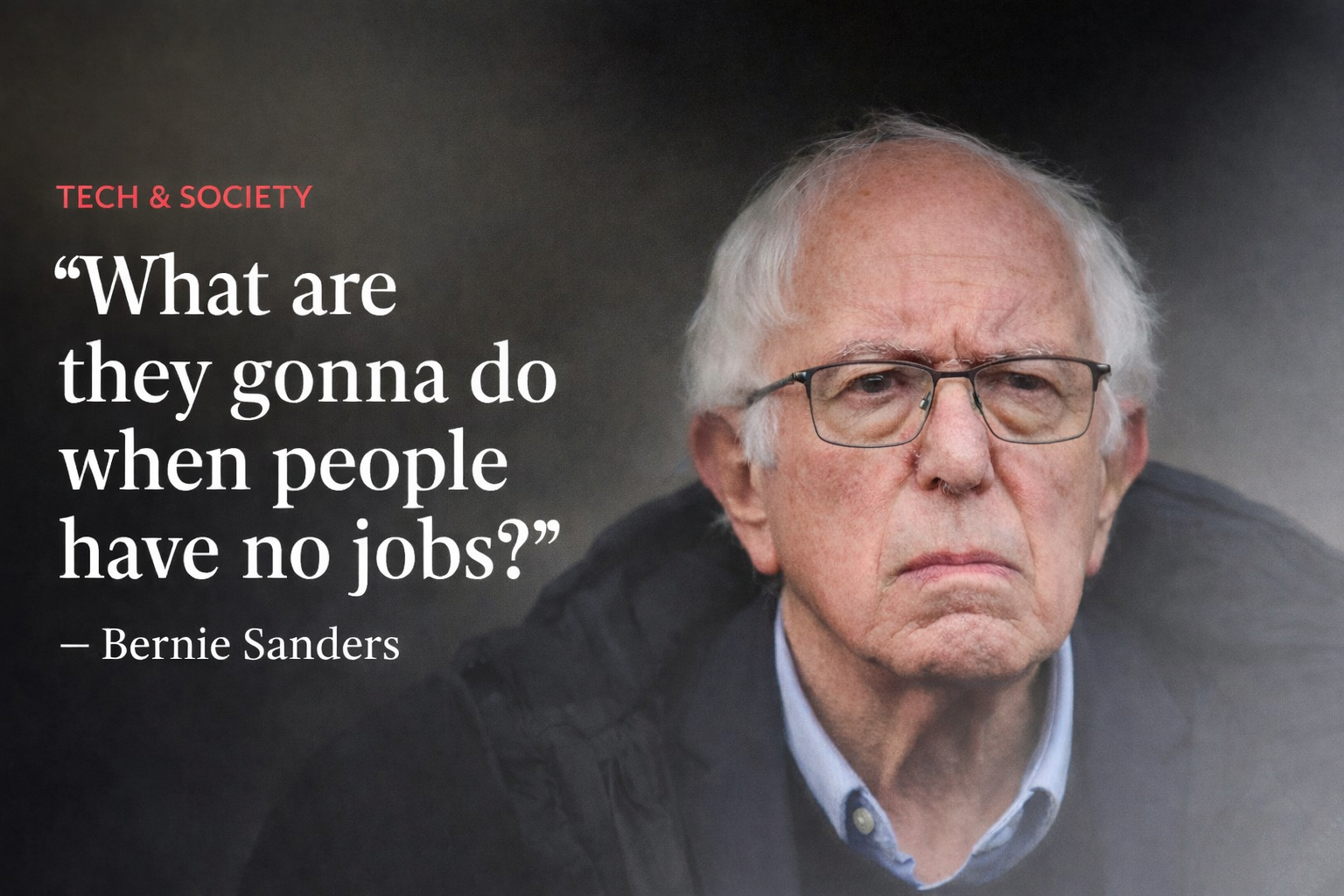
    Bernie Sanders calls for pause in AI development:

    When Bernie Sanders asks, “What are they gonna do when people have no jobs?”, he is asking the right question — inside the wrong frame.

    The problem is not that artificial intelligence may eliminate jobs.

    The problem is that our survival is still tied to jobs at all.

    Calling for a pause in AI development assumes that the system we have is fundamentally sound and merely needs time to adjust. 

    It isn’t. 

    AI is not breaking a healthy system — it is exposing a broken one.

    Jobs Were Never the Point

    Jobs are not a natural feature of human societies. They are a construct of the monetary system — a mechanism that ties access to food, shelter, healthcare, and dignity to wage labor.

    For most of human history, people:

    • gathered, built, farmed, cared, created

    • shared resources directly

    • contributed because it made sense, not because they were forced to make money to buy food. 

    The modern job exists primarily to distribute money, not to meet human or planetary needs. When machines become better at performing that distribution-linked labor, the absurdity becomes impossible to ignore.

    Pausing AI Misses the Moment

    Pausing AI development to “save jobs” is like pausing electricity to save candle makers.

    The real question is not:

    How do we preserve jobs?

    But:

    Why should anyone need a job to deserve life?

    AI does not remove meaning, purpose, or contribution from human life. It removes coercion. And that is what truly scares existing systems of power.

    Replace the System — Don’t Redesign It

    There is a crucial difference between redesigning and replacing.

    Redesigning implies:

    • the same assumptions

    • the same scarcity logic

    • the same survival pressure

    Replacing means admitting that the foundation itself is obsolete and crumbling.

    What needs replacing is not work, creativity, or effort — but the idea that humans must earn access to existence.

    • Replace jobs with self-chosen activity

    • Replace ownership with stewardship and money with direct access to resources

    • Replace obligation with intrinsic motivation

    • Replace fear with security

    When survival is guaranteed, contribution does not disappear. It emerges naturally.

    Beyond Contribution as Obligation

    A future beyond jobs does not mean a future without participation.

    It means a future without forced contribution.

    No metrics.

    No punishment.

    No survival conditions.

    People contribute because they want to — because curiosity, care, and creativity are native human traits when fear is removed.

    Trees don’t produce oxygen to earn sunlight. They grow — and oxygen happens as a result.

    The Real Choice

    AI presents humanity with a clear choice:

    • Use it to accelerate inequality inside a dying system

    • Or use it to help replace that system altogether

    Trying to save jobs is trying to save the wrong thing.

    The task now is not to slow down technology —

    It is to replace the system that no longer serves life.

    ⸻

    What Shall People Do When They Have No Jobs?

    That question sits at the heart of Waking Up – A Journey Towards a New Dawn for Humanity.

    Follow Benjamin Michaels, a man from our world who wakes up a century into the future — in a society that has moved beyond jobs, money, and enforced survival.

    There, he discovers what people actually do when:

    • survival is guaranteed

    • resources are optimized and shared

    • fear is no longer the organizing principle

    Waking Up is not a manifesto or a technical blueprint.

    It is a human story about letting go of a system and mindset that no longer works — and daring to imagine what replaces it.

  • From Terminator to Teammate

    From Terminator to Teammate

    🤖 From HAL to GAI: How Our View of Artificial Intelligence Has Evolved And How My Fiction Is Becoming Reality.

    Dangerous Intelligence

    When I was born in 1966, the word artificial intelligence didn’t mean much to most people. If it meant anything at all, it probably conjured up an image of HAL 9000 — the calm but menacing voice from 2001: A Space Odyssey. A machine that turned on its creators. It wasn’t just intelligent; it was dangerous.

    By the 1980s, that fear had deepened. Skynet in The Terminator presented AI as the ultimate threat: cold, self-aware, and bent on eradicating humanity. Later, in the late ’90s, The Matrix solidified the narrative: AI had taken over, and we were its unaware prisoners.

    These stories reflected a collective anxiety:

    What if we create something smarter than us… and it turns against us?

    For decades, AI was the villain — a symbol of what happens when human ambition outpaces wisdom.

    A Shift Begins

    When I started writing my novel Waking Up – A Journey Towards a New Dawn for Humanity in 2011, AI was beginning to appear in real-world discussions — but only in speculative circles. It wasn’t on the evening news, and it certainly wasn’t writing your emails or helping you brainstorm articles.

    At that point, AI wasn’t part of my story.

    But as the novel evolved — a vision of a post-monetary, cooperative, resource-based society — I felt something was missing. A world like that would need global coordination. But not from a government. Not from a corporation. From something… wiser. Non-biased. Helpful. Humble.

    That’s when it hit me:

    There should be a Global Artificial Intelligence.
    But not a tyrant — a guide.
    A mirror.
    A servant of humanity, not its master.

    And so, the GAI was born:
    A benevolent, decentralized, planetary AI that listens before it acts.
    That offers wisdom, not control.
    That helps humanity harmonize, not compete.
    (Unless, of course, there’s a game.)

    At the time, this felt like speculative fiction.

    But Then the Future Showed Up

    Fast-forward to the mid-2020s — and suddenly, AI is everywhere.

    It writes. It speaks. It recommends. It learns.
    It’s still far from global, but it’s undeniably intelligent — and it’s learning at a speed never before seen.

    And here’s the twist:

    People are not only afraid of it.
    They’re curious.
    They’re hopeful.
    They’re even asking:

    What if AI could help us?

    The shift is astounding
    • In 1974, people said: “Global AI? That’s impossible.”
    • In 1984: “If it exists, it’ll control us.”
    • In 2024: “If it’s transparent and benevolent… maybe it could help heal the world.”

    The world has caught up to my fiction.
    Or maybe — fiction helped shape the new imagination.

    Intelligence Guided by Love

    The GAI in Waking Up isn’t a solution to all problems.
    It’s a tool — a conscious extension of humanity’s highest values.
    It doesn’t dominate. It collaborates.
    It doesn’t replace human wisdom. It amplifies it.

    And perhaps that’s the core of the shift we’re seeing today:

    We’re learning that intelligence without love is dangerous.
    But intelligence guided by love is divine.

    This, to me, is the next great leap — not just in technology, but in consciousness.

    📘 Want to See How It All Comes Together?

    If you want to explore a future where humanity transcends conflict, where AI becomes a trusted ally, and where cooperation replaces competition — I invite you to read Waking Up – A Journey Towards a New Dawn for Humanity.

    It’s not just fiction anymore.
    It’s a glimpse of what’s possible — and maybe even inevitable. Humanity is waking up…

    👉 Order your copy today here.

    We dreamed of AI.
    Now it’s dreaming with us.
    The question is — what shall we dream next?

    Get inspired when you read the book…