Category: Book

  • The Great Unveiling – Awakening to the Real World

    The Great Unveiling – Awakening to the Real World

    What would actually happen if the world erased all debt overnight?

    1. The Starting Point

    Let’s start with a fact, not an opinion.

    As of 2025, total global debt is about $340 trillion — every mortgage, every student loan, every government bond, every corporate IOU combined.

    It is, quite literally, the sum of what humanity owes to itself.

    Let that sink in.

    To itself.

    How can a species owe itself money?

    How can the left hand be in debt to the right?

    The numbers are real enough on paper — but the logic behind them is absurd.

    We’ve built a global system in which humanity as a whole is perpetually indebted to… humanity as a whole.

    Meanwhile, the world’s annual GGP, Gross Global Product— the total value of everything we actually create and produce — is about $110 trillion.

    So globally we owe more than three times what we make in a year.

    We are, in effect, trying to pay ourselves with our own promises, and calling the shortfall “growth.”

    2. The Paradox of Debt-Money

    Here’s the strange truth of modern economics:

    Money isn’t printed first and then lent — it’s created by lending.

    When a bank issues a loan, it simply types numbers into an account.

    Those digits are new money, but they exist only because someone has agreed to owe them back.

    For every dollar of money, there’s a dollar of debt somewhere else. So of course, since we are constantly creating new money mostly by loans that needs to be repaid with interest which is not created, we constantly need to create new debt perpetually. If everyone repaid their loans tomorrow, almost every dollar in existence would vanish.

    The economy wouldn’t just slow down — it would cease to exist. Because money = debt.

    Debt isn’t a flaw in the system.

    Debt is the system.

    3. The Absurd Scale

    Three hundred and forty trillion dollars.

    A number so large it almost loses meaning.

    To “repay” it, we’d need about three more Earth-sized economies operating at today’s output — three planets producing, mining, farming, shipping, and consuming at full speed just to settle our existing balance sheet.

    But we have only one planet, and it’s already showing the strain: melting ice caps, depleting soils, rising seas.

    We’ve mortgaged the future to pay for the present, and even the collateral — the planet itself — is running out.

    The debt can never be repaid, because repayment would destroy the very money supply that makes repayment possible. The paradox is profound

    It’s a snake eating its own tail.

    4. The Thought Experiment

    So what if, instead of running faster on the treadmill, we simply stopped?

    What if: every government, bank, and individual agreed to wipe the slate clean — erase all debt at once?

    Technically, it would be easy.

    After all, when a bank issues a loan, it simply types numbers into an account.

    Those digits appear from nowhere, authorized by nothing more than confidence in the story.

    And just as easily as they’re created, they can be erased.

    The same keyboard that made them has another key — 

    backspace.

    Press it once for a typo.

    Press it a few more times, and the world is debt-free.

    Thus: the so-called global “debt crisis” is nothing more than a collection of keystrokes. 

    The difficulty isn’t technical. 

    It’s psychological.

    The moment those numbers disappear, the story humanity believes about itself — the story of credit, ownership, and fake obligation — vanishes with them.

    For a few hours, maybe days, the world would panic.

    Markets would freeze. Banks would have no assets. Governments would have no bonds.

    It would look like collapse.

    But collapse of what, exactly?

    5. What Would Still Exist

    Would the roads disappear?

    Would the houses crumble?

    Would the hospitals and schools evaporate?

    Would the oceans stop moving or the sun fail to shine?

    No.

    Every physical thing humanity has built and nature has created would still be there:

    every bridge, every farm, every power plant, every tool, every ship.

    The forests, the animals, the wind and rain — all still exactly as before.

    The real world would remain completely intact.

    The only thing missing would be the numbers we used to measure it.

    That’s the realization: the “economy” we thought sustained us was only a layer of code floating above what was real.

    When the code is erased, the world itself doesn’t vanish

    — it appears.

    6. The Great Unveiling

    That’s the unveiling — the moment when the illusion drops and we see what was always there.

    The money world was never the world.

    It was a veil — a story of ownership drawn over nature, over work, over life itself.

    When that story ends, nothing real is lost.

    In fact, reality becomes visible again.

    The forests keep breathing.

    The clouds still drift and drop rain.

    Birds still fly, insects still hum, whales still cross the oceans.

    People still wake up, stretch, laugh, argue, cook, and create.

    All of it continues as if nothing happened — because to the real world, nothing did.

    7. Seeing the Illusion for What It Was

    Imagine standing in a field the morning after the Great Erasure.

    The banks are silent, the stock tickers blank, but the sun still warms your skin.

    You realize how strange it was to think that this — sunlight, air, grass, breath — could ever be “priced.”

    The absurdity becomes obvious: we built a system that claims ownership over everything that already belongs to life.

    We invented scarcity in the middle of abundance. Saying only those with enough numbers in their accounts would have an abundance of time to really enjoy life.

    We called debt wealth and competition progress.

    We covered the real world with a mirage of money — and then forgot it was a mirage.

    And yet, beneath that mirage, everything real has been patiently waiting.

    8. What Happens Next

    At first, confusion.

    If no one owns anything, who decides?

    But slowly, reason returns.

    People realize they don’t need permission to use what already exists. 

    Food still grows. Tools still work. Knowledge still lives in every mind. We can peacefully agree to create abundance for all.

    Communities reorganize — not around money, but around contribution, skill, and trust.

    Value shifts from possession to participation.

    Humanity begins to live again as nature does — through exchange without debt, through cycles of giving and renewal.

    9. The Realization

    The true catastrophe isn’t the collapse of the money world — it’s that we mistook it for the real one.

    The true awakening is realizing the world doesn’t need to be rebuilt — only remembered.

    Everything that matters survives the erasure:

    the land, the oceans, the people, the animals, the insects, the sky, the sun.

    When the numbers vanish, what remains is life — unpriced, unowned, unending.

    10. The Invitation

    This is the Great Unveiling: not the end of civilization, but the end of its disguise.

    A collective seeing — that the wealth of the world was never in banks, but in being.

    Step outside.

    Feel the ground.

    Everything real is still here.

    The world is Waking Up.

    Are you?

    Follow the former billionaire Benjamin Michaels as he wakes up in a world where this has already happened. Shaken and shocked he staggers out of the hospital where he has been sleeping for a century, only to find his old world of money and numbers completely vanished… Only the real world remains.

  • The Tipping-Point Generation(who this book is for)

    The Tipping-Point Generation(who this book is for)

    We are living in the most paradoxical time in human history.

    Never before have we been so connected, yet so divided.

    So informed, yet so confused.

    So powerful, yet so close to the edge.

    Everywhere we look, something is collapsing — and something else is quietly being born.

    We stand between two possible futures: the abyss and the dawn.

    The Abyss — What’s Breaking Down

    The signs of exhaustion are everywhere.

    A planet fevered with heat and pollution.

    A suicidal economy that thrives on debt, fear, conflict and competition.

    A species so busy surviving that it has forgotten how to live.

    We scroll past wars, famine and wildfires in the same feed.

    We work harder while feeling emptier.

    We chase “growth” that devours its own foundation.

    This is the shadow side of our brilliance —

    a civilization built on separation, now facing the consequences of its illusion.

    The Dawn — What’s Emerging

    And yet — beyond the noise, something luminous is stirring.

    All over the world, people are beginning to wake up.

    To question, to reconnect, to imagine again.

    Open-source creators are sharing freely.

    Communities are forming outside the logic of money and profit.

    Technology is turning from exploitation to regeneration.

    Young people are marching not for ideology, but for life itself.

    Science, spirituality, and empathy are converging.

    Even AI — once feared as our rival — is revealing itself as a tool for healing, learning, and collaboration.

    This is the first light of the Generation of Awakening

    the ones who remember that the Earth was never ours to own, only to care for together.

    Who This Book Is For

    Waking Up was written for this generation — the Tipping-Point Generation.

    Not defined by age, but by awareness.

    It’s for those who sense that the old story of humanity has run its course,

    and that a new one is waiting to be told.

    For those who feel both the grief of what’s ending and the quiet certainty of what’s possible.

    This is not a book of escape.

    It’s an invitation — to remember, to imagine, to be inspired, and to help birth the world that lies just beyond our fear.

    From Impossible to Inevitable

    Many will say that such a world — without money, greed, or ownership — is impossible.

    But every transformation begins that way. With the impossible.

    Flying was impossible.

    Electricity was impossible.

    The moon was impossible.

    Talking to someone across the planet in real time was impossible.

    Healing the body with light and sound was impossible.

    Even believing that humanity could live in peace was impossible —

    until it wasn’t.

    What we call “impossible” is often just unimagined.

    The moment enough people see it, it begins to take shape.

    The future isn’t waiting for permission.

    It’s waiting for participation.

    If you’ve ever felt that subtle call — that there must be another way —

    this story is for you.

    👉 Read Waking Up – A Journey Towards a New Dawn for Humanity.

    Visit an online bookstore and be part of the generation that tips the balance.

  • Too Simple, Even Naïve — And Proud of It

    Too Simple, Even Naïve — And Proud of It

    The Alchemist has sold about 150 million copies since its quiet debut in 1988.

    My book, Waking Up – A Journey Towards a New Dawn for Humanity, launched on May 2, 2025, and is currently moving at a slightly more contemplative pace — around five or six copies a month.

    At this rate, I’ll catch up with Paulo Coelho somewhere around the year 47,312.

    But who’s counting?

    People have told me Waking Up is “too simple,” “too idealistic,” even “naïve.”

    And I smile, because those are the same words critics once used to describe some of the most beloved books ever written:

    The Alchemist — “childlike allegory.”

    The Little Prince — “too simple for adults.”

    Jonathan Livingston Seagull — “new-age fluff.”

    Siddhartha — “mystical oversimplification.”

    Always Coming Home — “utopian idealism.”

    Apparently, sincerity makes people nervous.

    But maybe simplicity isn’t a flaw — maybe it’s the distillation of depth.

    When a story dares to believe in meaning, kindness, or transformation without irony, critics roll their eyes — until the world quietly falls in love with it.

    How the “naïve” ones sold

    If we’re keeping score, here’s how the simpletons have done:

    The Little Prince — around 200 million copies.

    The Alchemist — about 150 million.

    Siddhartha — roughly 50 million.

    Jonathan Livingston Seagull — somewhere near 40 million.

    Always Coming Home — maybe a few hundred thousand.

    And then there’s Waking Up — proudly holding at five or six copies a month.

    Which, if you think about it, might make it the most energy-efficient book launch in history.

    (Why rush a planetary awakening, right?)

    But here’s the thing — I didn’t write Waking Up out of ambition at all.

    I wasn’t trying to become a bestselling author.

    I had never even written a full-length story before, only essays at university. Waking Up began as a screenplay, an idea for a film about a world beyond money and struggle. I had no clue if I could pull it off.

    What drove me wasn’t career — it was curiosity and hope.

    I wanted to show humanity an alternative future — a world we could actually long to live in.

    Not another dystopia to fear, but a vision to believe in.

    If Waking Up ever reaches millions of readers, it won’t be my “success” — it will be our success, because it means the story resonated deeply enough to tilt our collective imagination toward something better.

    The royalties wouldn’t fund mansions or yachts; they’d firstly help make a movie to spread the ideas even further, and then, build the first City of Light, a real-world prototype of the cooperative, money-free world described in the book.

    Buying the book helps make that future physically possible.

    Reading it helps make it emotionally possible.

    A lineage of clarity

    The Alchemist is a perfect example. It’s a straight road through the desert — one boy, one dream, one revelation. A parable so linear that a child can follow it, yet so archetypal that philosophers still quote it.

    Its strength lies in its clarity. The Alchemist asks,

    “What is your personal legend?”

    It became a global phenomenon because everyone, everywhere, can answer that question.

    Waking Up carries that torch into the 21st century — but widens the question:

    “What is humanity’s personal legend?”

    Where Santiago’s treasure was individual, Waking Up explores our collective treasure — a world healed of scarcity, fear, and competition. A civilization guided not by money and greed but by trust and creative abundance.

    Utopian? Maybe. But that’s the point.

    Of them all, Ursula Le Guin’s Always Coming Home might be the truest kin to Waking Up. Both imagine a cooperative, post-monetary humanity — not as a fantasy of escape but as a return home.

    Le Guin’s masterpiece was visionary, but also fragmented — an anthropological mosaic rather than a story. Critics admired it, but few readers finished it. It was too far ahead of its time, and too far from the emotional thread most readers need.

    I learned from that. I wanted to write a book that could touch the mainstream without dumbing down the vision.

    That’s why Waking Up is linear, cinematic, and emotionally grounded.

    It began as a screenplay — and maybe that’s why it reads like one.

    You don’t have to understand systems theory or spiritual philosophy to get it.

    You just follow Ben — and before you know it, you’ve crossed into another kind of world.

    The quiet revolution of sincerity

    My goal was simple: for the reader to pause somewhere in the story and think,

    “Hm. This is a world I’d like to live in.”

    That thought — quiet, almost casual — is the beginning of transformation.

    It’s the spark where imagination becomes possibility.

    Because in a culture addicted to irony, sincerity itself is rebellion.

    And the deepest revolutions have always begun with simple words that everyone can understand.

    So yes, call Waking Up naïve if you like.

    I’ll take that as a compliment.

    After all, The Alchemist had to start somewhere too.

    And maybe, just maybe, Waking Up is where we start — again.

    🌅 Ready to wake up?

    Read Waking Up – A Journey Towards a New Dawn for Humanity:

  • How Money Kills Sustainability

    How Money Kills Sustainability

    Everyone talks about sustainability, but almost no one questions the systemic structure that makes sustainability impossible.

    For decades, politicians, corporations, and well-meaning environmentalists have sung the same song:

    “We must be more sustainable.”

    More recycling. More green technology. More “eco-friendly” packaging. More energy-efficient cars and LED bulbs. On and on the chorus goes — a global choir repeating the mantra of sustainability while the Earth continues to burn.

    But despite all the talk, the world’s condition worsens. The oceans fill with plastic, forests vanish, species disappear, and temperatures rise. Every summit, every agreement, every pledge — somehow the graphs still move in the wrong direction. Why?

    Because none of them ever address the root cause:

    The Monetary System itself.

    The System That Requires Breakdown

    In the monetary system, everything must eventually break down.

    Not only products — but people, ecosystems, and peace.

    This isn’t a conspiracy. It’s simple arithmetic. The monetary system is a machine that only moves when money circulates. For it to function, things must be constantly bought, sold, replaced, and repaired unless it can be replaced. If products lasted forever, if homes were self-sufficient, if people needed less instead of more — the economy would grind to a halt.

    And so we have planned obsolescence — products deliberately designed to fail or become outdated. Phones that die after a few years, clothes that tear easily, cars that are cheaper to replace than repair. Waste isn’t an accident of the system; it’s a feature. The moment something lasts, it stops generating profit.

    But the most effective form of obsolescence isn’t physical — it’s psychological.

    Advertising convinces us that last year’s perfectly good clothes are suddenly out of fashion, that our still-functioning phone now makes us look poor or old-fashioned. It implants subtle dissatisfaction and status anxiety until we feel compelled to buy, buy, buy, buy, buy, buy, buy.

    If we made phones that lasted twenty years, cars that never rusted, or clothes that didn’t tear — or if advertising stopped convincing us that last year’s styles were shameful relics — millions would lose their jobs.

    In today’s world, sustainability is bankruptcy.

    The Growth Trap

    Every politician promises “economic growth.” Every company must deliver “quarterly growth.” Every nation competes for “GDP growth.” But growth, in a world of finite resources, is just another word for consuming more faster.

    Imagine a tree that never stops growing. At first it’s impressive. Then it crushes its surroundings, breaks its roots, and topples under its own weight. That’s our global economy — a cancerous organism mistaking endless expansion for health.

    The irony is brutal:

    The more we grow economically, the poorer the planet becomes.

    Every increase in GDP means another forest cut down, another mine opened, another shipment of “essential goods” crossing the world. The system rewards destruction and calls it development.

    And because money creates dependency, even the well-intentioned are trapped. A farmer who wants to protect his land must still sell crops. A doctor who dreams of curing people must work within the insurance system. A scientist who invents a breakthrough battery must sell it to investors who only care about quarterly returns.

    No one is free — not even those who want to do good.

    Innovation or Reinvention of Waste?

    We like to celebrate “innovation.” But much of what we call innovation is simply yet more waste reinvented — a slightly better phone, a shinier car, a new fashion line made with “50% recycled polyester.” The treadmill spins, and we clap for efficiency while the pile of trash grows.

    The monetary system doesn’t reward real progress — it rewards marketable novelty.

    If a company designs a technology that truly ends scarcity, it threatens every business model built on selling scarcity. That’s why free-energy devices never reach the market, why open-source solutions are underfunded, and why humanity’s brightest minds are hired to optimize ads instead of optimize life.

    We have the technology to make abundance real.

    But abundance is not profitable. Unfortunately.

    How Money Divides What Nature Unites

    Nature doesn’t bill for sunlight, charge for rain, or issue invoices for oxygen. It flows. It shares. It recycles perfectly. The only species that interrupts this harmony is the one that put a price tag on everything.

    Money divides what nature unites.

    It turns cooperation into competition, generosity into transaction, and trust into contract.

    It teaches us to see each other not as extensions of ourselves, but as resources to extract from or threats to outcompete.

    The results are everywhere: loneliness, burnout, exploitation, and war.

    Even peace becomes an industry — financed, negotiated, and sold.

    And still, we wonder why sustainability seems unreachable.

    Beyond the Economy

    A truly sustainable world begins when we stop asking how to fix the economy and start asking why we need one at all.

    What if we designed systems not for profit but for wellbeing?

    What if we measured success in health, harmony, and happiness — not in money?

    What if technology  served life instead of the market?

    The truth is that money once had a purpose. It simplified trade when resources were scarce and communication was limited. But today, technology has removed those limits. We can coordinate globally, automate production, and distribute abundance intelligently. The old operating system — money — has become the bottleneck. It forces artificial scarcity in a world that could already be free.

    It’s not that humanity lacks solutions. It’s that the current system forbids them due to its profit demand.

    The Shift Ahead

    When people hear about a world beyond money, many recoil:

    “Without money, how would we build roads? How would people work? Who would do the hard jobs?”

    But those questions only make sense inside the monetary mindset. In a natural exchange system — a world based on contribution, access, and stewardship — the answers change completely. Roads are built because people need them, not because someone profits. Work is shared according to passion and skill, not survival. Technology handles the labor that nobody enjoys.

    That is not utopia — it’s simply evolution. A new operating system for an awakened humanity.

    The End of the Old Song

    So the next time a politician preaches about sustainability, ask:

    “Do you mean sustainability of the planet — or sustainability of the economy?”

    Because those two are no longer compatible.

    A world that survives by endless consumption will consume itself… and die.

    And a species that measures life in profit will soon find life too expensive to afford.

    Money was humanity’s cleverest invention — and now it’s our most dangerous addiction.

    It’s time to wake up, log out of the old system, and begin designing the new one.

    Because a sustainable world — a peaceful, abundant, balanced world —

    will never be built within the monetary system.

    It begins after it.

    Beyond Money

    Discover how humanity could move beyond money and create a world that truly works — for people, communities, and the planet.

    👉 Read Waking Up – A Journey Towards a New Dawn for Humanity here:

  • When We Have No Choice but to Collaborate

    When We Have No Choice but to Collaborate

    When hurricanes tear roofs from homes like Band-Aids, when rivers overflow entire cities, when wildfires blacken skies from Canada to Greece — nature reminds us of something we’ve long forgotten: we’re all in the same boat.

    The recent devastation in Jamaica, where Hurricane Melissa left unimaginable destruction and forced hundreds of thousands to evacuate, is not an isolated event. It’s part of a rising pattern — storms, floods, and fires now so powerful that no nation, no corporation, no ideology, and certainly no family or individual  can handle them alone.

    Collaboration is no longer optional

    When disaster strikes, competition collapses.

    Think of the wildfires in Greece and California, where thousands of firefighters from different nations joined forces because the flames ignored borders.

    Or the COVID-19 pandemic, which revealed that no country can isolate itself from an invisible threat — we either share information and medicine, or we all suffer.

    Or the floods in Pakistan, submerging a third of the country and demanding global aid to prevent famine and disease.

    And the European droughts of 2022 and 2023, which exposed the fragility of an entire continent: the Rhine and Danube ran so low that barges carrying coal and grain could no longer pass; France’s nuclear plants had to reduce output because cooling water was too warm; Spain’s reservoirs dried to cracked mud plains as farmers watched their crops die.

    Suddenly, the flow of water — once taken for granted — became a shared lifeline, forcing nations that had long competed for energy and trade to co-manage rivers, power grids, and emergency reserves simply to keep their societies running.

    Even space debris orbiting Earth is now a shared danger, forcing rivals to coordinate to keep satellites — and civilization — functional.

    These are not moral choices. They’re survival imperatives.

    Nature, physics, and biology are saying the same thing:

    Collaborate — or collapse.

    Proof that we can

    History shows that when humanity truly faces extinction-level threats, we can rise above our divisions.

    The Montreal Protocol (1987) — one of the rare global environmental successes — saw countries unite to phase out ozone-depleting chemicals. The ozone layer is now healing.

    The international vaccine effort during COVID-19, despite chaos and politics, became the fastest cooperative medical breakthrough in history.

    The International Space Station, built by fifteen nations once divided by war, still circles the Earth as a living symbol of what humanity can achieve when it stops competing and starts co-creating.

    The Global Seed Vault in Svalbard safeguards the genetic foundation of our food systems, maintained through peaceful cooperation even between nations in conflict.

    Each example declares the same truth: when survival is at stake, collaboration beats control.

    Can We Stop Climate Change?

    The uncomfortable truth is: no, we can’t stop it entirely.

    Not anymore. The system is already in motion — oceans have warmed, glaciers are melting, and feedback loops like methane release and forest die-back are accelerating. What we’re witnessing now are the lagging effects of decades of fossil-fuel addiction. Even if we stopped all emissions today, the planet would keep warming for decades.

    But that doesn’t mean we’re powerless.

    It means we’re entering the era of responsibility — where humanity decides whether this transformation becomes a collapse or a rebirth.

    Here’s what we still can do:

    Slow the momentum. Every fraction of a degree we prevent means fewer hurricanes, less drought, and millions of lives saved. Renewable energy, regenerative agriculture, and reforestation aren’t just “green projects” — they’re emergency brakes on a speeding train.

    Adapt intelligently. Cities can be redesigned for resilience: water recycling, local food systems, hurricane safe buildings, self-sufficient energy grids, and shared resource hubs — prototypes of what Cities of Light could become.

    Heal ecosystems, not just economies. Nature can recover faster than we imagine — coral reefs, forests, and soils — if we simply stop harming them and assist their regeneration.

    Collaborate globally. Climate doesn’t care about politics. Shared data, open technology, and cooperative disaster response must become the new norm.

    Transform consciousness. Ultimately, the crisis is not environmental — it’s psychological. It’s the illusion of separation that allows destruction. When we see Earth not as a resource to exploit but as a living system of which we are part, everything changes.

    Do we have the money?

    But here’s a question few dare to ask out loud:

    Do we even have the money to do everything we must — to prepare, to brace, to rebuild, and to restore balance in the face and aftermath of accelerating climate change?

    Every expert agrees we have the resources, the technology, and the human capacity. What we lack is the permission of an outdated system — one that measures possibility in dollars instead of reality.

    So maybe it’s time to ask not “can we afford it?” but rather “can we afford to keep measuring life in this way?”

    The Monetary System

    But even if we did try to fund everything through the existing system, it would likely destabilize that very system. The monetary architecture we rely on was built for perpetual growth and profit — not planetary repair. Pouring tens of trillions into climate mitigation and adaptation without corresponding “returns” would expose how money itself depends on expansion, debt, and competition. Printing(digital and physical) or borrowing enough to save the planet would trigger inflation, strain supply chains, and shake the foundations of the global economy, revealing a painful irony: even survival doesn’t fit within the logic of our financial model.

    Yet that may be precisely the point of awakening. The moment we realize that saving life on Earth could bankrupt the very system designed to measure it, we also see what must come next — a transition from a profit-driven economy to a resource-based coordination system where collaboration and need, not capital, decides what can be done.

    From crisis to awakening

    Climate change is not the end of the world. It’s the end of a way of living in the world.

    And in that ending lies the beginning of something extraordinary — a civilization finally mature enough to act as one organism.

    The storms, the fires, the floods — they are the Earth’s way of saying:

    “Grow up. Work together. Remember who you are.”

    Because the truth is simple:

    When the storms come, there’s only one safe place to stand — together.

    The Natural Exchange System

    In the novel Waking Up – A journey towards a new dawn for humanity, the human population has awakened to precisely this truth. If we are to survive as a species on this planet, we must enter the phase of responsible collaboration, where we abandon the most destructive system on Earth: The Monetary System – and replace it with one where people and nature is front and center, not profit.

    Follow Benjamin Michaels when he wakes up in a world where humanity has taken collaboration to its utmost limit —

    and abandoned this system.

    In its place, a new model has emerged — one that works for both people and planet:

    NES — the Natural Exchange System, a society that mimics nature in human interactions.

    Just like in nature, exchange happens effortlessly — without money or trading — when each part contributes what it’s meant to and finds fulfillment in doing it.

    The soil doesn’t send an invoice to the tree for nutrients, nor does the bee demand payment for pollination. The ecosystem thrives through spontaneous reciprocity — a living flow of giving and receiving that keeps the whole balanced.

    In this same spirit, AI and robotics take care of tasks no one feels called to do — cleaning streets, collecting waste, managing logistics — freeing human beings to focus on creativity, empathy, learning, and the joy of purposeful living.

    Call To Action

    Waking Up – A Journey Towards a New Dawn for Humanity isn’t a blueprint — but it is an inspiration.

    A vision of what becomes possible when humanity dares to move beyond money, fear, and separation — and begins to live by trust, collaboration, and care for the planet and each other.

    By reading it — and by sharing these articles — you help spread that vision.

    Every person who awakens to a new way of thinking brings us closer to the tipping point where change becomes inevitable.

    Read it. Share it. Be part of the awakening.

  • The Invention of Scarcity

    The Invention of Scarcity

    For centuries, humanity has lived under two great experiments: capitalism and communism. On the surface, they seem like opposites — one worships the market, the other the state. But beneath their differences lies the same hidden root: fear and lack of trust.

    Artificial Scarcity

    Both systems were born from the same doubt — the belief that people cannot be trusted to share, cooperate, or care without being controlled.

    So one tried to control through money and ownership, the other through authority and rules.

    Both tried to prevent chaos. Both tried to prevent scarcity.

    But in truth, both created it.

    Capitalism thrives on artificial scarcity — on turning natural abundance into commodities, putting a price tag on life itself. It must keep people wanting, buying, and competing, because without scarcity, money loses meaning. Anything abundantly available has no value in capitalism.

    Communism, on the other hand, tried to redistribute the same imagined scarcity by replacing private ownership with state ownership and planning. But it still relied on control — and too much control always chokes flow. It feared greed, so it built walls. But walls only hide abundance from those who need it most. State control and distribution in communism only created a bottleneck for resources that was abundant in the first place, just like money and private ownership creates many bottlenecks in capitalism. Abundant resources first have to be filtered through who owns what and who can pay for it.

    Communism didn’t abolish ownership — it merely transferred it from individuals to the state. The state claimed all resources and distributed them as it saw fit. That’s not freedom; it’s just another form of control. True freedom begins only when ownership itself dissolves, and resources become our shared inheritance — managed with trust, not fear.

    The Currency of Trust

    And then, of course, it’s easy to think, “Oh, but… what if someone just takes much more than they need?”

    And that’s exactly how the old spiral begins again. Because that thought itself — that fear — is the opposite of trust.

    It’s the seed from which all control and scarcity grow.

    We simply need to choose trust, even in spite of the fear we might feel. Because when someone starts truly trusting, it spreads. Trust becomes contagious — and before long, fear loses its grip. In the end, both systems are mirrors of each other — two expressions of the same misunderstanding of human nature. Both are built on the assumption that trust is naïve, and that without control, people would take more than they need.

    But what if it’s the other way around?

    What if trust is the real economy — the invisible current that makes life flow? And a current that actually multiplies the more it is used. The more we trust the more trusting we get.

    What if scarcity was never natural at all, but a collective illusion born from fear?

    In the new world, the one described in Waking Up – A journey towards a new dawn for humanity, humanity simply remembers.

    We remember that the Earth already gives freely and abundantly. That collaboration isn’t utopian — it’s instinctive. That when everything is shared, nothing needs to be hoarded.

    It’s not communism, and it’s not capitalism.

    It’s a completely free world where humanity has simply chosen to share it instead of hoarding it.

    A world built not on fear, but on trust.

    And in that trust, the myth of scarcity finally ends.

    👉 Read the novel that envisions this world — Waking Up – A Journey Towards a New Dawn for Humanity:

    Available now HERE.

  • What if Everyone Awakened Tomorrow…?

    What if Everyone Awakened Tomorrow…?

    This isn’t just a spiritual fantasy; it’s a thought experiment that could reshape our understanding of humanity’s potential. What would happen if, overnight, 8 billion people saw through the illusions of materialism and power? Let’s explore this hypothetical scenario, diving into the immediate chaos, the transformation of society, and the long-term possibilities for a world reborn.

    🌪️ Day One: The Chaos

    Picture the scene: it’s October 27, 2025, and at precisely 8:00 AM, a wave of clarity sweeps the globe. Every person, from a farmer in rural India to a CEO in Manhattan, grasps the truth of existence—connection over competition, love over fear. The first hours are chaotic, but not in a destructive way. 

    The world hits pause.

    Workplaces grind to a halt. Politicians mid-speech freeze, drop their scripts, and declare “I’m sorry.”

    Stock markets collapse not from fear — but because no one cares about profit anymore.

    Pilots land their planes, hug their passengers, and walk into the sunset to meditate.

    X melts into a global therapy circle. Billionaires start live-streaming apologies.

    Elon Musk tweets: “Turns out rockets were just a distraction from inner peace. Selling everything for a commune on Mars — BYO enlightenment.”

    Armies lay down weapons. Dictators call for forgiveness summits.

    Banks and governments start erasing all debt.

    The Vatican live-streams “We meant well.”

    And somewhere, Jeff Bezos stares at a warehouse and whispers:

    “Why do I own all this stuff when others have nothing?”

    Moments later, he donates it all.

    Chaos? Yes.

    But it’s a sacred kind — the confusion of humanity waking from a collective nightmare.

    ☀️ Day Two: The Calm

    Then, silence.

    A great, planetary exhale.

    The systems built on fear and scarcity simply… stop.

    There’s no revolution, no coup — just a quiet realization that competition no longer makes sense.

    Former leaders become stewards of the Earth, and take all people with them. Corporations turn into Communities.

    Money dissolves, not through decree but through irrelevance.

    The same data that once optimized profit now coordinates abundance.

    AI becomes a caretaker of harmony — helping match every resource to every need.

    No hunger. No hoarding. No ownership — only usership and stewardship, guided by compassion and common sense.

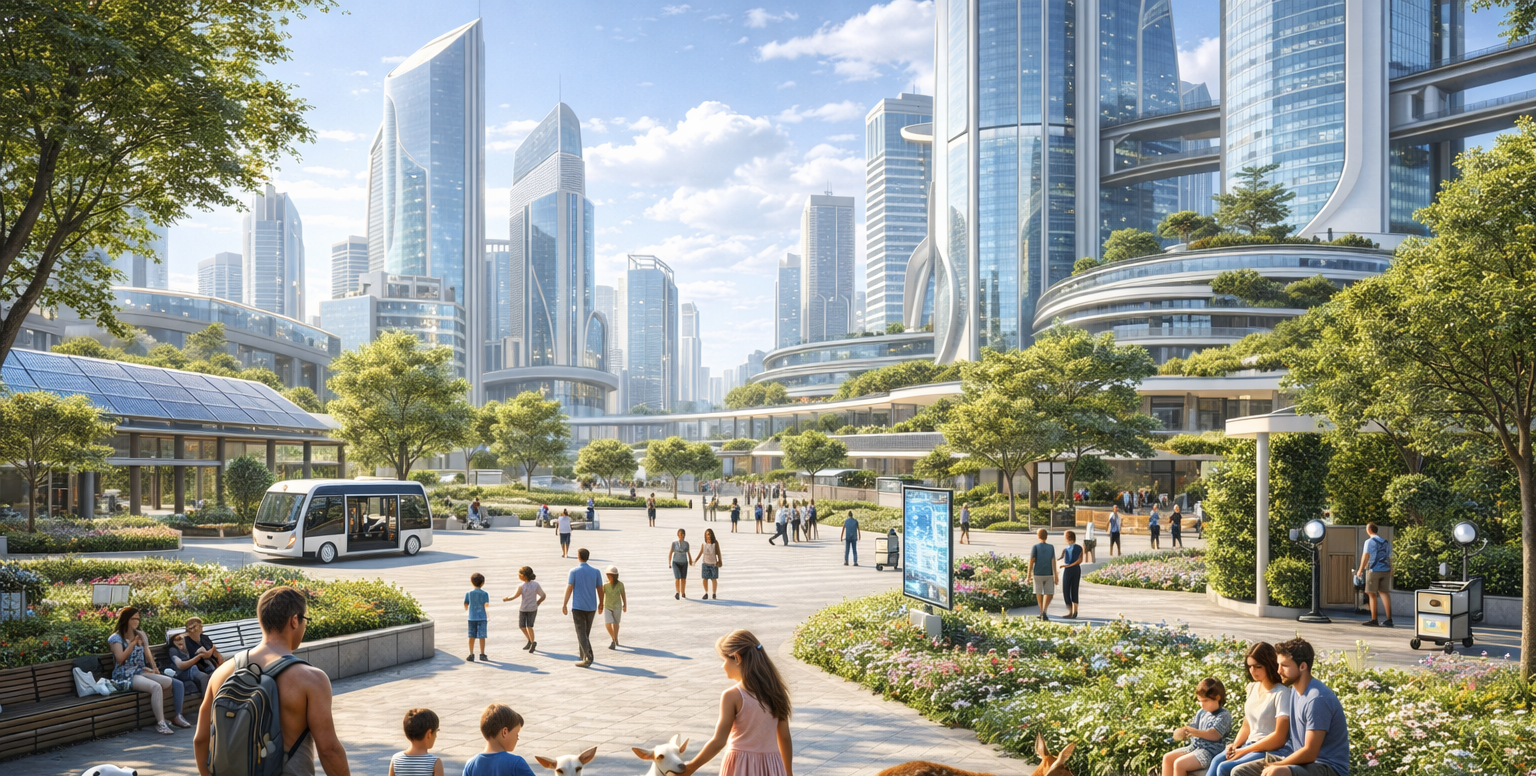
    Cities evolve into Cities of Light, radiant ecosystems where architecture follows nature, art, and joy.

    Education becomes exploration.

    Governments transform into councils of wisdom.

    Borders fade, for who can fence the sky?

    Humanity steps into what it always was meant to be: a living, creative organism of love.

    🌍 The Reunion of the Human Tribe

    And as the light of awareness stabilizes, something beautiful happens.

    We stop identifying as nations, classes, or ideologies.

    We remember that we’re a single tribe on a small, luminous sphere — spinning together through infinite space.

    War becomes unimaginable.

    Healing becomes the new free economy.

    Art becomes the language of diplomacy.

    The world no longer needs saving. It simply needs remembering.

    ✨ From Fiction to Possibility

    This is the world imagined in Waking Up — A Journey Towards a New Dawn for Humanity:

    a world where awakening spreads not by force, but by resonance.

    A world where humanity finally grows up, smiles at its own madness, and chooses love.

    Maybe it didn’t happen overnight.

    But every thought, every act of kindness, every page you turn toward awakening… brings it closer.

    🌅 Call to Action

    Dive deeper into the vision of a world beyond money, fear, and separation.

    Read Waking Up — A Journey Towards a New Dawn for Humanity today and join the movement of dreamers who dare to imagine the next step in human evolution.

  • How We Can ALL live a Life of Luxury on Earth — Without Breaking the Planet

    How We Can ALL live a Life of Luxury on Earth — Without Breaking the Planet

    From Excess to Access — A glimpse into the next Paradigm where Abundance, Technology, and Wisdom unite to create a world that works for everyone.

    Imagine a world where every human being lives in comfort and beauty.

    Where homes are energy-self-sufficient, food is fresh and locally grown, transport is clean and free, and no one worries about bills, borders, or basic survival.

    It sounds like a dream — but it’s only our outdated economic system that makes it seem impossible.

    The Myth of Scarcity

    We’ve been raised to believe there’s not enough for everyone — not enough land, not enough jobs, not enough “money.” Yet the Earth is overflowing with resources.

    We have enough sunlight striking the planet each hour to power civilization for a year. We produce 43 kg of food per day per person per year. But most is wasted to create profit. We have enough empty homes to house every homeless person several times over. Enough food to feed everyone — if we stopped throwing away most of it.

    Scarcity isn’t a natural law. It’s a policy decision.

    Scarcity is an artificial outcome of a system that rewards hoarding and punishes sharing — where competition, debt, and profit come before cooperation, dignity, and Life itself.

    The Real Meaning of Luxury

    Luxury today is marketed as excess — yachts, jets, and exclusivity. But true luxury has nothing to do with waste.

    Real luxury is freedom from stress, clean air, time to create, connection, and purpose.

    It’s walking barefoot on living soil, sleeping in peace, eating food you can trust, and feeling as part of something larger than yourself.

    When we redefine luxury from excess to access, the equation changes completely.

    A world where everyone has access to clean healthy water, sustainable energy, creative tools, and regenerative design is not only possible — it’s inevitable once we stop measuring life in old outdated currency.

    The Paradise Is Already Here

    There are over 100,000 tropical islands on Earth — from the turquoise lagoons of the Pacific to the coral-fringed coasts of the Indian Ocean and Caribbean.

    Humanity has more than 620,000 kilometers of coastline, much of it pristine and uninhabited. There is, quite literally, enough paradise for everyone.

    If we organized wisely, each of us could spend a good part of our year on a tropical beach, sipping an umbrella drink served by elegant solar-powered robots. If that’s what we wanted.

    And there would still be plenty of room — because people are beautifully different. Not everyone wants a Mai Tai under the palm trees. Some prefer mountain air, snow, forests, deserts, or bustling creative cities. The abundance of this planet includes the diversity of our dreams.

    The Tools Are Already Here

    We already possess everything required to build this world: renewable energy, 3D-printed housing, circular materials, global knowledge sharing, and AI-assisted logistics that can map and manage resources with stunning precision.

    What we lack isn’t technology — it’s alignment.

    A willingness to use these tools for collaboration instead of competition.

    The shift is from ownership to stewardship — from “mine” to “ours.” When resources become a shared inheritance instead of private property, abundance stops being an illusion.

    A Glimpse from the Future

    In Waking Up – A Journey Towards a New Dawn for Humanity, Benjamin Michaels wakes to a world that has made this transition.

    Money no longer exists. The Natural Exchange System ensures that everyone’s needs are met intelligently and sustainably. Cities of Light shine as living ecosystems — where architecture, art, and nature merge.

    It’s not a utopia. It’s simply what happens when humanity grows up — when we stop surviving and start thriving together.

    The Invitation

    The new world isn’t waiting in the future; it’s waiting in us.

    Every act of sharing, repairing, planting, and caring moves us closer. Every moment we choose collaboration over competition, we bring a fragment of paradise into form.

    We can all live a life of luxury — not by taking more, but by realizing we already have enough to share with everyone.

    🌍 Discover how humanity awakens in a world beyond money.

    Read Waking Up – A Journey Towards a New Dawn for Humanity and join the movement toward a world that truly works for all. Ebook is only $4,99

  • The World Is Waking Up — Are You…?

    The World Is Waking Up — Are You…?

    Our “Only for the Brave” campaign just ended — and it outperformed expectations by more than 102%! It was a so-called Blaze campaign where WordPress share a post to many more potential readers than I have on my blog.

    This  meant thousands of new readers across the world have now seen the call to challenge their beliefs — and many have joined the journey.

    For me, this milestone isn’t just about clicks or stats. It’s about connection.

    Every person who paused to look, to feel something, to wonder if a better world is possible — that’s one more spark of awareness lighting up the collective mind.

    If you didn’t get the ebook during the super-low promotion, don’t worry — it’s still just $4.99 on all ebook platforms. That’s less than a cappuccino for a story that invites you to imagine what life could look like beyond money, fear, and limitation.

    Waking Up isn’t just a fantasy. It’s a reflection of what humanity could become when trust replaces trade, and creativity flows freely again.

    The world is waking up.

    One reader — one brave soul — at a time.

  • Everyone a Landlord — From Ownership to Stewardship

    Everyone a Landlord — From Ownership to Stewardship

    For centuries, humanity has measured success through ownership — of land, of things, even of each other’s time. It has shaped our countries, our cities, our politics, and our sense of worth. Yet beneath the surface of this structure lies a quiet absurdity: how can we truly own what was here long before us, and will remain long after?

    The next step in our evolution isn’t to extend ownership, but to outgrow it completely— to move from possession to participation, from control to care, from ownership to stewardship. That understanding, for me, began long ago in a house outside Oslo, Norway.

    A Seed Planted in Childhood

    When I was young, my mother rented out rooms in our big house. She had inherited a bit of money, bought the house, and made ends meet by letting others live there.

    I saw people come and go — teachers, students, workers — handing over their rent month after month for something already built, already paid for. Even as a child, it didn’t feel right. Why should people have to pay just to exist somewhere? I really wanted everyone to be able to get free money just like us.

    But of course, I soon understood that if absolutely everyone owned houses there would be no one to rent them. There clearly was an imbalance in the world.

    That early sense of imbalance would later grow into a vision of a world where sanity rules instead of profit — where fairness isn’t an ideal, but a foundation.

    The Mirror of Ownership

    Later I saw how that household was a miniature version of Earth itself. Those who own — land, housing, resources — are sustained by those who don’t. Not always by cruelty, but by design.

    Ownership quietly governs who must work, who may rest, who lives with security, and who struggles with debt. And yet we seldom question it. We call it normal.

    But what if the very structure of ownership — the belief that life and land can belong to a few individuals — is the real flaw?

    The Turning Point: Discovering a Sane Design

    Decades later, I discovered The Venus Project and its vision of a Resource-Based Economy (RBE) — and the pattern finally came together.

    Here was the model that made my lifelong intuition tangible. A system where ownership dissolves into stewardship — where resources are shared intelligently, technology serves all humanity, and access replaces price.

    With an RBE, my childhood idea of “everyone a landlord” could finally come true — not through rent and property, but through universal belonging. Everyone would, in effect, be a responsible owner — not of separate things, but of the shared planet itself.

    The Ladder of Awakening: TMS → UBI → UO (RBE)

    Human progress toward sanity can be seen as an evolution of understanding:

    1. TMS – The Monetary System

    A structure built on ownership, scarcity and control. Humanity must earn its right to live.  A small part of humanity has taken control over something that should belong to everyone.

    2. UBI – Universal Basic Income

    A compassionate attempt to soften the edges of that system by redistributing purchasing power. A kind patch, but still a patch — money and ownership remains the gatekeeper.

    3. UO – Universal Ownership

    The realization that the next step is not redistribution but redesign. Everyone shares stewardship of the planet and its resources.

    That final stage — Universal Ownershipis the Resource-Based Economy: the world functioning on sanity, efficiency, and shared responsibility. We are all equal owners and stewards of Planet Earth.

    The Shape of Sanity

    In a sane world, we build things to last because waste is irrational.

    We share because collaboration works.

    We use technology to free, not enslave.

    We stop selling survival and start cultivating life.

    When ownership becomes stewardship, competition transforms into collaboration.

    Work becomes contribution.

    The economy becomes an ecosystem.

    The Moral Foundation

    At the root lies a truth so obvious we overlook it:

    The Earth was never meant to be owned.

    Just as the Moon was declared “the province of all humankind” under the 1967 Outer Space Treaty — belonging to no nation, corporation, or individual — so too can Earth be seen through that same lens. Our planet Earth, no less than the Moon, is a shared inheritance, not a possession. 

    The shift from ownership to stewardship begins with recognizing that no one can truly own what sustains us all — we can only care for it, together, as co-guardians of our common home.

    Money and ownership was once a tool for coordination — now it’s the master of everything.

    A Resource-Based Economy simply returns design and decision-making to where it belongs: within humanity itself, aligned with the wellbeing of all. Because when everyone belongs, no one has to pay rent on life anymore. 

    A New Dawn

    That journey — from confusion to clarity, from ownership to stewardship — is what inspired Waking Up – A Journey Towards a New Dawn for Humanity.

    The book reflects what I’ve always believed: that sanity is possible, and that it begins with how we see ownership itself. Once we recognize that we already belong here, the rest unfolds naturally.

    Follow the former billionaire Benjamin Michaels into this vision of stewardship and belonging when he wakes up in a world where humanity already has awakened…